
Introduction
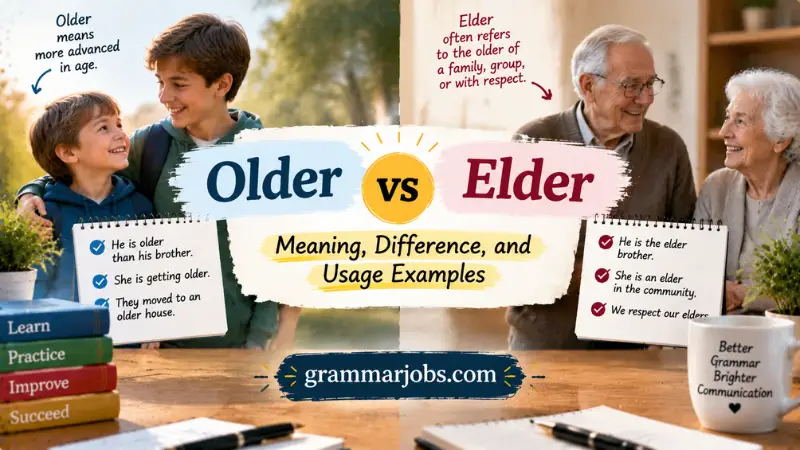
The difference between older vs elder is a common word-choice question in American English. Both words relate to age, which is why many writers and speakers wonder whether they can be used in the same situations. Although they share a similar meaning, they are not always interchangeable.
Understanding the older vs elder difference depends on context, sentence structure, and the relationship between the people being described. Older is the more common word and can describe people, animals, objects, and things in general. Elder is more limited and is often used when talking about people, especially within families or formal contexts.
Many people confuse older vs elder because both words compare age. For example, “my older brother” and “my elder brother” may seem identical, and in some situations they are. However, modern American English usually prefers older in everyday speech.
Knowing when to use older and elder helps make your writing sound more natural and precise. This difference appears often in family conversations, workplace discussions, history, literature, and formal writing.
Older vs Elder: Quick Answer
The main older vs elder difference is that older is the general word for comparing age, while elder is mainly used for people and often refers to a person who is older within a family or group. In modern American English, older is used more often in everyday conversation.
TL;DR
- Older compares age in general situations.
- Elder is mainly used for people.
- Older works for people, animals, and objects.
- Elder often appears in family relationships.
- Older is more common in modern American English.
- Elder can suggest respect or status.
Older vs Elder: Why People Confuse Them

The confusion around older vs elder happens because both words come from the same basic idea: greater age.
Compare:
- My older sister lives in Texas.
- My elder sister lives in Texas.
Both sentences can communicate that the sister has more age than the speaker. However, the second sentence sounds more formal and less common in everyday American English.
The main reason people mix up older vs elder is that elder was traditionally used more often when referring to family relationships. Expressions like “elder brother” and “elder sister” have been common in some varieties of English.
In the United States, most speakers usually choose older.
Examples:
- My older brother helped me move.
- Her older sister is a doctor.
These sentences sound natural in modern American English.
Elder still appears in certain situations:
- tribal elders
- community elders
- church elders
- respected elders
In these cases, elder often carries an additional meaning of experience, wisdom, or authority.
The older vs elder choice is therefore not only about age. It can also involve tone and meaning.
Key Differences At A Glance
| Feature | Older | Elder |
|---|---|---|
| Main meaning | Having more age | A person older in age or status |
| Common use | Everyday comparisons | Family, groups, formal contexts |
| Can describe objects? | Yes | Usually no |
| Common in US English | Very common | More limited |
| Example | My older car is reliable. | The village respected its elders. |
| Context | Best Choice | Why |
|---|---|---|
| Comparing two people | Older | Normal everyday choice |
| Talking about family order | Older or elder | Older is more common in the US |
| Describing objects | Older | Elder does not usually apply |
| Referring to respected leaders | Elder | Shows experience or status |
Meaning and Usage Difference
To understand the older vs elder difference, it helps to look at how each word functions in sentences.
How Older Is Used
Older is a comparative adjective. It means having more age than someone or something else.
Older can describe:
- people
- animals
- objects
- places
- ideas
Examples:
- My older brother is a teacher.
- This house is older than mine.
- That dog is older than our puppy.
- She bought an older computer.
In each example, older simply compares age.
It does not automatically suggest wisdom, respect, or authority.
For example:
- an older employee
only tells us the employee has more age.
It does not necessarily mean that person has more experience or a higher position.
How Elder Is Used
Elder also relates to age, but its use is narrower.
It is mainly used for people and often suggests a relationship, position, or respected role.
Examples:
- Her elder brother helped her.
- The elders of the community made the decision.
- The church elders organized the event.
The word elder can carry a sense of experience or authority.
However, in everyday American English, many speakers would replace “elder brother” with “older brother.”
Compare:
Common:
- My older sister is visiting.
More formal:
- My elder sister is visiting.
Both can be correct, but the tone is different.
Older vs Elder in Family Relationships
The biggest area where people compare older vs elder is family relationships. Both words can describe someone who was born before another person, but modern usage usually prefers one over the other.
Traditionally, elder was often used for family members who were older in birth order.
Examples:
- my elder brother
- her elder sister
- his elder son
These expressions are still understood, but in American English they often sound more formal or traditional.
Today, most Americans usually say:
- my older brother
- my older sister
- her older son
The older vs elder difference in family language is mostly about style and common usage.
Compare:
- My older brother lives in California.
This sounds natural in everyday conversation.
- My elder brother lives in California.
This sounds more formal and may suggest a traditional writing style.
Both can communicate the same basic idea, but older is the more common choice for most situations.
However, elder still works well when it refers to respected family members or people in a group.
Examples:
- The family elders shared stories from the past.
- She listened to the advice of her elders.
Here, elder does not simply mean “older.” It suggests experience, knowledge, or respect.
Tone, Context, and Formality
The older vs elder difference becomes clearer when you consider the tone of a sentence.
Everyday American English
In normal conversations, older is usually preferred.
Examples:
- My older sister works in New York.
- He has an older brother.
- This is my older laptop.
These sentences sound natural and casual.
Formal or Respectful Contexts
Elder is more common when discussing people with experience, authority, or social respect.
Examples:
- The community elders met to discuss the issue.
- Tribal elders shared traditional knowledge.
- Religious elders guided the group.
In these examples, elder means more than just age. It suggests a role or position.
The older vs elder choice can change the feeling of a sentence.
Compare:
- An older person joined the meeting.
This simply describes age.
- An elder joined the meeting.
This may suggest someone respected because of experience or wisdom.
Professional Writing
In professional writing, older is usually the safer and more natural choice when making age comparisons.
Examples:
- The older employees received additional training.
- The older building requires repairs.
Using elder in these situations may sound unusual unless the meaning involves a respected role.
Incorrect or unusual:
- The elder computer needs an update.
Correct:
- The older computer needs an update.
Elder normally applies to people, not objects.
Which One Should You Use?
Choosing between older vs elder becomes simple when you ask what you are describing.
Use older when:
- comparing ages
- describing objects
- talking about everyday situations
- writing for a general audience
Examples:
- My older cousin lives nearby.
- This is an older model of the phone.
- She is older than her classmates.
- The building is older than expected.
Older is the flexible choice because it works in many contexts.
Use elder when:
- referring to respected older people
- discussing leaders or advisors
- talking about traditional family roles
Examples:
- The village elders made the decision.
- The elders of the church organized the event.
- He respected his elders.
A useful memory rule for the older vs elder comparison:
Older = more age.
Elder = older person with a relationship, role, or respect attached.
This rule works in most modern American English situations.
When One Choice Sounds Wrong
The older vs elder difference becomes easier when you notice where elder does not fit naturally.
Mistake 1: Using Elder for Objects
Incorrect:
- I bought an elder car.
Correct:
- I bought an older car.
Why?
Cars, houses, computers, and other objects can be older, but they are not usually called elder.
Examples:
Correct:
- an older house
- an older phone
- an older model
Incorrect:
- an elder house
- an elder phone
- an elder model
The word elder is mainly connected with people.
Mistake 2: Using Elder in Normal Comparisons
Incorrect:
- She is elder than me.
Correct:
- She is older than me.
In modern American English, older is the normal comparative form.
Elder usually does not work after “than.”
Examples:
Natural:
- My brother is older than me.
- This tree is older than that one.
Less natural:
- My brother is elder than me.
The older vs elder difference here is about sentence structure.
Mistake 3: Thinking Elder Always Means Better
Some people assume elder means more important or superior.
That is not always true.
Example:
- My elder brother is five years older than me.
Here, elder only refers to age order.
But:
- The community elders gave advice.
Here, elder suggests respect and experience.
The meaning depends on context.
Mistake 4: Replacing Older With Elder Everywhere
Because elder sounds formal, some writers use it to make sentences sound more sophisticated.
However, this can make writing unnatural.
Example:
Unnatural:
- We studied elder buildings in the city.
Better:
- We studied older buildings in the city.
The correct older vs elder choice depends on whether you are describing age or referring to people with a respected role.
Common Mistakes (and Quick Fixes)
Many mistakes involving older vs elder happen because both words refer to age. However, the older vs elder difference becomes clear when you look at whether you are describing simple age, family order, or social respect.
Mistake 1: “He is elder than his brother”
Incorrect:
- He is elder than his brother.
Correct:
- He is older than his brother.
Why?
When making a direct comparison with than, modern American English usually uses older.
Examples:
Correct:
- Sarah is older than Emily.
- This house is older than that one.
- My dog is older than yours.
The word elder is generally not used in this comparative structure.
Mistake 2: “My elder car is expensive”
Incorrect:
- My elder car is expensive.
Correct:
- My older car is expensive.
Why?
Objects do not normally use elder.
Cars, houses, computers, phones, and other items can be older, but elder is mainly used for people.
Examples:
Correct:
- an older computer
- an older building
- an older version
Incorrect:
- an elder computer
- an elder building
- an elder version
This is one of the clearest rules in the older vs elder comparison.
Mistake 3: Using Older When Talking About Respected Leaders
Sometimes older is grammatically correct but does not express the full meaning.
Example:
- The older people of the community gave advice.
This only describes age.
But:
- The elders of the community gave advice.
This suggests respected members with experience or authority.
The older vs elder difference here is not only about age. Elder can include the idea of wisdom, responsibility, or leadership.
Mistake 4: Using Elder in Everyday Speech Too Often
Some learners use elder because it sounds more formal.
Example:
Unnatural:
- My elder friend lives nearby.
Better:
- My older friend lives nearby.
Why?
In ordinary American English, older is more common when describing a friend, coworker, neighbor, or classmate.
Elder is usually saved for specific situations involving family tradition, groups, or respected roles.
Mistake 5: Thinking Older and Elder Always Mean the Same Thing
Although both words relate to age, they are not always equal.
Compare:
- She is older than me.
Meaning:
She has more age.
- She is an elder in the community.
Meaning:
She is an older person with a respected position.
The older vs elder difference depends on whether age is the only idea or whether experience and status are also involved.
Everyday Examples
The best way to understand older vs elder is by seeing how Americans use both words in real situations.
Family Examples
Older:
- My older brother lives in Chicago.
- Her older sister became a doctor.
- I called my older cousin yesterday.
These examples sound natural in everyday American English.
Elder:
- He respected the elders in his family.
- The family elders shared their memories.
- She followed the advice of her elders.
Here, elder refers to older family members who are respected.
Workplace Examples
Older:
- The company hired an older employee.
- Older workers may have more experience.
- She uses an older version of the software.
These examples simply compare age or time.
Elder:
- The organization invited business elders to speak.
- Industry elders shared their knowledge.
Here, elder suggests experienced people who have authority or recognition.
Community Examples
Older:
- An older man helped the child cross the street.
- The older residents remember the neighborhood changes.
Elder:
- Community elders discussed local traditions.
- The elders helped solve the disagreement.
The second group gives the people a respected role.
Objects and Things
Only older is normally used.
Examples:
- an older car
- an older house
- an older phone
- an older technology system
- an older movie
The word elder does not normally describe objects.
This is an important part of the older vs elder difference.
Comparing People
Both words may work in some family situations.
Examples:
- My older sister is a lawyer.
- My elder sister is a lawyer.
The first sentence is more common in American English.
The second sentence is correct but sounds more formal or traditional.
For most everyday conversations, older is the safer choice.
Dictionary-Style Word Details
Verb
Older:
Older is not used as a verb in standard American English.
It functions mainly as a comparative adjective.
Examples:
- He is older than his brother.
- This building is older than that one.
Elder:
Elder is also not commonly used as a verb in standard American English.
It functions mainly as a noun or adjective related to age, experience, or status.
Examples:
- The elders met to discuss the issue.
- She is the elder member of the group.
Neither word normally functions as a verb, but their meanings differ based on their grammatical roles.
Noun
Older:
Older is not commonly used as a noun in standard American English.
It mainly works as an adjective to compare age.
Examples:
- My older brother moved to Florida.
- The older building needs repairs.
- She is older than her classmates.
However, older can sometimes appear as part of a noun phrase.
Example:
- The older generation remembers different traditions.
Here, older describes the noun generation.
Elder:
Elder can function as a noun when referring to an older person, especially someone respected because of experience, knowledge, or position.
Examples:
- The elders of the community met together.
- She asked her elders for advice.
- The tribal elders preserved important traditions.
Elder can also refer to a family member who is older in relation to another person.
Example:
- He followed the guidance of his elder.
In modern American English, this noun use is much more common than using elder simply as a replacement for older.
Synonyms
The closest alternatives for older vs elder depend on the meaning and context.
Older:
Closest plain alternatives:
- aged
- senior
- more mature
- advanced in age
Examples:
- an older person → a senior person
- an older building → an aged building
However, these alternatives are not always exact replacements.
For example:
- an older computer
cannot always become:
- a senior computer
because the meaning changes.
Elder:
Closest plain alternatives:
- senior
- respected older person
- community leader
- experienced member
Examples:
- community elders → respected community members
- family elders → older family members
The word senior may overlap with elder in some contexts, but senior can also refer to rank or workplace position.
Example Sentences
The best way to remember the older vs elder difference is to compare sentences where each word has a different purpose.
Examples With Older
Older usually compares age.
- My older sister lives in Seattle.
- This house is older than mine.
- He bought an older car.
- The older students helped the new students.
- That is an older version of the program.
- My dog is older than your dog.
In these examples, older simply tells us that something has existed longer or someone has more age.
Examples With Elder
Elder usually refers to people, relationships, or respected roles.
- My elder brother helped me with the decision.
- The village elders met to discuss the issue.
- She respected her elders.
- The church elders organized the event.
- The family elders shared stories from the past.
The meaning often includes experience, responsibility, or respect.
Compare Similar Sentences
Example 1:
- My older brother lives nearby.
- My elder brother lives nearby.
Both can be understood, but the first sentence sounds more natural in everyday American English.
Example 2:
- The older residents voted in the election.
- The elders voted in the election.
The first focuses on age.
The second suggests respected members of a group.
Example 3:
- This is an older tradition.
- This tradition was protected by community elders.
The first describes age.
The second describes people connected with preserving traditions.
Word History
Older:
Older comes from the comparative form of old, which has been part of English for many centuries. The word developed naturally as a way to compare age between people, animals, objects, and ideas.
In modern American English, older is the general choice for age comparisons.
Examples:
- older sibling
- older building
- older technology
- older tradition
Because it applies to many types of things, older is much more flexible.
Elder:
Elder also developed from the same basic idea of age but became more specialized over time.
The word began carrying meanings connected with seniority, family position, and respected status.
Examples:
- elder brother
- elders of a community
- respected elders
The older vs elder difference developed because elder gained a social meaning beyond simple age.
Today, older remains the everyday comparison word, while elder is often connected with people who hold experience, authority, or respect.
Older vs Elder: Phrases Containing

Common Phrases With Older
Older brother
Meaning:
A brother who has more age.
Example:
- My older brother taught me how to drive.
Older sister
Meaning:
A sister who was born before another sibling.
Example:
- My older sister lives in California.
Older generation
Meaning:
People from a previous age group.
Example:
- The older generation may remember different technology.
Older version
Meaning:
A previous form of something.
Example:
- I still use an older version of the software.
Older than
Used for direct age comparison.
Example:
- This tree is older than that one.
Common Phrases With Elder
Elder brother
Meaning:
A brother who is older, often used in formal or traditional contexts.
Example:
- He respected his elder brother.
Elder sister
Meaning:
An older sister.
Example:
- Her elder sister guided her through the experience.
Elders of the community
Meaning:
Respected older members of a group.
Example:
- The elders of the community helped solve the conflict.
Respect your elders
Meaning:
Show respect toward older people.
Example:
- Many cultures teach children to respect their elders.
Family elders
Meaning:
Older family members whose advice is valued.
Example:
- The family elders gathered for the celebration.
The main point in the older vs elder comparison is that older is the everyday age word, while elder often carries an added idea of respect, experience, or social role.
Frequently Asked Questions
What is the main difference between older vs elder?
The main older vs elder difference is that older is the general word used to compare age, while elder is usually connected with older people, family relationships, or respected positions. The older vs elder comparison becomes easier when you remember that older focuses on age, while elder often adds the idea of experience or status.
For example:
My older brother lives in New York.
This is the normal choice in everyday American English.
The elders of the community shared their knowledge.
Here, elder suggests experience and respect, not just age.
Is “elder” more correct than “older”?
No. Elder is not more correct than older. The correct choice depends on the situation and the meaning you want to express.
In the older vs elder comparison, older is usually more common and flexible because it can describe people, animals, objects, and things.
Examples:
an older car
an older building
an older employee
Elder is more limited and usually applies to people.
Examples:
family elders
community elders
respected elders
In modern American English, older is usually the better choice for normal age comparisons, while elder is used when the context involves family tradition, respect, or leadership.
Can I say “my elder brother” in American English?
Yes, but it sounds more formal or traditional. The phrase is grammatically acceptable, especially when discussing family relationships.
The sentence:
My elder brother helped me.
is correct.
However, most Americans would naturally say:
My older brother helped me.
The older vs elder difference here is mainly about tone and common usage. Elder is more common in some traditional forms of English, while older is preferred in everyday American conversations.
Does elder always mean wise or respected?
Not always.
Elder can simply mean someone older in a family relationship.
Example:
My elder sister helped me.
However, in many modern uses, especially when elder is used as a noun, it often suggests respect, experience, or authority.
Example:
The elders of the town made an important decision.
The meaning depends on context. The older vs elder difference changes depending on whether you are only comparing age or referring to someone’s role in a group.
Should I use older or elder for family members?
Both words can describe family members, but older is usually the more natural choice in the United States.
Examples:
Common:
My older sister is a doctor.
My older cousin lives nearby.
More formal:
My elder sister is a doctor.When talking about respected older relatives, elder may be more appropriate.
Example:
I asked my family elders for advice.
Here, elder refers to people whose experience and knowledge are valued. This is one reason the older vs elder difference is not only about age but also about context.
Can elder describe objects or animals?
Usually, no.
Older is the correct choice for objects and animals because it simply compares age.
Examples:
Correct:
an older dog
an older house
an older computer
Incorrect:
an elder dog
an elder house
an elder computer. The word elder is mainly used for people, especially when discussing older individuals, family roles, or respected members of a group.
Conclusion
The difference between older vs elder comes down to how each word works in a sentence. Older is the everyday choice for comparing age and can describe people, animals, objects, and situations. Elder is more specific and is usually connected with older people, family order, cultural traditions, or respected roles.
A simple way to remember the older vs elder difference:
Older = having more age.
Elder = an older person with a relationship, position, or respected role.
For most everyday American English situations, choose older. Use elder when you are referring to family elders, community leaders, or people whose experience gives them a special role.
Understanding older vs elder helps you choose words that sound natural, clear, and appropriate for the situation. The right choice depends not only on age but also on the meaning you want your sentence to communicate.


