
Introduction
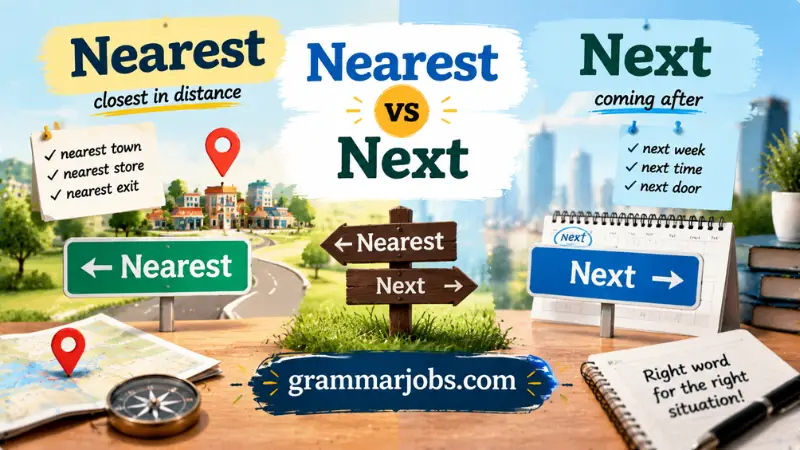
The difference between nearest vs next can be confusing because both words describe relationships between things, places, or events. However, they do not communicate the same idea. Nearest usually focuses on physical distance, while next usually focuses on position, order, or the thing that comes after something else.
In American English, people often confuse nearest vs next because both words can appear when talking about locations and time. For example, someone may ask about the nearest store when they need the closest place nearby, while they may ask about the next store when they are talking about the following store in a sequence.
Understanding the nearest vs next difference helps you choose the right word when giving directions, describing locations, organizing information, or talking about future events.
These words appear frequently in everyday conversations, travel situations, workplace communication, and casual discussions. Although they may seem similar, their meanings depend on whether you are describing distance or order.
Quick Answer
The main nearest vs next difference is that nearest means the closest in distance, while next means the one that follows in position, time, or sequence. In modern American English, use nearest for physical closeness and next for the following person, place, or event.
TL;DR
- Nearest describes the shortest physical distance.
- Next describes order, time, or sequence.
- The nearest store is the closest store.
- The next store is the following store.
- Nearest usually compares locations.
- Next often connects events or positions.
Why People Confuse Them

The confusion around nearest vs next happens because both words can describe something that is close to another thing. However, “close” can have different meanings.
For example:
- The nearest hospital is five miles away.
- The next hospital is across town.
The first sentence talks about distance. The second sentence talks about position or another option that comes after the current one.
Another reason people confuse nearest vs next is that both words are commonly used with places.
Examples:
- Where is the nearest gas station?
- Where is the next gas station?
These questions sound similar, but they ask for different information.
“Nearest gas station” means the gas station with the shortest distance from your current location.
“Next gas station” usually means the following gas station you will reach, often along a road or route.
The meaning depends on whether you are measuring space or following an order.
Key Differences At A Glance
| Feature | Nearest | Next |
|---|---|---|
| Main meaning | Closest in distance | Following in order or time |
| Common use | Locations and physical space | Sequence, events, and positions |
| Question answered | Which one is closest? | Which one comes after? |
| Example | The nearest bank is two blocks away. | The next meeting is Monday. |
| Context | Best Choice | Why |
|---|---|---|
| Finding a nearby restaurant | Nearest | It focuses on distance |
| Talking about tomorrow’s event | Next | It refers to following time |
| Giving driving directions | Nearest or next | Depends on meaning |
| Discussing order in a list | Next | It shows sequence |
Meaning and Usage Difference
To understand the nearest vs next difference clearly, it helps to look at how each word works in a sentence.
How Nearest Is Used
Nearest is related to distance. It describes something that is physically closest compared with other options.
Examples:
- The nearest pharmacy is two minutes away.
- Can you tell me the nearest airport?
- We stopped at the nearest restaurant.
In each example, nearest answers the question:
“Which one is closest?”
Nearest is often used when people need directions or want to find a location quickly.
Examples in everyday situations:
- A traveler asks for the nearest hotel.
- A driver looks for the nearest gas station.
- Someone searches for the nearest emergency room.
The focus is always distance.
How Next Is Used
Next usually describes something that follows another thing in time, order, or position.
Examples:
- The next meeting is on Friday.
- She was the next person in line.
- What should we do next?
In these sentences, next does not mean closest. It means the thing that comes after something else.
The word next is commonly used for:
- time
- order
- steps
- events
- positions
Examples:
- next week
- next month
- next step
- next question
- next person
The nearest vs next difference becomes clear when you ask whether you mean “closest” or “following.”
Tone, Context, and Formality
The nearest vs next difference also depends on the situation where each word is used. Both words are common in American English, but they create different expectations for the listener.
Nearest is usually neutral and practical. It is commonly used when someone needs information about location, distance, or accessibility.
Examples:
- Where is the nearest hospital?
- Find the nearest parking lot.
- The nearest coffee shop is around the corner.
These examples focus on helping someone locate the closest option.
Next is also common, but it usually connects ideas through order or time. It tells someone what comes after the current item, moment, or position.
Examples:
- What is the next step?
- I will call you next week.
- She is the next person to speak.
The nearest vs next difference becomes important because replacing one word with the other can completely change the meaning.
Compare:
- I went to the nearest store.
Meaning:
I went to the store closest to me.
- I went to the next store.
Meaning:
I went to the store after another store in a sequence or route.
Nearest in Directions and Travel
When giving directions, nearest usually means the shortest distance from a specific point.
Examples:
- The nearest subway station is three blocks away.
- The nearest airport is about 20 miles from here.
- Turn left at the nearest intersection.
In these situations, people want the closest available option.
Next in Directions and Routes
Next can also appear in directions, but it has a different meaning. It usually refers to the following location on a path or list.
Examples:
- The next exit is coming up.
- The next gas station is five miles ahead.
- Turn right at the next street.
Here, next does not necessarily mean the closest option. It means the one you will encounter after your current position.
For example:
- The nearest gas station may be behind you.
- The next gas station may be ahead on your route.
Both sentences can be correct because they describe different ideas.
Which One Should You Use?
Choosing between nearest vs next becomes easier when you identify what you are describing.
Use nearest when you mean:
- closest location
- shortest distance
- most nearby option
Examples:
- Where is the nearest grocery store?
- This is the nearest entrance.
- We found the nearest parking space.
Use next when you mean:
- following item
- upcoming event
- next position
- another step in a process
Examples:
- The next chapter explains the solution.
- Our next appointment is tomorrow.
- She was the next person in line.
A simple memory rule:
Nearest = closest.
Next = after this.
If you can replace the word with “closest,” choose nearest.
Example:
- The closest restaurant → The nearest restaurant.
If you can replace it with “following,” choose next.
Example:
- The following meeting → The next meeting.
When One Choice Sounds Wrong
The nearest vs next difference becomes clearer when one word does not match the intended meaning.
Mistake 1: Using next for distance
Incorrect:
- Where is the next hospital?
This may sound incomplete if someone is asking for the closest hospital.
Better:
- Where is the nearest hospital?
The speaker wants the hospital with the shortest distance.
However, “next hospital” can be correct in certain situations.
Example:
- The next hospital on this road is 10 miles away.
Here, next refers to the hospital that appears later on the route.
Mistake 2: Using nearest for sequence
Incorrect:
- My nearest meeting is tomorrow.
Better:
- My next meeting is tomorrow.
A meeting does not have physical distance, so next is the natural choice because it refers to time order.
Mistake 3: Confusing nearest and next in a line
Compare:
- He is the nearest person to me.
- He is the next person in line.
The first sentence describes physical distance.
The second sentence describes position in a sequence.
Both words can describe relationships, but they measure different things.
Mistake 4: Using nearest with time
Incorrect:
- My nearest vacation is next month.
Better:
- My next vacation is next month.
Time follows a sequence, so next is the correct choice.
Nearest is mainly used for physical space, not upcoming events.
Common Mistakes (and Quick Fixes)
The nearest vs next difference becomes easier to remember when you understand the type of relationship each word describes. Most mistakes happen because people use both words for things that feel “close,” even though the type of closeness is different.
Mistake 1: Using Nearest When Talking About Time
Incorrect:
- My nearest vacation is in July.
Correct:
- My next vacation is in July.
Why?
Vacation is an event that happens in a sequence of time. Since it refers to the upcoming event, next is the correct choice.
More examples:
- My next appointment is Monday.
- Our next meeting starts at 3 p.m.
- The next holiday is coming soon.
The word nearest does not normally describe future events.
Mistake 2: Using Next When Asking for the Closest Place
Incorrect:
- Where is the next bank?
Correct:
- Where is the nearest bank?
Why?
The speaker wants to know the bank with the shortest distance.
More examples:
- Find the nearest restaurant.
- The nearest gas station is five minutes away.
- The nearest hotel is across the street.
However, next bank can be correct when talking about order or a route.
Example:
- The next bank on this street is near the corner.
Here, next means the following bank you will reach.
Mistake 3: Thinking Nearest Always Means Best Option
Nearest only describes distance. It does not mean the best, largest, cheapest, or most convenient choice.
Example:
- The nearest airport is 15 miles away.
This only tells us about location.
It does not tell us:
- whether it has the cheapest flights
- whether it is the biggest airport
- whether it is the easiest to use
The nearest vs next difference is about relationship, not quality.
Mistake 4: Confusing Next With Nearest in Lists
Incorrect:
- The nearest item on my list is number two.
Better:
- The next item on my list is number two.
A list has an order, not physical distance.
Examples:
- Read the next question.
- Complete the next step.
- Choose the next option.
These all describe sequence.
Mistake 5: Using Next and Nearest Interchangeably
Incorrect:
- I stopped at the next store because it was the closest.
This sentence may be unclear because next does not automatically mean closest.
Better:
- I stopped at the nearest store because it was the closest.
Or:
- I stopped at the next store on the road.
This means the store that came after the current location.
The nearest vs next difference depends on whether you are measuring space or following an order.
Everyday Examples
The best way to understand nearest vs next is to compare real situations from daily American life.
Shopping Examples
Nearest:
- Where is the nearest grocery store?
- The nearest supermarket is two miles away.
- I walked to the nearest store.
In these examples, the focus is distance.
Next:
- The next store has better prices.
- The next store on the street sells electronics.
- We will visit the next store after lunch.
Here, next refers to another place in order.
Travel Examples
Nearest:
- What is the nearest airport?
- The nearest hotel is close to the highway.
- We searched for the nearest train station.
These examples help someone find a location.
Next:
- The next flight leaves at noon.
- The next stop is downtown.
- The next train arrives in ten minutes.
These examples describe what comes after.
Workplace Examples
Nearest:
- The nearest office is in Chicago.
- Please use the nearest printer.
Next:
- The next meeting is scheduled for Friday.
- What is the next task?
- She will handle the next project.
Work situations often use next because they involve order and schedules.
Technology Examples
Nearest:
- The nearest device is connected to the network.
Next:
- Install the next update.
- Open the next page.
- Move to the next step.
Technology usually uses next when describing sequence, progress, or versions.
Dictionary-Style Word Details

Verb
Nearest:
Nearest is not commonly used as a verb in standard American English.
It mainly functions as an adjective or a superlative form related to distance.
Examples:
- The nearest store is nearby.
- This is the nearest location.
Next:
Next is not commonly used as a verb in standard American English.
It mainly functions as an adjective, adverb, noun, or determiner.
Examples:
- The next chapter begins tomorrow.
- What happens next?
Neither word is normally used as a verb in everyday American English.
Noun
Nearest:
Nearest can sometimes appear as a noun in specific contexts, but this use is uncommon.
Example:
- Choose the nearest available option.
Usually, American English speakers use a noun after nearest.
Examples:
- nearest store
- nearest station
- nearest location
Next:
Next can function as a noun when referring to the following person, thing, or event.
Examples:
- Who is next?
- I will be next.
- The next is waiting outside.
The noun use of next is much more common than the noun use of nearest.
Synonyms
The closest alternatives for nearest vs next depend on the meaning you want to express. These words are not direct replacements because they describe different types of relationships.
Nearest
When nearest means closest in physical distance:
Closest plain alternatives:
- closest
- closest nearby
- most accessible
- shortest distance away
Examples:
- The nearest hospital → The closest hospital
- The nearest entrance → The closest entrance
When talking about locations, closest is often the simplest replacement for nearest.
However, nearest does not always mean easiest or most convenient.
Example:
- The nearest airport may not have the best flight options.
Next
When next means following in order or time:
Closest plain alternatives:
- following
- upcoming
- succeeding
- coming
Examples:
- The next meeting → The upcoming meeting
- The next person → The following person
- The next step → The following step
When next means the one after something else, these alternatives can work depending on the sentence.
The nearest vs next difference is important because closest and following are not the same idea.
Example Sentences
The best way to remember the nearest vs next difference is to see how each word works in real sentences.
Examples With Nearest
Nearest describes physical distance.
- The nearest coffee shop is across the street.
- We found the nearest parking space.
- Where is the nearest emergency room?
- The nearest gas station is five minutes away.
- She lives near the nearest train station.
- This is the nearest entrance to the building.
- The nearest hotel offers free parking.
In each example, nearest identifies the option that is physically closest.
Examples With Next
Next describes order, position, or time.
- The next meeting is scheduled for Tuesday.
- She was the next person to arrive.
- What should we do next?
- The next chapter explains the answer.
- The next bus arrives in ten minutes.
- He finished the task and moved to the next step.
- We will discuss this in the next class.
In these examples, next shows what comes after something else.
Compare Similar Sentences
The nearest vs next difference becomes clearer when similar sentences are compared.
Example 1:
- I went to the nearest restaurant.
Meaning:
I chose the restaurant closest to my location.
- I went to the next restaurant.
Meaning:
I chose the restaurant that came after another one in order or along a route.
Example 2:
- The nearest station is one mile away.
Meaning:
It is the closest station by distance.
- The next station is one mile away.
Meaning:
It is the station that comes after the current one.
Example 3:
- The nearest store is closed.
Meaning:
The closest store is unavailable.
- The next store is open.
Meaning:
The following store is available.
Example 4:
- Find the nearest exit.
Meaning:
Find the closest way out.
- Take the next exit.
Meaning:
Use the exit that comes after the current location.
These examples show why replacing nearest with next can change the entire meaning.
Word History
Nearest
Nearest comes from the idea of being close or near. It developed from the word “near,” which describes short physical distance or closeness.
In modern American English, nearest is mainly connected with location and distance.
Examples:
- nearest hospital
- nearest store
- nearest airport
The meaning remains focused on finding the closest available option.
Next
Next developed from the idea of something following another thing in a sequence. It is connected with order, continuation, and what comes after.
Modern uses include:
- next week
- next person
- next step
- next chapter
The meaning of next is based on position or progression rather than distance.
The nearest vs next difference comes from these different concepts:
- Nearest is based on closeness in space.
- Next is based on order, time, or sequence.
Phrases Containing
Common Phrases With Nearest
Nearest and dearest
Meaning:
The people closest to someone, especially family or close friends.
Example:
- She invited her nearest and dearest to the celebration.
Nearest neighbor
Meaning:
The person or place closest to another.
Example:
- Our nearest neighbor lives half a mile away.
Nearest location
Meaning:
The closest available place.
Example:
- Use the nearest location for pickup.
Nearest exit
Meaning:
The closest way to leave a building or area.
Example:
- Please move toward the nearest exit.
Nearest store
Meaning:
The closest store by distance.
Example:
- The nearest store is only a few blocks away.
Common Phrases With Next
Next time
Meaning:
A future occasion after the current one.
Example:
- I will remember next time.
Next week
Meaning:
The week after the current week.
Example:
- We have a meeting next week.
Next step
Meaning:
The following action in a process.
Example:
- The next step is to review the results.
Next level
Meaning:
A higher stage or future point.
Example:
- She wants to take her skills to the next level.
Next door
Meaning:
The place immediately beside another place.
Example:
- My neighbor lives next door.
What happens next
Meaning:
What occurs afterward.
Example:
- Nobody knew what would happen next.
Frequently Asked Questions
How do I remember nearest vs next?
Remember:
Nearest = closest.
Next = after this.
This simple rule makes the nearest vs next difference easier to understand.
Is next more common than nearest?
Both words are common but have different uses. Next is common for time and order, while nearest is common for locations and distance.
Can nearest describe time?
Usually, no. Nearest is mainly for distance, while next is used for future events.
Example: “My next appointment is tomorrow” is correct.
Can next mean closest?
Usually, no. In the nearest vs next difference, next shows order or sequence, while nearest shows physical distance.
Use nearest when you mean “closest.”
Should I use nearest or next for directions?
Use nearest for the closest place and next for the following place on a route.
Example: “Where is the nearest gas station?” vs “Take the next exit.”
Is nearest the same as closest?
Yes, nearest and closest often have the same meaning when talking about distance.
However, in the nearest vs next comparison, next does not mean closest. It refers to something that comes after another.
What is the main difference between nearest vs next?
The main nearest vs next difference is that nearest means the closest by distance, while next means the one that follows in time, order, or position.
Example: The nearest store is closest; the next store comes after it.
Conclusion
The nearest vs next difference depends on whether you are talking about distance, position, or time. In the nearest vs next comparison, nearest means the closest person, place, or thing, while next means the one that comes after another in a sequence.
Remembering the nearest vs next difference is simple:
Nearest = the closest one.
Next = the one after this.
For example:
- The nearest store is two miles away.
This means the store is the closest option. - The next store is on the corner.
This means the store comes after the current location.
The nearest vs next choice often depends on the situation. When you ask for the nearest hospital, restaurant, or airport, you are asking about distance. When you ask about the next meeting, step, chapter, or event, you are talking about order or time.
The nearest vs next difference appears frequently in everyday American English. People use nearest when finding locations, giving directions, or comparing physical distance. They use next when discussing schedules, future plans, instructions, and sequences.
Understanding the nearest vs next difference helps you avoid common word-choice mistakes. Whether you are looking for the nearest coffee shop, choosing the nearest exit, planning your next appointment, or completing the next task, each word has a specific purpose.
The best way to remember the nearest vs next difference is to ask one question:
“Am I talking about the closest thing, or the thing that comes after?”
If the answer is closest, use nearest. If the answer is after this, use next. This simple rule makes the nearest vs next comparison easier in conversations, writing, travel, and daily communication.


