
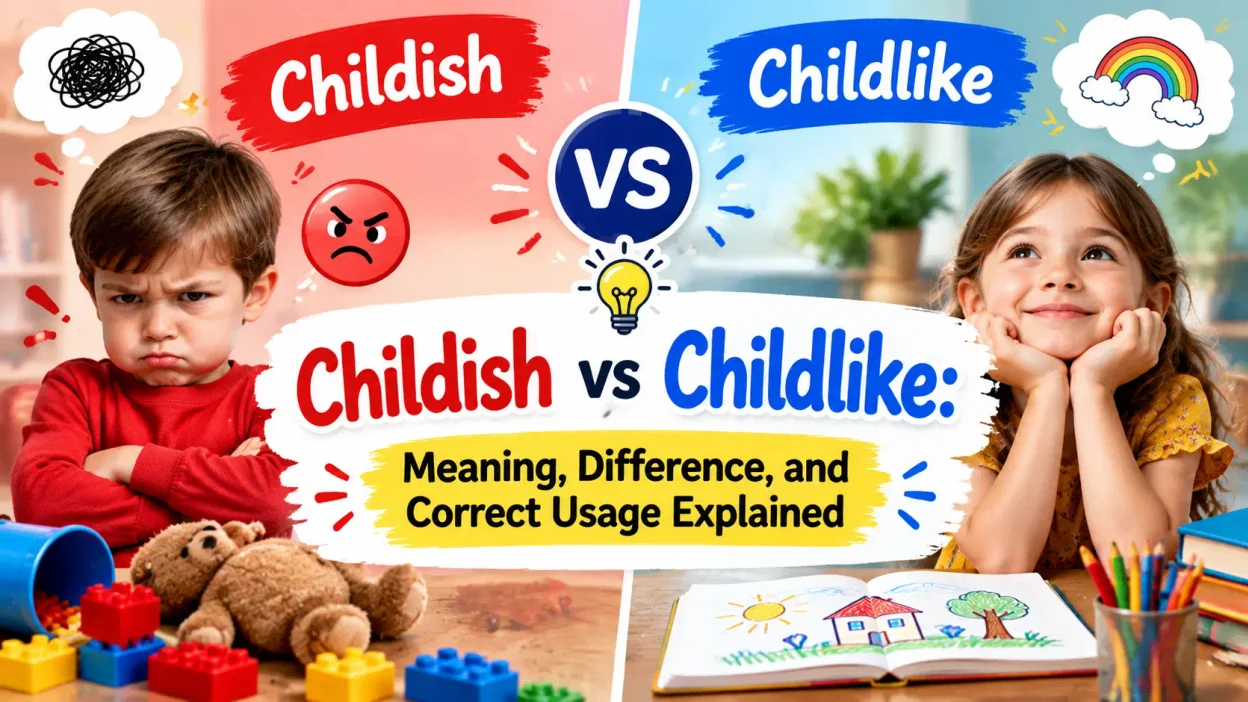
Feature Image Prompt
Create an 800×450 professional editorial grammar image for a US English website explaining “Childish vs Childlike.” Use a split-screen comparison. Left side: an adult behaving immaturely with a frustrated expression, labeled “CHILDISH = Immature Behavior.” Right side: an adult showing curiosity, creativity, and innocence, labeled “CHILDLIKE = Positive Child Qualities.” Use a clean modern educational style, blue and white color palette with a warm accent, clear typography, and a premium language-learning website design.
Alt Text
Childish vs childlike comparison showing the difference between immature behavior and positive child qualities.
Childish vs Childlike: Meaning, Difference, and Correct Usage
Introduction
The words childish and childlike look almost identical, and both are connected to the idea of children. However, they have very different meanings and emotional effects.
Many people assume these words mean the same thing because they both describe qualities associated with children. In reality, one word is usually negative, while the other is often positive.
The main difference is:
Childish describes immature behavior that is inappropriate for someone’s age. Childlike describes positive qualities commonly associated with children, such as innocence, curiosity, imagination, and openness.
For example:
- His argument was childish.
(His behavior was immature.) - She has a childlike sense of wonder.
(She has a positive quality associated with children.)
Understanding this difference helps you describe people more accurately and avoid accidentally insulting someone.
Quick Answer
Use childish when you mean someone is acting immature, silly, or irresponsible.
Use childlike when you mean someone has positive qualities often associated with children, such as innocence, excitement, or creativity.
Examples:
✅ Stop being childish and solve the problem.
✅ The artist has a childlike imagination.
Simple memory tip:
Childish = like a child in a negative or immature way.
Childlike = like a child in a positive or innocent way.
Why People Confuse Them
The confusion happens because both words contain the word child, but the suffixes create different meanings.
The endings -ish and -like change the meaning.
Childish
The ending -ish often suggests a quality or behavior that resembles something. In many cases, it can suggest something negative or undesirable.
Examples:
- foolish
- selfish
- childish
When we call an adult childish, we usually mean the person is behaving in a way that seems immature.
Example:
- He threw a childish tantrum during the meeting.
This does not mean he acted like a young child in a positive way. It means his reaction was immature.
Childlike
The ending -like means “similar to” or “having the qualities of.”
Examples:
- lifelike = similar to life
- dreamlike = similar to a dream
- childlike = having qualities of a child
Childlike usually focuses on positive qualities.
Example:
- Her childlike curiosity helped her discover new ideas.
This suggests enthusiasm and openness, not immaturity.
Key Differences At A Glance
| Context | Best Choice | Why |
|---|---|---|
| Immature adult behavior | Childish | Shows lack of maturity |
| Innocence and wonder | Childlike | Shows positive child qualities |
| A rude reaction | Childish | Negative behavior |
| Creativity and imagination | Childlike | Positive quality |
| Complaining over something small | Childish | Immature response |
| Excitement about a new experience | Childlike | Positive enthusiasm |
Feature Comparison
| Feature | Childish | Childlike |
|---|---|---|
| Main meaning | Immature or inappropriate behavior | Positive qualities of children |
| Typical tone | Negative | Positive |
| Common use | Criticism | Compliment |
| Focus | Lack of maturity | Innocence and wonder |
| Can describe adults? | Yes | Yes |
| Emotional effect | Often insulting | Usually kind or admiring |
Meaning and Usage Difference
How to Use Childish
Childish describes behavior, attitudes, or actions that seem immature.
It is commonly used when someone acts in a way that does not match their age or situation.
Examples:
- Ignoring someone to get attention is childish.
- Their argument became childish.
- He made a childish joke during the serious discussion.
Childish behavior may include:
- refusing to cooperate
- overreacting
- seeking attention in an immature way
- avoiding responsibility
The word often carries criticism.
For example:
- “That was a childish response.”
The speaker is saying the response lacked maturity.
How to Use Childlike
Childlike describes positive characteristics associated with children.
Common meanings include:
- innocent
- curious
- imaginative
- enthusiastic
- full of wonder
Examples:
- She looked at the stars with childlike excitement.
- His childlike creativity inspired the team.
- The museum gave visitors a childlike sense of discovery.
Childlike does not mean someone is immature. Instead, it suggests someone has kept positive qualities often seen in children.
Tone, Context, and Formality
Both words are common in everyday American English, but their emotional meanings are very different.
Childish Tone
Childish usually sounds negative.
Examples:
- That was a childish thing to do.
- Stop acting childish.
When used toward an adult, it often suggests criticism.
Childlike Tone
Childlike usually sounds positive or affectionate.
Examples:
- She has a childlike enthusiasm for learning.
- His childlike joy made everyone smile.
Writers often use childlike to describe creativity, kindness, and emotional openness.
Which One Should You Use?
Ask yourself:
Am I criticizing immature behavior or describing a positive quality?
If the behavior is immature:
→ Use childish
Examples:
- childish argument
- childish complaint
- childish behavior
If the quality is positive:
→ Use childlike
Examples:
- childlike wonder
- childlike curiosity
- childlike excitement
When One Choice Sounds Wrong
Example 1: Talking About Curiosity
Incorrect:
❌ She has a childish curiosity.
This usually suggests the curiosity is immature or inappropriate.
Better:
✅ She has childlike curiosity.
This suggests innocent interest and excitement.
Example 2: Talking About Arguments
Incorrect:
❌ Their argument was childlike.
This could suggest innocence or simplicity, but it does not clearly criticize the behavior.
Better:
✅ Their argument was childish.
This clearly means immature.
Example 3: Talking About Creativity
Incorrect:
❌ The artist has a childish imagination.
This may sound negative.
Better:
✅ The artist has a childlike imagination.
This suggests creativity and originality.
Common Mistakes (and Quick Fixes)
Understanding the difference between childish and childlike is important because choosing the wrong word can completely change the meaning of a sentence.
A person may accidentally sound insulting when they want to give a compliment, or they may describe immature behavior too softly.
Mistake 1: Using Childish as a Compliment
Wrong:
❌ She has a childish sense of wonder.
This usually sounds negative because childish often suggests immaturity.
Correct:
✅ She has a childlike sense of wonder.
This means she experiences the world with curiosity and excitement.
Mistake 2: Using Childlike for Immature Behavior
Wrong:
❌ His refusal to apologize was childlike.
This does not clearly express criticism.
Correct:
✅ His refusal to apologize was childish.
This shows that the behavior was immature.
Mistake 3: Assuming Both Words Mean “Like a Child”
Although both words are connected to children, they describe different qualities.
Compare:
Childish behavior
= behavior that lacks maturity.
Example:
- Throwing a fit because you lost a game is childish.
Childlike behavior
= behavior that shows positive child qualities.
Example:
- Being excited about learning something new is childlike.
Mistake 4: Using Childish When Describing Creativity
Wrong:
❌ The designer has a childish imagination.
This may suggest the imagination is immature or unrealistic.
Better:
✅ The designer has a childlike imagination.
This suggests creativity, freedom, and originality.
Mistake 5: Using Childlike for Adult Irresponsibility
Wrong:
❌ His childlike attitude caused problems at work.
This may sound like you are describing innocence rather than poor behavior.
Better:
✅ His childish attitude caused problems at work.
This clearly means he behaved immaturely.
Everyday Examples
Childish Examples
Personal Behavior
- Complaining about every small problem can seem childish.
- His childish reaction made the situation worse.
- She apologized for her childish behavior.
Arguments
- The two coworkers had a childish argument.
- Their childish competition distracted everyone.
Attitudes
- Refusing to listen to others is childish.
- Blaming everyone else is a childish response.
Actions
- The prank was childish and unnecessary.
- His childish comments offended the team.
Childlike Examples
Curiosity
- The scientist kept a childlike curiosity throughout his career.
- Her childlike questions showed genuine interest.
Happiness
- The children’s performance brought him childlike joy.
- She smiled with childlike excitement.
Creativity
- The artist uses a childlike approach to color and design.
- His childlike imagination created unique ideas.
Wonder
- They explored the city with childlike enthusiasm.
- The view filled visitors with childlike amazement.
Modern US English Examples
Workplace Examples
Childish
- Sending angry emails instead of discussing the issue is childish.
- A manager should avoid childish behavior during disagreements.
Childlike
- A great teacher often keeps a childlike curiosity about new ideas.
- Her childlike enthusiasm helped the team stay motivated.
Family Examples
Childish
- His childish reaction to losing the game surprised everyone.
- The siblings stopped their childish arguing.
Childlike
- The grandfather had a childlike excitement when opening gifts.
- Her childlike happiness made the celebration special.
Creative Examples
Childish
- The movie’s humor felt childish and was aimed at very young viewers.
Childlike
- The artist’s childlike style created a feeling of imagination and wonder.
Dictionary-Style Word Details
Verb
Childish
Childish is not commonly used as a verb in standard US English.
The related verb is:
- behave childishly
Example:
- He behaved childishly during the disagreement.
Childlike
Childlike is not commonly used as a verb in standard US English.
The related expression is:
- act in a childlike way
Example:
- She acted in a childlike way when she saw the surprise.
Noun
Childish
Childish is not commonly used as a noun.
Related nouns include:
- childishness
- immaturity
Example:
- His childishness caused problems.
Childlike
Childlike is not commonly used as a noun.
Related nouns include:
- innocence
- curiosity
- wonder
Example:
- Her sense of wonder inspired others.
Synonyms
Childish Synonyms
Childish usually has negative or critical meanings.
Closest plain alternatives:
- immature
- silly
- foolish
- petty
- immaturely playful
Examples:
- childish behavior → immature behavior
- childish argument → petty argument
These alternatives depend on the exact situation.
Childlike Synonyms
Childlike usually has positive meanings.
Closest plain alternatives:
- innocent
- curious
- playful
- imaginative
- pure
Examples:
- childlike wonder → innocent wonder
- childlike curiosity → natural curiosity
These words are not always exact replacements, but they share similar positive meanings.
Antonyms
Childish Antonyms
Possible opposites:
- mature
- responsible
- sensible
- adult
Example:
- childish behavior ↔ mature behavior
Childlike Antonyms
There is no single perfect opposite for childlike because the meaning depends on context.
Possible contrasts:
- cynical
- serious
- hardened
- experienced
Example:
- childlike wonder ↔ cynical attitude
Example Sentences
Childish
- His childish behavior embarrassed his friends.
- The argument became childish after a few minutes.
- She realized her reaction was childish.
- Making excuses was a childish response.
- The comments sounded childish and unnecessary.
Childlike
- The childlike excitement in her voice was obvious.
- He maintained a childlike curiosity about nature.
- The painting captured a childlike sense of imagination.
- Her childlike optimism helped others.
- The experience brought back a childlike feeling of happiness.
Word History
Both childish and childlike developed from the word child, but their meanings moved in different directions.
The word childish traditionally described something related to children. Over time, it became strongly associated with immature behavior, especially when describing adults.
The word childlike developed from the idea of having qualities similar to children. It often kept a more positive meaning connected with innocence, curiosity, and imagination.
Today:
- Childish usually focuses on a lack of maturity.
- Childlike usually focuses on positive qualities associated with childhood.
Phrases Containing
Common Phrases With Childish
Childish behavior
Meaning:
Immature actions or attitudes.
Example:
- The company does not tolerate childish behavior.
Childish argument
Meaning:
A disagreement handled in an immature way.
Example:
- Their childish argument delayed the meeting.
Childish attitude
Meaning:
An immature way of thinking.
Example:
- His childish attitude prevented progress.
Childish games
Meaning:
Games or actions considered immature.
Example:
- They stopped playing childish games and focused on work.
Common Phrases With Childlike
Childlike wonder
Meaning:
A feeling of curiosity and amazement.
Example:
- The museum filled visitors with childlike wonder.
Childlike curiosity
Meaning:
A desire to explore and learn.
Example:
- Scientists often maintain childlike curiosity.
Childlike innocence
Meaning:
A pure and trusting quality.
Example:
- The story captures a sense of childlike innocence.
Childlike enthusiasm
Meaning:
Strong excitement and interest.
Example:
- She approached every project with childlike enthusiasm.
Frequently Asked Questions (FAQs)
Is childish always negative?
Usually, yes. In modern English, childish often suggests immaturity or behavior that is inappropriate for someone’s age.
However, context matters. Sometimes it can simply mean “related to children,” but when describing adults, it is usually negative.
Is childlike a compliment?
Yes, childlike is often positive.
It usually describes qualities such as:
- curiosity
- innocence
- creativity
- excitement
For example:
“Her childlike enthusiasm was inspiring.”
This is a compliment.
Can adults be childlike?
Yes. Adults can be described as childlike when they show positive qualities associated with children.
Examples:
- childlike curiosity
- childlike excitement
- childlike imagination
It does not mean they are immature.
Can children be childish?
Yes. Children can also be childish when they behave in an immature way.
Example:
- His childish behavior upset his friends.
Is childish the same as immature?
They are very similar.
Childish often describes behavior that seems immature.
Example:
- A childish reaction = an immature reaction.
Is childlike the same as childish?
No.
They have opposite emotional meanings in many situations.
Compare:
- childish behavior → immature behavior
- childlike wonder → positive innocence
Conclusion
The difference between childish vs childlike comes down to the type of child-related quality being described.
Childish usually refers to negative traits, such as immaturity, poor judgment, or inappropriate behavior.
Childlike usually refers to positive traits, such as curiosity, innocence, imagination, and excitement.
Remember:
Childish = acting like a child in an immature way.
Childlike = having the best qualities of a child.
When describing someone’s behavior, ask yourself whether you mean criticism or appreciation. If the quality shows a lack of maturity, use childish. If it shows wonder, creativity, or innocence, use childlike.


