
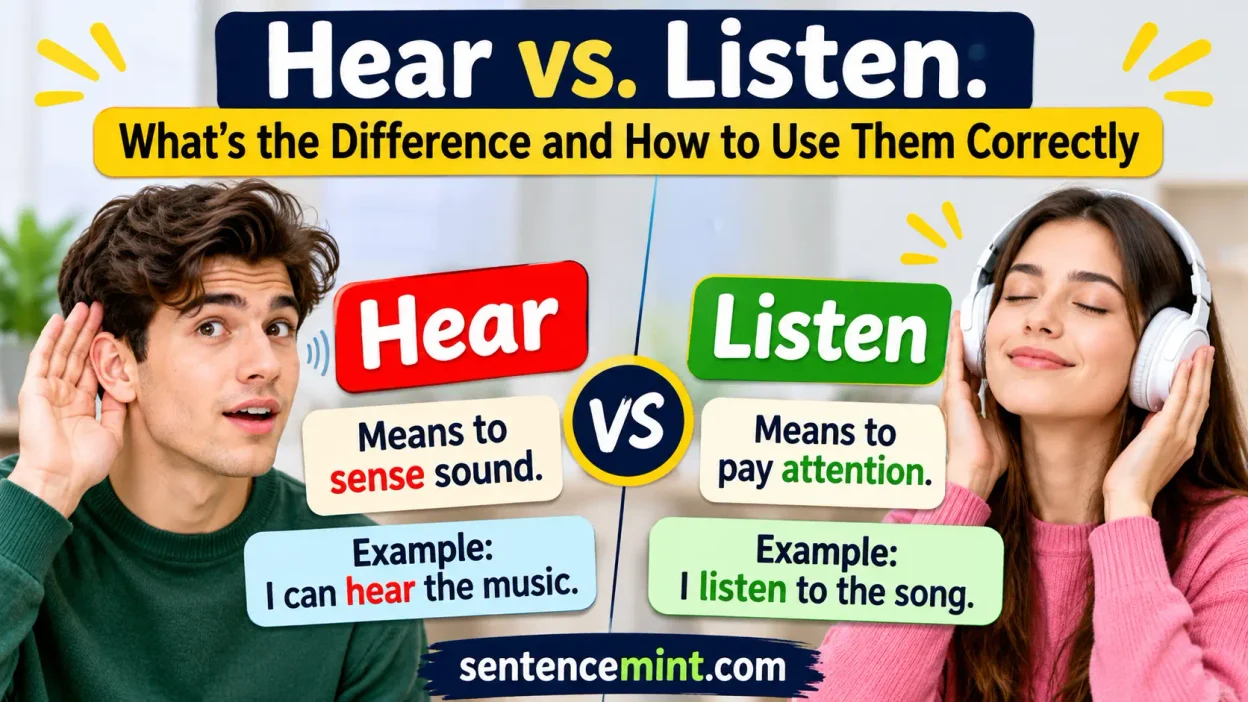
The words hear and listen are closely related because both describe how we experience sounds. However, they are not interchangeable in every situation. Although both involve our sense of hearing, they express different actions.
Hear usually means to perceive a sound naturally through your ears, whether you intend to or not. Listen means to pay attention to a sound deliberately because you want to understand or notice it.
For example, you might hear someone talking in another room without trying, but you listen when you concentrate on what that person is saying.
Understanding the difference between hear and listen can help you communicate more clearly and avoid common grammar mistakes. In this guide, we will explain their meanings, sentence structures, differences, examples, and everyday uses.
Hear vs. Listen: Quick Difference
The main difference between hear and listen is whether you are making a conscious effort to pay attention to a sound.
| Word | Meaning | Usage |
|---|---|---|
| Hear | To perceive sound through your ears | Usually involuntary or unintentional |
| Listen | To pay attention to a sound | Usually intentional and deliberate |
Hear focuses on receiving sound, while listen focuses on paying attention to it.
Examples:
- I can hear music coming from the next room.
- I like to listen to music while studying.
- Did you hear that strange noise?
- Please listen carefully to the instructions.
What Does Hear Mean?
The verb hear means to perceive or become aware of sounds through your ears. It generally describes something that happens naturally, without requiring you to make a conscious effort.
You can hear a car passing, birds singing, someone speaking, or a phone ringing even when you are not actively paying attention.
Examples of Hear in Sentences
- I can hear the birds singing outside.
- Did you hear the doorbell?
- She heard someone calling her name.
- We could hear the rain hitting the windows.
- I heard a strange noise last night.
- He cannot hear very well without his hearing aid.
- I heard that you got a new job.
- They heard the news yesterday.
Different Uses of Hear
The word hear can be used in several contexts.
1. Perceiving sounds
This is the most common meaning of hear.
Example: I can hear children playing outside.
2. Receiving information
Hear can also mean learning information from someone or somewhere.
Example: I heard that the company is hiring new employees.
3. Listening to someone’s concerns or explanation
Hear can sometimes mean giving someone an opportunity to speak or considering what they say.
Example: The manager agreed to hear our complaints.
4. Official consideration
In legal contexts, hear can mean that a court or authority listens to and considers a case.
Example: The judge will hear the case tomorrow.
What Does Listen Mean?
The verb listen means to pay attention to sounds or spoken words deliberately. Unlike hearing, listening usually involves conscious effort and concentration.
When you listen, you are not simply receiving sound. You are trying to understand, follow, or appreciate what you hear.
For example, listening to a teacher requires concentration, while hearing the teacher’s voice may happen even if your attention is elsewhere.
Examples of Listen in Sentences
- Please listen carefully to the teacher.
- I love to listen to classical music.
- She listened to her friend patiently.
- You should listen before making a decision.
- He was listening to the radio when I arrived.
- The children listened to the story quietly.
- I always listen to podcasts while driving.
- They listened carefully to the instructions.
Different Uses of Listen
1. Paying attention to sounds
Example: Listen to the birds singing in the garden.
2. Understanding someone
Example: My friend listened to my problems without judging me.
3. Following instructions or advice
Example: You should listen to your parents’ advice.
4. Enjoying music or other audio
Example: She listens to music every evening.
Key Differences Between Hear and Listen
Although both verbs relate to sound, they have different meanings and grammatical patterns.
1. Natural Perception vs. Deliberate Attention
The most important difference is that hearing is generally passive, while listening is generally active.
- Hear: You hear a dog barking outside.
- Listen: You listen to a dog barking because you want to identify where it is.
2. Intention
Hear does not usually require intention. You may hear something without expecting it.
Listen generally involves intention because you choose to focus on a particular sound.
- I heard the announcement accidentally.
- I listened to the announcement carefully.
3. Attention and Concentration
Hearing does not necessarily mean you understand or pay attention to a sound.
Listening involves giving attention to what you hear.
- I heard what he said, but I wasn’t paying attention.
- I listened to what he said and understood his point.
4. Grammar and Sentence Structure
Hear is commonly used without the preposition to when followed directly by an object.
Example: I heard the music.
Listen usually requires the preposition to when followed by the sound or person receiving attention.
Example: I listened to the music.
Hear vs. Listen Comparison Table
| Feature | Hear | Listen |
|---|---|---|
| Basic meaning | Perceive sound | Pay attention to sound |
| Nature | Usually passive | Usually active |
| Intention | Not necessary | Usually necessary |
| Concentration | Not required | Usually required |
| Common structure | Hear something | Listen to something |
| Example | I hear the birds. | I listen to the birds. |
| Main focus | Receiving sound | Paying attention |
Hear vs. Listen: Sentence Examples
Understanding both words in similar situations makes their difference easier to remember.
| Hear | Listen |
|---|---|
| I hear music outside. | I listen to music every day. |
| Did you hear the announcement? | Please listen to the announcement. |
| She heard her name. | She listened to her name being called. |
| We heard the teacher speaking. | We listened to the teacher carefully. |
| He heard the news yesterday. | He listened to the news on the radio. |
| I heard someone knocking. | I listened for another knock. |
Notice that hear describes the perception of sound, while listen describes the attention given to it.
Hear vs. Listen: Grammar Rules
Knowing the grammatical patterns of these verbs will help you use them correctly.
1. Hear + Object
Hear is commonly followed directly by a noun or pronoun.
Examples:
- I heard a loud noise.
- She heard the announcement.
- We heard the children.
- Did you hear me?
You generally do not need to between hear and its direct object.
Incorrect: I heard to the music.
Correct: I heard the music.
2. Listen + To + Object
Listen usually takes the preposition to before the person or sound receiving attention.
Examples:
- Listen to the teacher.
- I listen to music every morning.
- She listened to her mother.
- We listened to the speech.
Incorrect: I listen music every day.
Correct: I listen to music every day.
3. Hear Someone Doing Something
Hear can be followed by an object and a verb in its -ing form when you perceive an action in progress.
Examples:
- I heard someone singing.
- She heard the children laughing.
- We heard the dog barking.
4. Hear Someone Do Something
Hear can also be followed by an object and the base form of a verb. This often describes hearing an entire action or event.
Examples:
- I heard him open the door.
- She heard the baby cry.
- We heard someone shout.
5. Listen Carefully
Listen is often used with adverbs that describe how someone pays attention.
Examples:
- Listen carefully to the instructions.
- She listened patiently to her friend.
- He listened quietly to the conversation.
Common Expressions with Hear and Listen
Both words appear in many everyday expressions.
Common Expressions with Hear
| Expression | Meaning | Example |
|---|---|---|
| Hear about | Receive information about something | I heard about your promotion. |
| Hear from | Receive communication from someone | I haven’t heard from him lately. |
| Hear of | Know that someone or something exists | Have you heard of this author? |
| Hear out | Listen to someone until they finish | Please hear me out. |
| Hear someone out | Give someone a chance to explain | She heard him out before responding. |
| Hear a noise | Perceive a sound | I heard a noise outside. |
Common Expressions with Listen
| Expression | Meaning | Example |
|---|---|---|
| Listen to | Pay attention to something | Listen to this song. |
| Listen carefully | Pay close attention | Listen carefully to the directions. |
| Listen up | Pay attention | Everyone, listen up! |
| Listen in | Listen to a conversation or broadcast | He listened in on the discussion. |
| Listen out for | Pay attention for a particular sound | Listen out for the doorbell. |
| Listen to advice | Pay attention to someone’s guidance | You should listen to her advice. |
Can You Hear Something Without Listening?
Yes. You can hear a sound without deliberately listening to it.
For example, imagine that you are reading a book while someone is talking in the next room. You may hear their voice even though you are concentrating on your book.
Similarly, you may hear traffic, birds, or music in the background without paying attention to those sounds.
This is why hearing is generally considered a passive process, while listening involves active attention.
Can You Listen Without Hearing?
Listening normally depends on receiving sound, but the two words are not always limited to ordinary physical hearing.
For example, a person with hearing loss may use hearing aids, sign language, or other communication methods. In everyday English, listen can also describe paying attention to a message or communication in a broader sense.
The important distinction is that listening involves attention and engagement, not simply the physical ability to detect sound.
Common Mistakes When Using Hear and Listen
English learners sometimes confuse these verbs because they describe related actions. Here are common mistakes and their corrections.
| Incorrect Sentence | Correct Sentence |
|---|---|
| I listened music yesterday. | I listened to music yesterday. |
| I heard to a strange noise. | I heard a strange noise. |
| Listen me carefully. | Listen to me carefully. |
| Did you listened to him? | Did you listen to him? |
| I am hearing music. | I am listening to music. |
| She heard to the teacher. | She heard the teacher. |
Important tip: Use hear when you mean perceiving a sound. Use listen to when you mean deliberately paying attention to it.
Hear vs. Listen in Everyday Situations
Here are some practical examples showing how the two verbs work in daily conversations.
At home
- I heard the phone ringing.
- I listened to the voicemail.
At school
- I heard the teacher’s voice.
- I listened to the teacher’s explanation.
While driving
- I heard a car horn.
- I listened to the radio.
During a conversation
- I heard what you said.
- I listened carefully to your explanation.
While enjoying music
- I heard a song playing in the shop.
- I listened to my favorite song at home.
These examples demonstrate how the same sound can be described differently depending on whether you are simply perceiving it or intentionally paying attention.
Frequently Asked Questions
1. What is the main difference between hear and listen?
Hear means to perceive sound through your ears, usually without making a conscious effort. Listen means to pay attention to a sound deliberately. For example, you hear noise outside but listen to a conversation.
2. Is hear passive and listen active?
Generally, yes. Hearing is usually passive because sounds can reach your ears without your intention. Listening is active because it involves focusing your attention on sounds or spoken words.
3. Do you say listen or listen to?
You generally say listen to when identifying the person, sound, or thing receiving your attention.
Correct: Listen to the music.
Correct: Listen to me.
However, listen can be used without to when it stands alone or is followed by an adverb.
Example: Listen carefully!
4. Do you say hear or hear to?
You normally say hear without to when it takes a direct object.
Correct: I heard a noise.
Incorrect: I heard to a noise.
However, hear to appears in some specialized or older expressions, but it is not the normal structure for perceiving sounds.
5. Can I use hear and listen in the same sentence?
Yes. Both verbs can appear together when describing different actions.
Example: I heard the music and stopped to listen to it.
Here, heard describes noticing the sound, while listen describes deliberately paying attention.
6. Is “I am hearing music” correct?
It can be grammatically possible in certain contexts, but it is not the usual way to describe actively paying attention to music.
More natural: I am listening to music.
For ordinary sound perception, English usually uses the simple present: I hear music.
7. What is the difference between hearing someone and listening to someone?
Hearing someone means perceiving their voice or words. Listening to someone means paying attention to what they are saying.
Example: I heard my friend speaking, but I wasn’t listening to her.
8. Which is correct: listen music or listen to music?
Listen to music is correct because listen normally requires the preposition to before its object.
Example: I listen to music every evening.
9. What is the past tense of hear and listen?
The past tense of hear is heard, while the past tense of listen is listened.
Examples:
- I heard a strange sound.
- I listened to the radio.
10. What is the difference between hear about and hear from?
Hear about means to receive information concerning something or someone.
Example: I heard about your new job.
Hear from means to receive communication from someone.
Example: I haven’t heard from my brother today.
Conclusion
The difference between hear and listen comes down to perception and attention. Hear means to receive or perceive sounds naturally, while listen means to focus on sounds deliberately.
You hear a doorbell when it rings, but you listen when someone speaks to you and you concentrate on their words. Remember that hear usually takes a direct object, while listen generally uses to before its object.
Once you understand this simple distinction, you can use both verbs more confidently in everyday conversations, writing, and English communication.