
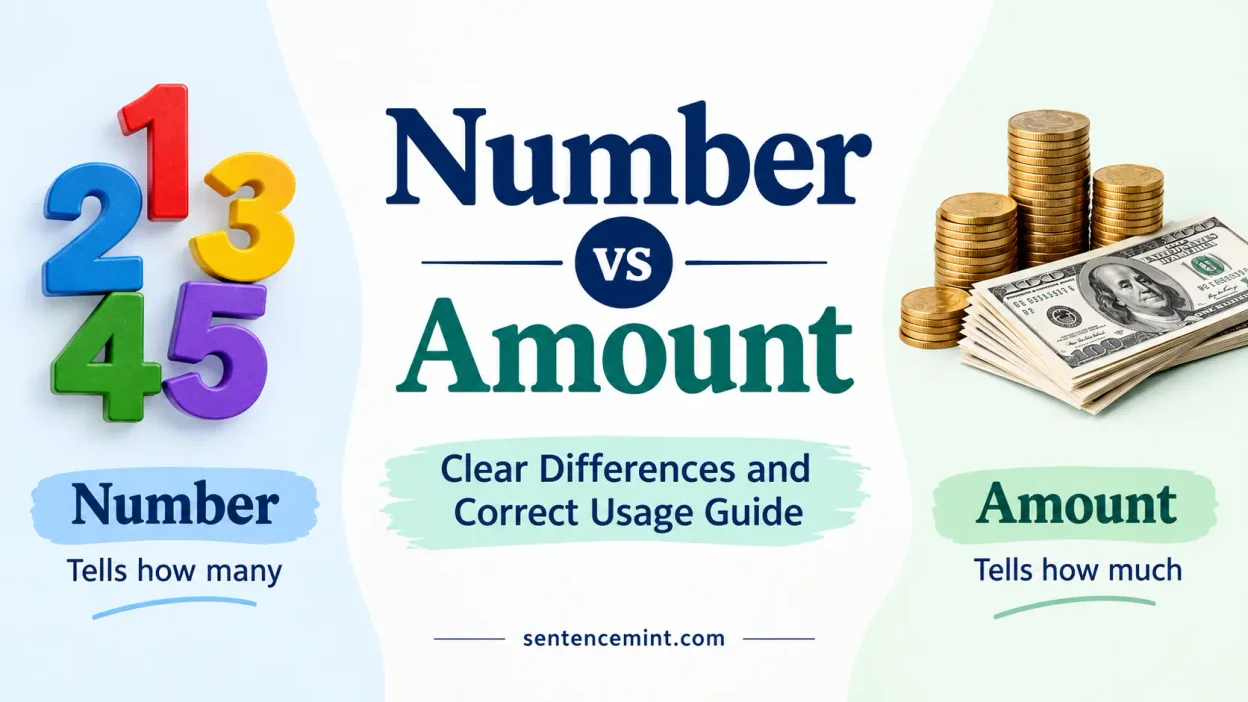
Feature Image Prompt: Create an 800×450 HD educational grammar illustration for an American English learning website. Center the bold, readable title “Number vs Amount” with the subtitle “Meaning, Differences & Examples.” On the left, show neatly counted books, people, and apples labeled “NUMBER.” On the right, show water, money, and flour labeled “AMOUNT.” Use a clean navy-blue, white, and aqua palette, modern magazine-style typography, balanced spacing, sharp details, and a professional educational design. Keep every word inside the image with generous margins. No cropped text, extra wording, logos, or watermarks.
Alt Text: Number vs amount comparison showing countable items such as books and apples alongside quantities of water, money, and flour.
Introduction
Number and amount both describe quantity, but they do not fit the same kinds of nouns in standard written English. Choosing the right word makes sentences clearer and helps your writing sound natural.
Use number when referring to things you can count individually, such as students, books, or applications. Use amount when referring to a quantity of something treated as a whole, such as water, time, money, or patience.
For example, “The number of applications increased” is correct because applications can be counted. “The amount of time available decreased” is correct because time is treated as an overall quantity.
Quick Answer
Number vs amount: Which is correct?
- Number: Use it with countable nouns, especially plural nouns. Example: “The number of customers increased.”
- Amount: Use it with uncountable nouns. Example: “The amount of traffic increased.”
Both words are standard English. The noun that follows them usually determines which one you should choose.
Why People Confuse Them
The confusion occurs because both words answer questions about quantity. They can describe something being greater, smaller, sufficient, or insufficient.
However, counting and measuring are different ways of describing quantity. You can count individual customers, appointments, and emails. You normally measure or consider water, time, and effort as quantities.
Money adds another layer of confusion. You can discuss the amount of money in an account, but you can count the number of dollars in a particular collection of one-dollar bills.
The key is to focus on what the sentence measures or counts rather than choosing a word based only on whether the quantity is large or small.
Key Differences At A Glance
| Feature | Number | Amount |
|---|---|---|
| Main use | Countable items | Uncountable quantities |
| Typical question | How many? | How much? |
| Common nouns | Students, books, calls | Water, time, patience |
| Money example | Number of dollar bills | Amount of money |
| Common construction | A large number of orders | A large amount of work |
Meaning and Usage Difference
Number refers to a count or a quantity of individually identifiable items. It commonly appears before of and a plural countable noun.
Examples include:
- The number of employees has increased.
- We received a large number of applications.
- She checked the number of messages on her phone.
Amount refers to a quantity or total of something considered as a whole. It commonly appears before of and an uncountable noun.
Examples include:
- The amount of water in the tank is low.
- I spent a considerable amount of time studying.
- The amount of information in the report was overwhelming.
Some nouns can be countable or uncountable depending on their meaning. For example, paper usually refers to a material when uncountable, as in “the amount of paper used.” It can refer to individual documents when countable, as in “the number of papers submitted.”
Likewise, work is generally uncountable when referring to a workload, while tasks are countable individual assignments.
Tone, Context, and Formality
The difference between number and amount is mainly grammatical, not a difference in formality. Both words work in casual conversations, academic writing, business reports, and professional communication.
In formal writing, use number of employees, number of complaints, and number of records when counting individual items. Use amount of funding, amount of effort, and amount of information when referring to overall quantities.
In everyday conversation, people sometimes use amount with plural countable nouns, particularly when discussing a very large group. Readers will often understand the intended meaning. However, number remains the safer choice in carefully edited writing.
Money is another context in which the choice depends on meaning. “The amount of money collected” refers to a total sum. “The number of coins collected” refers to countable objects.
Which One Should You Use?
Use this comparison table to choose the right word for common situations.
| Context | Best Choice | Why |
|---|---|---|
| Students attending a class | Number | Students are individually countable. |
| Water in a bottle | Amount | Water is treated as an uncountable substance. |
| Hours spent studying | Number or amount, depending on wording | Count individual hours, but describe overall time as an amount. |
| Money in a bank account | Amount | The focus is on the total sum. |
| Customer complaints | Number | Each complaint can be counted. |
| Effort required for a project | Amount | Effort is generally treated as uncountable. |
| Emails received | Number | Emails are countable items. |
| Information in a report | Amount | Information is generally uncountable. |
A quick test can help: ask whether you are counting individual units or considering a whole quantity. If you are counting units, choose number. If you are describing an overall quantity of an uncountable noun, choose amount.
When One Choice Sounds Wrong
Some combinations sound unnatural in standard edited English because the noun does not match the word describing its quantity.
- Less natural: “The amount of customers increased.”Better: “The number of customers increased.”
- Incorrect for the intended standard construction: “The number of water in the tank decreased.”Better: “The amount of water in the tank decreased.”
- Less natural: “We received a large amount of complaints.”Better: “We received a large number of complaints.”
The distinction is not absolute in every real-world sentence. Some speakers use amount with countable nouns, and particular contexts can influence how a quantity is understood. Nevertheless, matching number with countable nouns and amount with uncountable nouns is the clearest standard choice.
Common Mistakes (and Quick Fixes)
Mistake 1: Using amount with people
People can be counted individually, so use number when referring to how many people are present.
Incorrect: “The amount of people at the meeting surprised me.”
Correct: “The number of people at the meeting surprised me.”
Mistake 2: Using number with uncountable nouns
Water, furniture, and information are generally uncountable in their ordinary meanings.
Incorrect: “The number of information in the file was impressive.”
Correct: “The amount of information in the file was impressive.”
Mistake 3: Confusing money with monetary units
Use amount for a total sum and number for countable units.
Correct: “The amount of money raised was $5,000.”
Correct: “The number of dollar bills in the envelope was 50.”
Mistake 4: Assuming every noun has only one countability pattern
A noun can behave differently according to its meaning.
Correct: “The amount of paper wasted was excessive.”
Correct: “The number of papers submitted was higher this year.”
Everyday Examples
Here are natural examples of number and amount in everyday American English.
- School: The number of students in the class increased after enrollment reopened.
- Shopping: The amount of money I spent on groceries was higher than expected.
- Work: We received a large number of customer emails this morning.
- Cooking: Add a small amount of salt to the soup.
- Travel: The number of flights delayed by the storm continued to rise.
- Health and fitness: The amount of time you spend resting can affect your recovery.
- Technology: The number of files on my laptop doubled this year.
- Home: We need a larger amount of storage space for our furniture.
- Business: The number of applications received by the company exceeded its expectations.
- Education: The amount of research required for the assignment surprised the students.
Notice how the choice changes with the noun. You count flights, files, and applications. You describe salt, time, and storage space as quantities.
Dictionary-Style Word Details
Verb
Number: As a verb, number can mean to total a particular count or to assign numbers to items.
Examples:
- The volunteers number 25 in total.
- Please number the pages before submitting the report.
Amount: As a verb, amount commonly appears in the phrase amount to. It can mean to add up to a total or to have a particular overall effect or significance.
Examples:
- The expenses amount to $300.
- His repeated delays amounted to a serious problem.
The verb uses are different from the main noun comparison, but both are standard English.
Noun
Number: A count or quantity of individual items, people, or events. It can also refer to a mathematical value or a numeral.
Example: The number of tickets available is limited.
Amount: A quantity or total, particularly of something treated as uncountable.
Example: The amount of fuel remaining was enough for the trip.
Synonyms
Number: Depending on the context, closest plain alternatives include count, total, and tally. These alternatives are not interchangeable in every sentence. For example, count emphasizes the act or result of counting.
Amount: Closest plain alternatives include quantity, total, and sum. Sum fits money or arithmetic totals, while quantity can refer to countable or uncountable things.
There is no single synonym that replaces either word in every context.
Example Sentences
Number:
- The number of available seats is limited.
- A growing number of families are moving to the area.
- Please record the number of packages delivered.
Amount:
- The amount of rain overnight caused flooding.
- We have a limited amount of time to finish the project.
- The final amount on the invoice includes all approved charges.
Word History
Number: The word has a long history through French and Latin, where related forms referred to counting or a numerical value.
Amount: The word entered English through French and is associated with the idea of adding up or reaching a total.
These histories help explain their broad meanings, but the modern grammatical distinction is best learned through actual usage rather than word origins alone.
Phrases Containing
Number:
- A number of people
- The number of employees
- A large number of requests
- Number one
- Phone number
Amount:
- A large amount of money
- A small amount of water
- The amount of time
- A certain amount of effort
- Amount to something
Remember that a number of can mean several or many, while the number of usually refers to the count itself.
Conclusion
The difference between number and amount comes down mainly to how you describe quantity. Use number for things you can count individually, such as customers, books, applications, and appointments. Use amount for uncountable quantities, such as water, time, money, effort, and information.
When you are unsure, look at the noun that follows the phrase. If you are counting separate items, choose number. If you are describing an overall quantity, choose amount. This simple check will help you make the right choice in everyday conversation and professional writing.