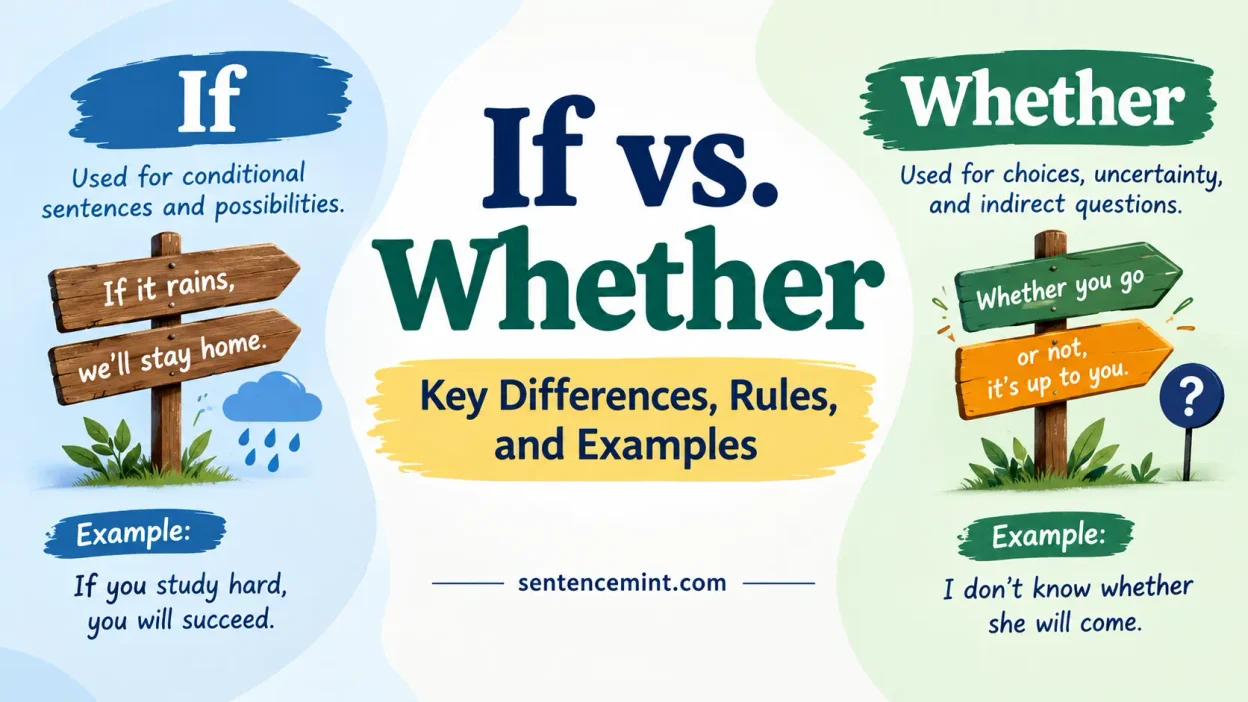
Featured Image Prompt: Create a premium 800×450 HD educational grammar blog featured image titled “If vs. Whether: What’s the Difference?” Show two elegant speech bubbles, one labeled “IF” and the other “WHETHER,” with a subtle question mark and a simple two-choice visual. Use a clean, modern editorial design, high contrast, balanced spacing, readable centered title, and a professional U.S. English learning website aesthetic. Avoid clutter, spelling errors, cropped text, and watermarks.
Image Alt Text: If vs whether grammar comparison showing the differences between the two words
If vs. Whether: What’s the Difference?
Quick Answer: If and whether can both introduce indirect yes-or-no questions, such as “I don’t know if she is coming” and “I don’t know whether she is coming.” However, if also introduces conditions, while whether is preferred when discussing alternatives and is required in certain structures, including before a to-infinitive and after a preposition.
Understanding the difference between if vs. whether can help you write clearer sentences, avoid common grammar mistakes, and sound more natural in everyday conversations. Although the two words sometimes have the same meaning, you cannot always use them interchangeably.
For example, you can say, “I will call you if I have time.” Here, if introduces a condition. You can also say, “I don’t know whether I have enough time.” In this sentence, whether introduces uncertainty.
Both words are useful in American English, but each has its own grammatical role. Let’s look at their meanings, rules, examples, and common mistakes.
If vs. Whether: Quick Comparison
| Feature | If | Whether |
|---|---|---|
| Main uses | Conditions and indirect questions | Indirect questions, choices, and alternatives |
| Conditional sentences | Yes | Generally no when meaning “on the condition that” |
| Indirect yes-or-no questions | Yes | Yes |
| Before a to-infinitive | No | Yes |
| After a preposition | Generally not in standard usage | Yes |
| Before “or not” | Not directly | Yes |
| Formal writing | Common | Often preferred for decisions and alternatives |
The most important distinction is that if can describe a condition, while whether often presents uncertainty about which possibility is true.
What Does “If” Mean?
The word if is a conjunction that commonly introduces a condition. It tells the reader or listener that one situation depends on another.
For example:
- If it rains, we will stay home.
- You can borrow my laptop if you need it.
- If you practice every day, your English may improve.
- I will help you if I finish my work early.
In each example, the action or result depends on a particular condition.
If in Indirect Questions
The word if can also introduce an indirect question when someone wants to know whether something is true.
Examples:
- I wonder if he is at home.
- She asked if I needed help.
- Do you know if the store is open?
- Please check if the document is ready.
In these sentences, if does not introduce a condition. Instead, it introduces an indirect question with a possible yes-or-no answer.
This second use is where if and whether often overlap.
What Does “Whether” Mean?
The word whether introduces uncertainty, a question involving two possibilities, or a choice between alternatives. It is especially useful when discussing decisions or explaining that something remains unknown.
Examples:
- I don’t know whether she is available.
- We must decide whether to stay or leave.
- He asked whether the meeting had started.
- The manager will consider whether the proposal is practical.
In the first and third examples, whether introduces an indirect yes-or-no question. In the second, it presents two alternatives.
Whether in Formal and Professional Writing
Writers often prefer whether when discussing decisions, choices, research questions, or formal matters.
For example:
- The committee will determine whether the proposal meets the requirements.
- We need to consider whether the new policy is effective.
- The report examines whether the results support the original claim.
These sentences sound natural in professional and academic writing. Although if may also work in some indirect questions, whether often makes the intended meaning clearer.
When Can You Use If and Whether Interchangeably?
You can often use either word when reporting a yes-or-no question indirectly. The meaning usually stays the same.
| With If | With Whether |
|---|---|
| I don’t know if she is coming. | I don’t know whether she is coming. |
| He asked if I was ready. | He asked whether I was ready. |
| Can you tell me if the office is open? | Can you tell me whether the office is open? |
| We need to find out if they received the email. | We need to find out whether they received the email. |
| She wondered if he understood the instructions. | She wondered whether he understood the instructions. |
Both versions are grammatically acceptable in these examples.
In casual conversation, if is often the more natural choice. In formal writing, whether may be preferable, especially when the sentence focuses on a decision or alternatives.
Remember that this interchangeability applies to certain indirect questions. It does not mean you can replace if with whether in every sentence.
When Should You Use If Instead of Whether?
Use if when you want to express a condition or describe what may happen in a particular situation.
1. To Express a Condition
Examples:
- If you are hungry, there is food in the kitchen.
- If I finish early, I will call you.
- If the weather improves, we can go hiking.
- If you miss the bus, take the next one.
In these examples, if means something close to “in the event that.” The action depends on whether the stated condition occurs.
2. To Describe a Possible Future Situation
Examples:
- If she arrives early, ask her to wait.
- If the package comes today, let me know.
- If you need more information, contact the office.
The word whether cannot simply replace if in these sentences without changing the meaning or making the sentence ungrammatical.
For instance:
Incorrect: Whether you need more information, contact the office.
Correct: If you need more information, contact the office.
3. To Introduce a General Truth or Repeated Situation
Examples:
- If water reaches its freezing point under normal atmospheric pressure, it freezes.
- If I drink coffee late at night, I have trouble sleeping.
- If he feels stressed, he usually takes a short walk.
Here, if introduces a condition that explains a result or a repeated response.
When Should You Use Whether Instead of If?
There are several grammatical situations in which whether is the standard choice.
1. Before a To-Infinitive
Use whether before a verb in the to-infinitive form when discussing a decision.
Examples:
- I can’t decide whether to accept the offer.
- She is wondering whether to buy a new phone.
- We discussed whether to postpone the meeting.
- He hasn’t decided whether to apply for the job.
Do not use if directly before a to-infinitive in standard English.
Incorrect: I can’t decide if to accept the offer.
Correct: I can’t decide whether to accept the offer.
This is one of the clearest differences between the two words.
2. After a Preposition
Use whether when the clause follows a preposition such as about, on, or over.
Examples:
- We talked about whether the plan would work.
- It depends on whether she agrees.
- They argued over whether the decision was fair.
- There is uncertainty about whether the event will take place.
In standard English, avoid using if to introduce these clauses directly after a preposition.
Incorrect: It depends on if she agrees.
Correct: It depends on whether she agrees.
3. Before “Or Not”
Use whether or not when you want to express two possibilities explicitly.
Examples:
- I don’t know whether or not he will attend.
- We must decide whether or not to continue.
- She asked whether or not the payment had arrived.
You can also place or not later in the clause:
- I don’t know whether he will attend or not.
With if, the phrase or not normally belongs at the end of the clause rather than immediately after if.
Natural: I don’t know if he will attend or not.
Not standard: I don’t know if or not he will attend.
4. When Presenting Clear Alternatives
Use whether when the sentence focuses on a choice between two or more options.
Examples:
- I can’t decide whether to walk or drive.
- She asked whether we preferred tea or coffee.
- The team must determine whether to expand or remain small.
- We need to decide whether the report should be revised or replaced.
In many sentences, if is possible too. However, whether often makes the alternatives clearer, particularly in formal writing.
5. At the Beginning of a Sentence as the Subject
Use whether when an indirect question functions as the subject of a sentence.
Examples:
- Whether he agrees remains unclear.
- Whether we can finish on time depends on the weather.
- Whether the plan succeeds is difficult to predict.
In these examples, the entire whether clause acts as the subject.
For standard written English, do not replace whether with if in these subject clauses.
If vs. Whether in Everyday Conversations
Both words are common in everyday American English. The best choice depends on what you want to communicate.
Consider these examples:
Example 1: Asking about someone’s plans
- “Do you know if Maya is coming?”
- “Do you know whether Maya is coming?”
Both sentences are correct. The first may sound more conversational, while the second can sound slightly more formal.
Example 2: Making a decision
- “We need to decide whether to leave now.”
- “We need to decide if we should leave now.”
Both can be acceptable, but whether to leave is the standard construction before a to-infinitive.
Example 3: Giving instructions
- “Call me if you need help.”
Here, if expresses a condition. The speaker wants the other person to call only if help is needed.
Example 4: Describing uncertainty
- “I’m not sure whether the office is open.”
This sentence expresses uncertainty about the office’s status. “I’m not sure if the office is open” is also correct.
If vs. Whether in American English Writing
In American English, the distinction between if and whether follows the same basic grammar rules used in other major varieties of English.
For emails, conversations, and everyday messages, if is perfectly natural in many indirect questions.
For reports, essays, business documents, and academic writing, whether is often a better choice when you discuss decisions, alternatives, or formal questions.
Compare:
Casual: I wonder if we should order lunch now.
More formal: We need to consider whether we should order lunch now.
Both sentences communicate uncertainty, but the second fits a more formal discussion.
The key is not to treat whether as automatically more correct. Choose the word that fits the sentence’s grammatical structure and intended meaning.
Common Mistakes With If and Whether
Learning the rules is easier when you recognize common errors.
| Incorrect or less suitable | Better version | Reason |
|---|---|---|
| I don’t know if to go. | I don’t know whether to go. | Use whether before a to-infinitive. |
| It depends on if he agrees. | It depends on whether he agrees. | Use whether after a preposition. |
| I don’t know if or not she is ready. | I don’t know whether or not she is ready. | Use whether directly before or not. |
| Whether it rains, we will stay home. | If it rains, we will stay home. | Use if for an ordinary condition. |
| Whether you need help, call me. | If you need help, call me. | The sentence expresses a condition. |
Notice that not every sentence containing if is wrong. Many indirect questions can use either word. The goal is to recognize the specific situations in which the choice matters.
How to Remember the Difference Between If and Whether
Use these simple guidelines when writing:
- If = condition: “If I have time, I’ll visit.”
- If or whether = indirect yes-or-no question: “I don’t know if/whether he is home.”
- Whether = decision: “We must decide whether to go.”
- Whether = before a to-infinitive: “She can’t decide whether to stay.”
- Whether = after a preposition: “It depends on whether they agree.”
- Whether = direct alternative or “whether or not”: “I don’t know whether or not she is coming.”
A useful test is to ask yourself whether the sentence describes a condition or expresses uncertainty about an answer or choice.
If the meaning is “on the condition that,” if is generally the right choice. If the sentence discusses which possibility is true, whether may be more appropriate.
Practice: Choose If or Whether
Test your understanding with these sentences.
- I will help you _____ I have enough time.
- She doesn’t know _____ to accept the job.
- We discussed _____ the new schedule would work.
- _____ it rains tomorrow, the outdoor event may be canceled.
- It depends on _____ the manager approves the request.
- I wonder _____ they received our message.
- He must decide _____ to stay or leave.
- Please tell me _____ you need anything.
Answers and Explanations
- If — It introduces a condition.
- Whether — Use whether before a to-infinitive.
- Whether — It is preferred after discussed in standard formal usage.
- If — It introduces a condition.
- Whether — Use whether after the preposition on.
- If or whether — Both are correct in an indirect question.
- Whether — It introduces a choice and comes before a to-infinitive.
- If or whether — Both are acceptable in this indirect question.
Frequently Asked Questions
Is “if” or “whether” correct?
Both words are correct, but they serve different grammatical purposes. You can use either one in many indirect yes-or-no questions. Use if for ordinary conditions and whether in structures such as “whether to go” and “depends on whether.”
Are if and whether interchangeable?
Sometimes. For example, “I don’t know if she is coming” and “I don’t know whether she is coming” are both correct. However, the words are not interchangeable in every context.
Can I say “if or not”?
You can use if … or not when or not appears at the end of the clause. For example, “I don’t know if he is coming or not.” To place the phrase directly after the conjunction, use whether or not.
Should I use whether in formal writing?
Often, yes. Whether is commonly preferred when discussing decisions, alternatives, and formal questions. However, if remains correct in many indirect questions, including in professional writing.
Can I use if before “to”?
Not when if directly introduces a to-infinitive in standard English. Write “I don’t know whether to leave,” not “I don’t know if to leave.”
Is “whether or not” always necessary?
No. You can often use whether by itself when the alternatives are already understood. For example, “I don’t know whether she will attend” is complete and correct.
What is the easiest way to remember if vs. whether?
Remember that if commonly introduces a condition, while whether often introduces a question, uncertainty, or choice. Also remember to use whether before a to-infinitive and after a preposition.
Conclusion
The difference between if vs. whether depends on the meaning and structure of the sentence. Both words can introduce indirect yes-or-no questions, but if is also used for conditions, while whether is the standard choice before a to-infinitive, after a preposition, and in several structures involving alternatives.
For everyday conversation, either word often works when you are reporting an indirect question. For clearer and more polished writing, pay attention to the grammatical context instead of assuming that one word is always better.
Remember these examples: “If I have time, I’ll call you” expresses a condition, while “I don’t know whether to call you” expresses uncertainty about a decision. Once you understand this distinction, choosing between if and whether becomes much easier.