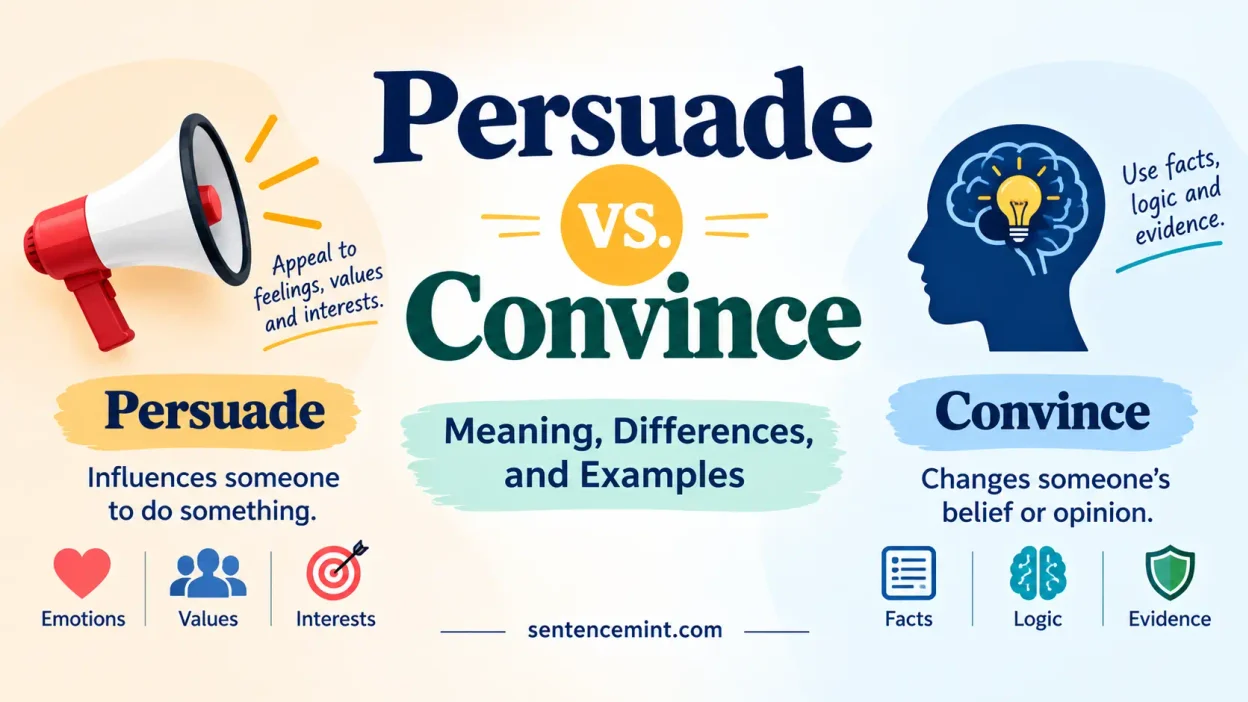
Featured Image Prompt: Create a premium 800×450 HD educational grammar blog featured image titled “Persuade vs. Convince: What’s the Difference?” Divide the design into two balanced sections. On the left, show one person encouraging another to take action, labeled “PERSUADE.” On the right, show a person presenting clear evidence to another person, labeled “CONVINCE.” Use a clean, modern editorial design, readable centered title, strong contrast, balanced spacing, and a professional American English learning website aesthetic. Ensure all text is correctly spelled, fully visible, and free from watermarks or clutter.
Image Alt Text: Persuade vs convince grammar comparison showing action and belief
Persuade vs. Convince: What’s the Difference?
Quick Answer: Persuade usually means to get someone to agree to do something, while convince usually means to make someone believe that something is true or reasonable. For example, “I persuaded my friend to join the team” focuses on an action, while “I convinced my friend that the team was talented” focuses on a belief. However, the two words sometimes overlap in modern English.
The difference between persuade vs. convince can be confusing because both words describe influencing someone’s thoughts, decisions, or behavior. They are similar, but they often emphasize different results.
Use persuade when you want someone to take action, such as accepting an invitation or changing a decision. Use convince when you want someone to believe an idea, accept an explanation, or recognize that something is true.
For example:
- I persuaded my brother to apply for the job.
- I convinced my brother that he was qualified for the job.
In the first sentence, the focus is on what the brother does. In the second, the focus is on what the brother believes.
Learning this distinction will help you choose the right word in conversations, emails, essays, and professional writing.
Persuade vs. Convince: Quick Comparison
| Feature | Persuade | Convince |
|---|---|---|
| Main meaning | Influence someone toward a decision or action | Make someone believe or accept something |
| Main focus | Behavior or agreement | Belief or certainty |
| Common grammar | Persuade someone to do something | Convince someone that something is true |
| Example | She persuaded me to attend. | She convinced me that it was worthwhile. |
| Common context | Requests, decisions, invitations | Evidence, explanations, opinions |
| Can the meanings overlap? | Yes | Yes |
The easiest way to remember the difference is this: persuade focuses on getting someone to act; convince focuses on getting someone to believe.
What Does Persuade Mean?
Persuade is a verb that means to influence someone to do something, agree to something, or accept a particular idea. It often involves giving reasons, explaining benefits, or appealing to someone’s feelings.
Examples:
- I persuaded my friend to attend the event.
- The teacher persuaded the students to participate.
- She persuaded her parents to let her travel.
- The manager persuaded the team to try a new approach.
In these examples, someone influences another person’s decision or behavior.
Persuade Someone to Do Something
One of the most common grammatical patterns is:
Persuade + someone + to + verb
Examples:
- He persuaded me to join the club.
- They persuaded their neighbors to attend the meeting.
- My sister persuaded me to try a new restaurant.
- The coach persuaded the player to continue practicing.
This pattern is especially useful when explaining how someone encourages another person to take action.
Persuade Someone Not to Do Something
You can also use persuade to encourage someone to avoid an action.
Examples:
- I persuaded him not to quit his job.
- Her friends persuaded her not to cancel the trip.
- The doctor persuaded the patient not to ignore the symptoms.
- We persuaded the team not to abandon the project.
In these sentences, the person changes their decision and chooses not to do something.
Persuade Someone That Something Is True
Although persuade often emphasizes action, it can also mean making someone believe something.
Examples:
- She persuaded me that the plan was practical.
- The lawyer persuaded the jury that the evidence was reliable.
- He tried to persuade his parents that he was ready.
This use shows that persuade and convince are not completely separate in meaning.
What Does Convince Mean?
Convince is a verb that means to make someone believe that something is true, reasonable, or worth accepting. It often involves evidence, facts, explanations, or arguments.
Examples:
- The evidence convinced the jury of his innocence.
- She convinced me that her explanation was correct.
- His results convinced the manager that he was qualified.
- I could not convince my friend that the story was true.
In each example, the focus is on belief, understanding, or acceptance.
Convince Someone That Something Is True
A common grammatical pattern is:
Convince + someone + that + clause
Examples:
- I convinced her that the information was accurate.
- The teacher convinced the class that practice improves performance.
- He convinced his parents that he could manage the responsibility.
- The report convinced the committee that the proposal deserved attention.
These sentences focus on changing someone’s opinion or helping them accept a statement.
Convince Someone of Something
You can also use convince with the preposition of.
Convince + someone + of + noun or noun phrase
Examples:
- She convinced me of her honesty.
- The evidence convinced the jury of his innocence.
- He convinced the manager of the project’s value.
- We need to convince customers of the product’s benefits.
This pattern is useful when the object of belief is expressed as a noun or noun phrase rather than a full clause.
Convince Someone to Do Something
In modern English, especially American English, convince someone to do something is also common and accepted.
Examples:
- I convinced my brother to apply for the position.
- She convinced me to give the restaurant another chance.
- The coach convinced the player to return to practice.
These sentences focus on actions, even though they use convince. The pattern is widely used in contemporary English, so it is not correct to label it universally wrong.
For a traditional distinction, persuade someone to do something emphasizes influencing the action, while convince someone that something is true emphasizes belief.
When Should You Use Persuade Instead of Convince?
Use persuade when your main point is that someone agreed to do something or changed a decision after another person influenced them.
1. When Encouraging Someone to Take Action
Examples:
- She persuaded me to attend the workshop.
- They persuaded their friend to join the team.
- The company persuaded customers to try its new service.
- He persuaded his brother to study for the exam.
The focus is on the action that follows the persuasion.
2. When Changing Someone’s Decision
Examples:
- I persuaded my parents to let me travel.
- Her colleagues persuaded her to reconsider the offer.
- We persuaded the manager to delay the decision.
- The coach persuaded the player to remain on the team.
These sentences describe changes in decisions or intended behavior.
3. When Making a Request More Effective
Examples:
- He persuaded his supervisor to approve the schedule.
- She persuaded the landlord to repair the damaged door.
- The students persuaded their teacher to extend the deadline.
In each case, the speaker’s efforts lead another person to agree to a request.
When Should You Use Convince Instead of Persuade?
Use convince when your focus is on making someone believe, understand, or accept a particular idea.
1. When Presenting Evidence
Examples:
- The photographs convinced us that the damage was serious.
- The test results convinced the researchers that further study was needed.
- The witness convinced the jury that his account was reliable.
- The data convinced the manager that the strategy was working.
The emphasis is on belief supported by evidence.
2. When Changing Someone’s Opinion
Examples:
- I convinced my friend that the movie was worth watching.
- Her explanation convinced me that I had misunderstood the situation.
- The teacher convinced the students that the topic was important.
- He finally convinced his parents that he was telling the truth.
These sentences focus on changing what someone thinks or accepts as true.
3. When Expressing Certainty
Examples:
- I am convinced that she made the right decision.
- The team is convinced that the plan will work.
- He was not convinced by the explanation.
- We remain convinced that the evidence supports our conclusion.
Here, convinced describes a state of belief or certainty.
Persuade vs. Convince in Example Sentences
Compare these examples to see how the words differ.
| Persuade | Convince |
|---|---|
| She persuaded me to buy the book. | She convinced me that the book was useful. |
| He persuaded his friend to apologize. | He convinced his friend that an apology was necessary. |
| They persuaded the manager to change the schedule. | They convinced the manager that the schedule was unfair. |
| I persuaded my brother to exercise regularly. | I convinced my brother that exercise was important. |
| The teacher persuaded the students to join the activity. | The teacher convinced the students that the activity would help them learn. |
Notice the difference between the actions and beliefs. Persuade often describes getting someone to do something, while convince often describes changing what someone believes.
Can Persuade and Convince Be Used Interchangeably?
Sometimes. In everyday American English, the two words overlap, particularly when someone influences another person to take action.
For example, both sentences are natural:
- I persuaded her to see a doctor.
- I convinced her to see a doctor.
Both describe influencing her decision.
However, the distinction is still useful when you want to be precise. Compare these sentences:
- I persuaded him to attend the meeting.
- I convinced him that the meeting was important.
The first emphasizes his decision to attend. The second emphasizes his belief about the meeting’s importance.
A practical rule is to use persuade when the action matters most and convince when the belief matters most. Remember, though, that this is a helpful guideline rather than an absolute rule.
Persuade vs. Convince in American English
Both words are widely used in American English, and their meanings sometimes overlap. You will hear expressions such as “convince someone to try” and “persuade someone to try” in everyday conversations.
For formal writing, the traditional distinction can make your meaning clearer:
- Persuade: She persuaded the committee to approve the proposal.
- Convince: She convinced the committee that the proposal was necessary.
In the first example, the committee takes action. In the second, the committee accepts an idea.
Both verbs can also introduce a that clause. For example, “He persuaded me that the plan would work” is correct, though convinced me that may be more natural when the focus is specifically on belief. <Link url=”https://www.oxfordlearnersdictionaries.com/definition/english/persuade” title=”Oxford Learner’s Dictionaries explains that the two verbs can overlap in meaning”/>.
Common Mistakes With Persuade and Convince
Understanding these common errors will help you use the words more accurately.
| Incorrect or less suitable | Better wording | Explanation |
|---|---|---|
| I persuaded him that to leave was best. | I persuaded him that leaving was best. | The clause needs a natural grammatical structure. |
| She convinced me of that the plan was safe. | She convinced me that the plan was safe. | Use that before a full clause, not directly after of. |
| He persuaded me for joining the club. | He persuaded me to join the club. | Use persuade someone to do something. |
| The evidence persuaded me of his innocence. | The evidence convinced me of his innocence. | Convince is often more natural when emphasizing belief based on evidence. |
| She convinced me to attend the meeting. | She convinced me to attend the meeting. | This is acceptable modern English, including American English. |
The last example is important: convince someone to do something is widely accepted today. Avoid treating the traditional distinction as an inflexible grammar rule.
How to Remember the Difference Between Persuade and Convince
Use these simple memory tips:
- Persuade = action: Someone influences another person to do something.
- Convince = belief: Someone helps another person believe or accept something.
- Persuade to: “She persuaded me to apply.”
- Convince that: “She convinced me that I was ready.”
- Convince of: “She convinced me of the plan’s value.”
A useful question is: “Am I emphasizing what the person does or what the person believes?”
If the sentence focuses on an action or decision, persuade is often the clearest choice. If it focuses on a belief or conclusion, convince is often more suitable.
Practice Quiz: Persuade or Convince?
Choose the word that best completes each sentence. In some cases, both words may be possible, depending on the intended emphasis.
- The evidence helped _____ the jury that the witness was telling the truth.
- She _____ her brother to join the school team.
- I could not _____ him that the information was accurate.
- The manager _____ the employees to attend the training session.
- He _____ me of the importance of saving money.
- We tried to _____ our parents to let us travel.
- The results _____ the researchers that their method was effective.
- My friend _____ me to try the new restaurant.
Answers and Explanations
- Convince — The focus is on the jury’s belief about the witness.
- Persuaded — The sentence emphasizes the action of joining the team.
- Convince — The speaker is trying to change someone’s belief.
- Persuaded — The employees are being influenced to take action.
- Convinced — The sentence emphasizes accepting the importance of saving.
- Persuade — The goal is to influence the parents’ decision.
- Convinced — The results changed the researchers’ belief.
- Persuaded — The focus is on encouraging the friend to take action.
Some answers could change in different contexts. The key is to identify whether the sentence emphasizes a person’s belief or action.
Frequently Asked Questions
What is the main difference between persuade and convince?
Persuade usually emphasizes influencing someone to act or agree, while convince usually emphasizes making someone believe that something is true or reasonable. However, the meanings overlap in modern English.
Is it correct to say “convince someone to do something”?
Yes. “Convince someone to do something” is common and accepted in modern American English. For example, “I convinced her to apply for the job” is correct.
Is persuade stronger than convince?
Neither word is automatically stronger. The result depends on the situation, the reasons given, and the person being influenced. Someone may be persuaded to act without fully accepting an argument, or convinced of an idea without acting on it.
Can you persuade someone without convincing them?
Yes. A person might agree to do something because of pressure, convenience, or a reward without truly believing the argument behind it. For example, someone might agree to attend an event without believing it will be enjoyable.
Can you convince someone without persuading them?
Yes. Someone may accept that an idea is correct but still decide not to act on it. For example, a person may believe exercise is beneficial but choose not to exercise regularly.
Should I use persuade or convince in formal writing?
Use persuade when the emphasis is on getting someone to take action, and convince when the emphasis is on belief or acceptance. Both words are appropriate in formal writing when used clearly and naturally.
What prepositions follow persuade and convince?
Common patterns include “persuade someone to do something,” “persuade someone of something,” “convince someone that something is true,” and “convince someone of something.” Both verbs can also be used with that clauses.
Conclusion
The difference between persuade vs. convince is mainly about emphasis. Persuade usually focuses on influencing a person’s decision or action, while convince usually focuses on changing a person’s belief or helping them accept an idea.
For example, “I persuaded her to apply for the job” emphasizes her action. “I convinced her that she was qualified” emphasizes her belief.
Because the words sometimes overlap, you do not need to treat the distinction as an absolute rule. Instead, choose the word that best expresses your intended meaning. Remember: persuade often focuses on action, while convince often focuses on belief.