
Introduction
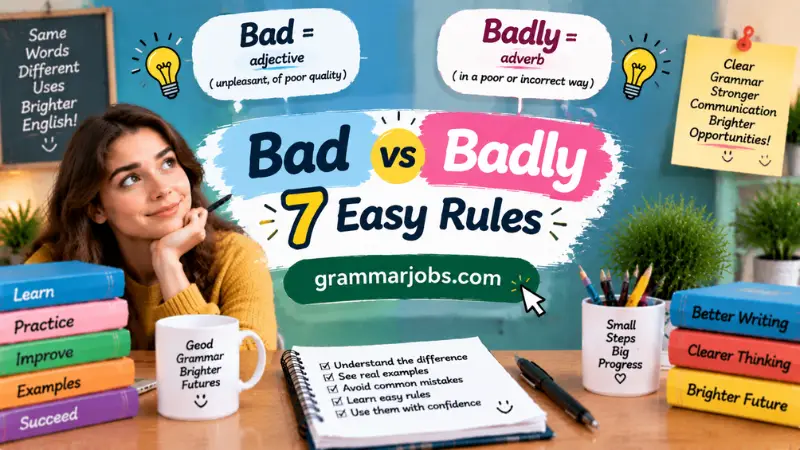
Bad vs badly is a common English word-choice confusion because both words describe something negative, and many learners use them interchangeably. However, the two words have different grammar roles and meanings.
The main bad vs badly difference is:
Bad is usually an adjective that describes a person, thing, situation, or condition.
Badly is usually an adverb that describes how an action happens.
Compare:
- The movie was bad. = The movie was poor quality.
- The actor performed badly. = The actor performed in a poor way.
The words are related, but they do not work the same way.
The bad vs badly choice depends on what you are describing.
Use bad when you mean:
- poor quality
- unpleasant
- harmful
- incorrect
- negative
Use badly when you mean:
- in a poor manner
- incorrectly
- severely
- strongly or greatly
Understanding the bad vs badly difference helps you avoid common mistakes in everyday American English.
For example:
She feels bad about the mistake.
Meaning:
She feels sorry or unhappy.
She performed badly in the competition.
Meaning:
Her performance was poor.
The meaning is connected, but the grammar changes.
A simple memory rule:
Bad describes a thing or condition.
Badly describes an action.
Quick Answer
The easiest bad vs badly rule is:
Use bad to describe a noun or a person’s condition.
Use badly to describe how someone does something.
Examples:
That was a bad decision.
Meaning:
The decision was poor.
He made the decision badly.
Meaning:
He made the decision in a poor way.
Another comparison:
I feel bad about what happened.
Meaning:
I feel sorry or unhappy.
I played badly yesterday.
Meaning:
My performance was poor.
The biggest mistake in the bad vs badly comparison is assuming that badly is always the correct choice because it ends with -ly.
Many learners remember that adverbs often end in -ly, but English has exceptions and special patterns.
A simple test:
Ask:
“Am I describing a thing, person, or situation?”
Use bad.
Example:
a bad experience
Ask:
“Am I describing how an action happened?”
Use badly.
Example:
He played badly.
Why People Confuse Them

The main reason people confuse bad vs badly is that badly looks like the adverb form of bad.
Many English adjectives create adverbs by adding -ly.
Examples:
- quick → quickly
- slow → slowly
- careful → carefully
Because of this pattern, learners often think every situation requires badly.
However, the bad vs badly difference depends on the role of the word in the sentence.
Bad is usually an adjective.
Examples:
a bad day
a bad idea
a bad result
Here, bad describes a noun.
Badly is usually an adverb.
Examples:
performed badly
answered badly
handled badly
Here, badly describes an action.
Compare:
The team had a bad game.
Meaning:
The game itself was poor.
The team played badly.
Meaning:
The team’s performance was poor.
The bad vs badly difference becomes clearer when you ask what word is being described.
Questions Answered by Bad
What kind of thing is it?
Example:
a bad mistake
Answer:
The mistake is negative or harmful.
Questions Answered by Badly
How did something happen?
Example:
He explained it badly.
Answer:
The explanation happened poorly.
Key Differences At A Glance
The main bad vs badly differences are:
| Feature | Bad | Badly |
|---|---|---|
| Main meaning | Poor, negative, unpleasant | In a poor way or severely |
| Common role | Adjective | Adverb |
| Focus | A person, thing, or situation | An action or condition |
| Example | A bad result | Performed badly |
| Question answered | What is it like? | How did it happen? |
The central bad vs badly comparison:
- Bad describes something negative.
- Badly describes the way an action happens.
Examples:
She made a bad choice.
Meaning:
The choice was poor.
She chose badly.
Meaning:
Her action of choosing was poor.
Another example:
It was a bad experience.
Meaning:
The experience was unpleasant.
The company handled the situation badly.
Meaning:
The company handled it poorly.
The bad vs badly difference is not about stronger or weaker meaning. It is about grammar and sentence structure.
Bad often appears before nouns:
- bad news
- bad habit
- bad decision
- bad result
Badly often appears after verbs:
- performed badly
- reacted badly
- failed badly
- behaved badly
Meaning and Usage Difference
The bad vs badly difference becomes easier to understand when you focus on what each word describes.
Bad as an Adjective
The word bad is most commonly used as an adjective. It describes a person, thing, situation, or experience that is negative, poor, harmful, or unpleasant.
Examples:
That was a bad decision.
Meaning:
The decision was not good.
She had a bad experience at the restaurant.
Meaning:
The experience was unpleasant.
This is a bad idea.
Meaning:
The idea is not suitable or useful.
He is a bad driver.
Meaning:
His driving skills are poor.
In these examples, bad describes nouns:
- decision
- experience
- idea
- driver
The bad vs badly difference is clear because bad answers the question:
“What kind of thing or situation is it?”
Badly as an Adverb
The word badly is most commonly used as an adverb. It describes how an action happens.
Examples:
He played badly in the game.
Meaning:
His performance was poor.
She explained the problem badly.
Meaning:
Her explanation was unclear or poor.
The company handled the situation badly.
Meaning:
The company managed it poorly.
In these examples, badly modifies verbs:
- played
- explained
- handled
The bad vs badly difference becomes clearer because badly answers the question:
“How did the action happen?”
Bad for Conditions and Feelings
The word bad is also common when describing conditions, health, emotions, and situations.
Examples:
I feel bad about what happened.
Meaning:
I feel sorry or unhappy.
My back hurts really bad.
This is common in informal American speech.
In careful writing:
My back hurts really badly.
is often preferred when describing the intensity of pain.
The weather is bad today.
Meaning:
The weather conditions are unpleasant.
Badly for Actions and Degree
The word badly can also mean “severely” or “greatly.”
Examples:
The building was badly damaged.
Meaning:
The damage was serious.
She badly needed a vacation.
Meaning:
She needed a vacation very much.
He was badly injured.
Meaning:
His injury was severe.
This meaning is different from simply describing a poor action.
The bad vs badly difference depends on context.
Compare:
He made a bad mistake.
Meaning:
The mistake itself was wrong.
He made the mistake badly.
Meaning:
The way he handled the situation was poor.
Bad and Badly in Similar Sentences
Comparing similar sentences shows the difference more clearly.
She gave a bad answer.
Meaning:
The answer was incorrect or poor.
She answered badly.
Meaning:
The way she answered was poor.
Another example:
It was a bad performance.
Meaning:
The performance was poor.
They performed badly.
Meaning:
They performed in a poor way.
Another example:
That was a bad reaction.
Meaning:
The reaction itself was inappropriate.
He reacted badly.
Meaning:
His response was poor.
The bad vs badly difference depends on whether you describe the result or the action.
Bad vs Badly With Feelings
One area that often confuses learners is the phrase:
feel bad
and
feel badly
In most everyday American English:
Feel bad is the common choice when talking about emotions.
Example:
I feel bad about forgetting your birthday.
Meaning:
I feel sorry.
However, feel badly can have a different meaning.
Example:
I feel badly because my hand is injured.
Meaning:
My sense of touch is not working well.
The difference:
- feel bad = emotional feeling
- feel badly = physical ability to feel
In normal conversations about emotions, feel bad is usually the natural choice.
Tone, Context, and Formality
The bad vs badly difference is not mainly about formal or informal English. Both words are common in American English.
The choice depends on what you want to describe.
Bad often sounds direct because it labels something as negative.
Examples:
That was a bad choice.
This is bad news.
The situation is bad.
Badly often focuses on the quality or result of an action.
Examples:
The team played badly.
The project was badly planned.
The issue was badly handled.
Common Contexts for Bad
You will often see bad with:
- news
- ideas
- decisions
- habits
- situations
- experiences
- results
- conditions
Examples:
bad weather
bad advice
bad timing
bad behavior
In these examples, bad describes the thing itself.
Common Contexts for Badly
You will often see badly with:
- performed
- behaved
- reacted
- handled
- damaged
- injured
- needed
Examples:
performed badly
behaved badly
badly damaged
badly injured
In these examples, badly describes the action or condition.
Formality Differences
Both words are acceptable in professional and everyday writing.
However, some informal expressions use bad where formal writing may prefer badly.
Example:
Informal:
I want it real bad.
Standard:
I want it really badly.
Meaning:
I want it very much.
The bad vs badly difference is about usage, not whether one word is always formal and the other is informal.
Which One Should You Use?
When choosing between bad vs badly, ask what you are describing.
Use bad when:
- describing a person, thing, or situation
- saying something is negative
- describing quality
Examples:
a bad decision
a bad result
a bad experience
Use badly when:
- describing an action
- explaining how something happened
- showing serious damage or need
Examples:
performed badly
handled badly
badly injured
| Context | Best Choice | Why |
|---|---|---|
| A poor decision | Bad | Describes the decision |
| Someone performs poorly | Badly | Describes the action |
| A serious injury | Badly | Shows severity |
| Negative weather | Bad | Describes the condition |
| Strong desire | Badly | Shows intensity |
A simple test:
If you can replace the word with “poor” or “negative,” use bad.
Example:
a bad result
→ a poor result
Correct.
If you can replace the word with “poorly” or “severely,” use badly.
Example:
The machine was badly damaged.
→ The machine was severely damaged.
Correct.
The bad vs badly difference becomes much easier when you identify whether you are describing a thing or an action.
When One Choice Sounds Wrong
Many bad vs badly mistakes happen because learners choose the word based only on meaning instead of grammar. Both words describe negative ideas, but they fit different sentence structures.
The correct choice depends on whether you describe a thing, a condition, or an action.
Mistake 1: Using Badly Before a Noun
Incorrect:
That was a badly decision.
Correct:
That was a bad decision.
Why?
Decision is a noun, and you are describing the decision itself.
Use bad before nouns:
- bad decision
- bad idea
- bad habit
- bad experience
The bad vs badly difference is clear because bad describes what something is like.
Mistake 2: Using Bad Instead of Badly With Actions
Incorrect:
He performed bad in the competition.
Correct:
He performed badly in the competition.
Why?
The sentence describes the action of performing.
Use badly after verbs when explaining how something happens.
Examples:
She reacted badly.
They played badly.
The company handled the issue badly.
Mistake 3: Saying “I Feel Badly” for Emotions
Incorrect:
I feel badly about missing your birthday.
Better:
I feel bad about missing your birthday.
Why?
When talking about emotions, feel bad means:
- feel sorry
- feel guilty
- feel unhappy
Example:
I feel bad that I forgot your name.
However, feel badly can refer to the physical ability to feel.
Example:
My hand is numb, so I feel badly with my fingers.
In everyday conversations about emotions, feel bad is the natural choice.
Mistake 4: Using Bad for Serious Damage
Incorrect:
The building was bad damaged.
Correct:
The building was badly damaged.
Why?
The sentence describes the degree of damage.
Use badly when something happens severely.
Examples:
badly injured
badly damaged
badly affected
Mistake 5: Using Badly When Describing Quality
Incorrect:
This is a badly movie.
Correct:
This is a bad movie.
Why?
You are describing the movie itself.
Use bad with nouns:
a bad movie
a bad book
a bad result
Mistake 6: Confusing “Bad” and “Badly” With Want or Need
Informal:
I want it real bad.
Standard:
I want it really badly.
Meaning:
I want it very much.
In everyday speech, people often use bad informally in this way, but badly is the traditional adverb choice in careful writing.
Examples:
She badly wants the job.
He badly needs help.
The bad vs badly difference changes the grammar, even when the meaning feels similar.
Mistake 7: Using Badly With “Be”
Incorrect:
The situation is badly.
Correct:
The situation is bad.
Why?
The sentence describes a condition, not an action.
Use bad after linking verbs like:
- is
- was
- seems
- feels
Examples:
The weather is bad.
The situation seems bad.
The results were bad.
Mistake 8: Confusing “Bad” and “Badly” in Questions
Compare:
Did you have a bad day?
Meaning:
Was your day unpleasant?
Did your day go badly?
Meaning:
Did things happen poorly?
Both are correct, but they describe different ideas.
Common Mistakes (and Quick Fixes)
The bad vs badly difference becomes easier when you remember these quick corrections.
Mistake: “She sings bad.”
Fix:
She sings badly.
Reason:
The word describes how she sings.
Mistake: “He is a badly person.”
Fix:
He is a bad person.
Reason:
Person is a noun.
Mistake: “I feel badly about the problem.”
Fix:
I feel bad about the problem.
Reason:
You are describing an emotion.
Mistake: “The car was bad damaged.”
Fix:
The car was badly damaged.
Reason:
The sentence describes the severity of damage.
Mistake: “This is a badly idea.”
Fix:
This is a bad idea.
Reason:
Idea is a noun.
Mistake: “The student did bad on the test.”
Better:
The student did badly on the test.
Reason:
The sentence describes performance.
Quick Memory Trick
Remember:
Bad + thing
Examples:
- bad news
- bad result
- bad choice
- bad situation
Badly + action
Examples:
- performed badly
- reacted badly
- behaved badly
- explained badly
This simple pattern solves most bad vs badly mistakes.
Everyday Examples
Real examples make the bad vs badly difference easier to understand.
Work
The company made a bad decision.
Meaning:
The decision was poor.
The company handled the situation badly.
Meaning:
The company managed it poorly.
School
That was a bad answer.
Meaning:
The answer was incorrect.
The student answered badly.
Meaning:
The student gave poor responses.
Conversations
I feel bad about what happened.
Meaning:
I feel sorry.
He spoke badly about his coworkers.
Meaning:
He said negative things about them.
Business
The company had a bad year.
Meaning:
The year was unsuccessful.
The company performed badly last quarter.
Meaning:
The company’s performance was poor.
Health
She has a bad cold.
Meaning:
The cold is unpleasant.
She was badly injured.
Meaning:
The injury was serious.
Technology
The app has a bad design.
Meaning:
The design is poor.
The app works badly on older devices.
Meaning:
The app functions poorly.
Daily Life
That was a bad choice.
Meaning:
The choice was not good.
I handled the situation badly.
Meaning:
My way of handling it was poor.
The bad vs badly difference appears everywhere in American English, but the main rule stays the same:
Bad describes a thing or condition.
Badly describes an action or degree.
Dictionary-Style Word Details
Verb
In the bad vs badly comparison, neither word is commonly used as a main verb in standard American English.
Bad:
Bad is not normally used as a verb when it means poor, negative, or harmful.
Example:
That was a bad experience.
Here:
- was = verb
- bad = adjective describing experience
Badly:
Badly is not a verb.
Example:
The team performed badly.
Here:
- performed = verb
- badly = adverb describing how the team performed
The bad vs badly difference is mainly about adjective and adverb usage.
Bad describes a condition or quality.
Badly describes the way an action happens.
Noun
In the main bad vs badly comparison, neither word is commonly used as a noun in everyday American English.
Bad:
Although bad is usually an adjective, it can sometimes be used as a noun in expressions that refer to something negative.
Example:
The good and the bad.
Meaning:
Positive and negative things.
However, this noun use is not the main meaning discussed in the bad vs badly comparison.
Most common uses:
bad news
bad result
bad decision
Badly:
Badly is not used as a noun.
It functions as an adverb.
Example:
The project was badly managed.
Here, badly describes the way the project was managed.
The bad vs badly difference is easiest to remember:
- bad = describes something negative
- badly = describes an action or degree
Synonyms
The alternatives for bad vs badly depend on the meaning you want to express.
Because the two words have different grammar roles, their synonyms are not always interchangeable.
Bad — closest plain alternatives
When bad means poor quality:
- poor
- terrible
- awful
- unpleasant
Examples:
a bad movie
Closest alternatives:
a poor movie
a terrible movie
When bad means harmful or negative:
- harmful
- negative
- serious
- wrong
Examples:
a bad habit
Closest alternatives:
a harmful habit
a negative habit
Badly — closest plain alternatives
When badly means poorly:
- poorly
- incorrectly
- unsuccessfully
Examples:
The job was done badly.
Closest alternatives:
The job was done poorly.
When badly means severely:
- seriously
- greatly
- severely
Examples:
badly injured
Closest alternatives:
seriously injured
severely injured
The bad vs badly difference means you should choose synonyms based on sentence structure.
You can say:
a bad decision
because you describe the decision.
You can say:
decided badly
because you describe the action.
Example Sentences
The easiest way to understand the bad vs badly difference is by comparing examples.
Bad Examples
That was a bad choice.
Meaning:
The choice was poor.
She received bad news.
Meaning:
The news was unpleasant.
This restaurant has bad reviews.
Meaning:
The reviews are negative.
He is a bad driver.
Meaning:
His driving ability is poor.
It was a bad experience.
Meaning:
The experience was unpleasant.
Badly Examples
He played badly during the game.
Meaning:
His performance was poor.
She explained the instructions badly.
Meaning:
The explanation was unclear.
The building was badly damaged.
Meaning:
The damage was severe.
The company was badly affected by the change.
Meaning:
The impact was serious.
They handled the situation badly.
Meaning:
They managed it poorly.
Direct Bad vs Badly Comparisons

That was a bad performance.
Meaning:
The performance itself was poor.
They performed badly.
Meaning:
The action of performing was poor.
She made a bad decision.
Meaning:
The decision was wrong or poor.
She decided badly.
Meaning:
Her process of deciding was poor.
It was a bad result.
Meaning:
The result was negative.
The team played badly.
Meaning:
The team played poorly.
These examples show the main bad vs badly rule:
Bad describes the result, thing, or condition.
Badly describes the action or level of damage.
Word History
The words bad and badly are closely connected because badly developed from bad with the addition of the adverb ending -ly.
The word bad has long been associated with ideas of something being poor, harmful, unpleasant, or incorrect.
Over time, badly developed its own uses as an adverb.
Today:
Bad commonly describes nouns:
a bad decision
a bad situation
a bad experience
Badly commonly describes actions or conditions:
performed badly
handled badly
badly injured
The bad vs badly difference comes from modern usage. Although they share the same base word, they do not serve the same grammatical purpose.
Phrases Containing
Both words appear in common English phrases, but they have different meanings.
Common Phrases With Bad
Bad news
I have some bad news.
Meaning:
Unpleasant information.
Bad idea
That is a bad idea.
Meaning:
An idea that is not good.
Bad habit
Smoking is a bad habit.
Meaning:
A harmful habit.
Bad experience
It was a bad experience.
Meaning:
It was unpleasant.
Bad decision
Leaving early was a bad decision.
Meaning:
The decision was poor.
Common Phrases With Badly
Badly damaged
The car was badly damaged in the accident.
Meaning:
The damage was severe.
Badly injured
The player was badly injured.
Meaning:
The injury was serious.
Badly needed
I badly needed a break.
Meaning:
I needed it very much.
Badly affected
Many businesses were badly affected.
Meaning:
They were seriously impacted.
Behave badly
The child behaved badly.
Meaning:
The behavior was poor.
The bad vs badly difference remains consistent in these phrases:
- Bad describes something negative.
- Badly describes an action, result, or degree.
Frequently Asked Questions
Which is correct: “I did bad” or “I did badly”?
The standard choice is usually:
I did badly.
Example:
I did badly on the exam.
Meaning:
My performance was poor.
However, I did bad can appear in informal speech in some regions.
For standard American English writing, badly is usually the better choice when describing performance.
Is badly just the adverb form of bad?
Yes, in many situations badly works as the adverb form of bad.
Example:
bad performance
performed badly
However, English does not always follow simple adjective-to-adverb patterns.
For example:
I feel bad
is the normal expression for emotions, even though the phrase describes a feeling.
The bad vs badly difference depends on meaning, not only word formation.
Can bad and badly be used interchangeably?
No. They are related, but they do different jobs.
Incorrect:
She sings bad.
Correct:
She sings badly.
Why?
The sentence describes how she sings.
Incorrect:
This is a badly movie.
Correct:
This is a bad movie.
Why?
The word describes the movie.
The bad vs badly difference depends on sentence structure.
Is “I feel bad” or “I feel badly” correct?
In most situations, I feel bad is correct.
Example:
I feel bad about forgetting your birthday.
Meaning:
I feel sorry or guilty.
The phrase feel badly usually refers to a physical ability to feel.
Example:
My fingers are numb, so I feel badly with my hands.
However, in everyday American English, when talking about emotions, people normally say:
I feel bad.
The bad vs badly choice depends on whether you mean emotion or physical sensation.
What is the main difference between bad and badly?
The main bad vs badly difference is grammar.
Bad is usually an adjective. It describes a person, thing, situation, or condition.
Example:
That was a bad decision.
Meaning:
The decision was poor.
Badly is usually an adverb. It describes how an action happens.
Example:
He made the decision badly.
Meaning:
The way he made the decision was poor.
A simple rule:
Bad describes something.
Badly describes an action.
Which one should I use in professional writing?
Use both words correctly according to their meaning.
Examples:
Correct:
The report contains bad information.
Correct:
The report was badly written.
The first describes the information.
The second describes how the report was written.
Professional writing does not avoid either word. It uses the correct one.
Should I say “a bad mistake” or “a badly mistake”?
The correct phrase is:
A bad mistake.
Why?
Mistake is a noun, and bad describes the mistake.
Examples:
a bad mistake
a bad choice
a bad result
You do not use badly before a noun in this meaning.
Is “badly damaged” correct?
Yes.
Badly damaged means seriously damaged.
Example:
The house was badly damaged during the storm.
Meaning:
The damage was severe.
This is a common use of badly to show degree.
Is “badly needed” correct?
Yes.
Badly needed means strongly needed or greatly needed.
Example:
I badly needed a vacation.
Meaning:
I needed a vacation very much.
Here, badly does not mean “in a poor way.” It shows a high degree of need.
Which is correct: “The car looks bad” or “The car looks badly”?
The correct choice is:
The car looks bad.
Why?
The sentence describes the condition or appearance of the car.
Examples:
The car looks bad after the accident.
Meaning:
The car’s condition is poor.
Badly would describe an action, not the appearance.
Conclusion
The bad vs badly difference becomes simple once you know what each word describes.
Use bad when describing:
- a thing
- a person
- a situation
- a condition
- a result
Examples:
a bad idea
a bad experience
a bad decision
Use badly when describing:
- an action
- a performance
- the way something happens
- serious damage or need
Examples:
performed badly
handled badly
badly injured
The most useful rule to remember:
Bad answers “What is it like?”
Badly answers “How did it happen?”
Compare:
It was a bad game.
The game itself was poor.
They played badly.
Their performance was poor.
Both words are common in American English, but they are not interchangeable.
When you describe something negative, choose bad.
When you describe an action or degree, choose badly.
Understanding the bad vs badly difference will help your writing sound more natural, accurate, and confident.


