Feature Image Prompt:
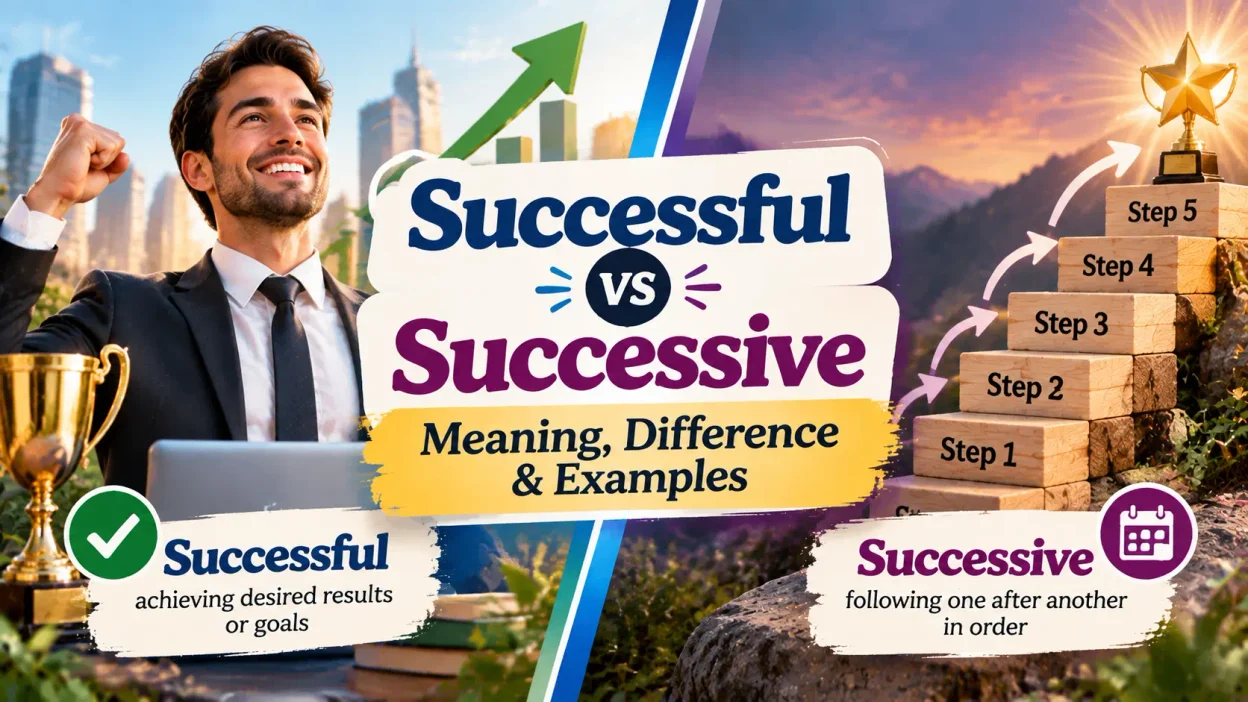
Create a professional 800×450 editorial grammar image for a US English website. Show a split-screen comparison between “Successful” and “Successive.” Left side: a person achieving a goal with a trophy, upward growth chart, and check mark labeled “SUCCESSFUL = Achieving a Good Result.” Right side: a timeline showing repeated events in order labeled “SUCCESSIVE = Following One After Another.” Use a clean modern educational design, blue and white color palette, simple icons, readable text, and premium grammar website style.
Alt Text:
Successful vs successive comparison showing achievement versus events happening one after another.
Successful vs Successive: Meaning, Difference, and Correct Usage
Introduction
The words successful and successive look and sound similar, but they have different meanings. Many English learners confuse them because both words come from the same root word, success.
However, they describe completely different ideas.
Successful means achieving a desired goal or producing a good result.
Successive means following one after another in a sequence.
For example:
- The company had a successful year.
(The company achieved good results.) - The team won three successive games.
(The team won three games in a row.)
Understanding this difference helps you avoid one of the most common word-choice mistakes in English.
Quick Answer
Use successful when talking about achievement, victory, or a positive outcome.
Use successive when talking about things that happen one after another.
Examples:
✅ She is a successful entrepreneur.
✅ The project was successful.
✅ They had five successive victories.
✅ He visited the office on three successive days.
Easy memory tip:
Successful = achieved success.
Successive = comes next in sequence.
Why People Confuse Them
The confusion comes from their similar spelling and shared connection to the word success.
Both words contain the idea of something going well or moving forward, but their meanings developed in different directions.
Compare:
Successful career
This means the career has achieved good results.
Successive career changes
This means several career changes happened one after another.
The key difference:
- Successful focuses on the result.
- Successive focuses on the order of events.
Key Differences At A Glance
| Context | Best Choice | Why |
|---|---|---|
| A person achieving goals | Successful | Describes achievement |
| A profitable business | Successful | Shows positive results |
| Several events in a row | Successive | Shows sequence |
| Consecutive wins | Successive | Events happen one after another |
| A completed project with good results | Successful | Focuses on outcome |
| Repeated actions over time | Successive | Focuses on order |
Feature Comparison
| Feature | Successful | Successive |
|---|---|---|
| Main meaning | Achieving a desired result | Following one after another |
| Focus | Outcome | Sequence |
| Describes people | Yes | No |
| Describes events | Sometimes | Yes |
| Positive meaning | Usually yes | Not always |
| Common phrase | Successful business | Successive years |
Meaning and Usage Difference
How to Use Successful
Successful is an adjective that describes someone or something that achieves a goal or has a positive result.
It can describe:
People
- She is a successful writer.
- He became a successful business owner.
Projects
- The campaign was successful.
- The experiment was successful.
Organizations
- The company launched a successful product.
Events
- The conference was successful.
In each example, successful means that something worked well or achieved what was expected.
How to Use Successive
Successive is an adjective used when one thing follows another without interruption.
It often appears with time periods, events, or repeated actions.
Examples:
- The team won three successive games.
- She worked for five successive hours.
- The company reported growth for four successive years.
Successive does not mean successful.
A person can have:
- successful results
- successive attempts
The first describes quality. The second describes order.
Tone, Context, and Formality
Both words are common in formal and everyday English, but they appear in different situations.
Successful
Often used in:
- business
- education
- personal achievements
- careers
- projects
Examples:
- a successful student
- a successful business
- a successful plan
Successive
More common in:
- reports
- news writing
- statistics
- history
- formal descriptions
Examples:
- successive elections
- successive generations
- successive attempts
In casual conversation, people often use phrases like:
- in a row
- one after another
instead of successive.
Example:
More formal:
- The company grew for five successive years.
More casual:
- The company grew for five years in a row.
Which One Should You Use?
Ask yourself:
Am I talking about achievement or order?
If you mean:
“Did it work well?”
→ Use successful
Examples:
- successful business
- successful project
- successful career
If you mean:
“What happened next?”
→ Use successive
Examples:
- successive meetings
- successive victories
- successive generations
When One Choice Sounds Wrong
Mistake 1: Using Successive for Achievement
Wrong:
❌ She is a successive author.
Correct:
✅ She is a successful author.
A person can achieve success, but they are not “successive.”
Mistake 2: Using Successful for Repeated Events
Wrong:
❌ The team won three successful games.
This changes the meaning. It suggests the games were good or effective, not necessarily consecutive.
Correct:
✅ The team won three successive games.
This means three games were won one after another.
Mistake 3: Confusing Successive Years and Successful Years
Compare:
Successful years
Means the years had good results.
Example:
- The company had three successful years.
Successive years
Means the years came one after another.
Example:
- The company expanded for three successive years.
A year can be both successful and successive depending on the meaning.
Common Mistakes (and Quick Fixes)
Mistake 1: Describing a Person as Successive
Wrong:
❌ He is a successive businessman.
Correct:
✅ He is a successful businessman.
People achieve success; they do not follow themselves in sequence.
Mistake 2: Using Successful When Talking About Order
Wrong:
❌ The player scored in five successful games.
Correct:
✅ The player scored in five successive games.
The focus is on consecutive games.
Mistake 3: Assuming They Mean the Same Thing
Successful and successive share a root but are not interchangeable.
Remember:
- Successful = good result
- Successive = next in order
Everyday Examples
Successful Examples
- She built a successful online business.
- The restaurant became successful after one year.
- The new product was successful with customers.
- He had a successful career in medicine.
- The team created a successful strategy.
Successive Examples
- The team won four successive championships.
- She called him on three successive days.
- The company opened stores in successive locations.
- Two successive generations worked in the family business.
- The player scored in successive matches.
Dictionary-Style Word Details
Verb
Successful:
Not commonly used as a verb. The related verb is succeed.
Example:
- She succeeded in completing the project.
Successive:
Not commonly used as a verb.
Noun
Successful:
Not commonly used as a noun.
A related noun is success.
Example:
- His success came after years of effort.
Successive:
Not commonly used as a noun.
Synonyms
Successful
Closest plain alternatives:
- effective
- accomplished
- victorious
- prosperous
- achieving
Examples:
- successful business → prosperous business
- successful person → accomplished person
Successive
Closest plain alternatives:
- consecutive
- following
- sequential
- consecutive
Examples:
- successive days → consecutive days
- successive events → events following one another
Example Sentences
Successful
- The company launched a successful product.
- She became successful through hard work.
- The project was successful because it solved the problem.
Successive
- He won three successive races.
- The store closed on two successive days.
- The team achieved success in successive seasons.
Word History
Both words come from the Latin root connected to the idea of following or coming after.
Over time, English developed separate meanings:
- Successful became connected with achieving a desired result.
- Successive became connected with things following each other in order.
Today, they are used differently despite their shared origin.
Phrases Containing
Successful
- successful career
- successful business
- successful attempt
- successful outcome
- successful launch
Successive
- successive years
- successive generations
- successive attempts
- successive victories
- successive stages
Conclusion
The difference between successful vs successive is simple once you focus on the meaning.
Successful describes achievement, good results, or reaching a goal.
Successive describes things that happen one after another in a sequence.