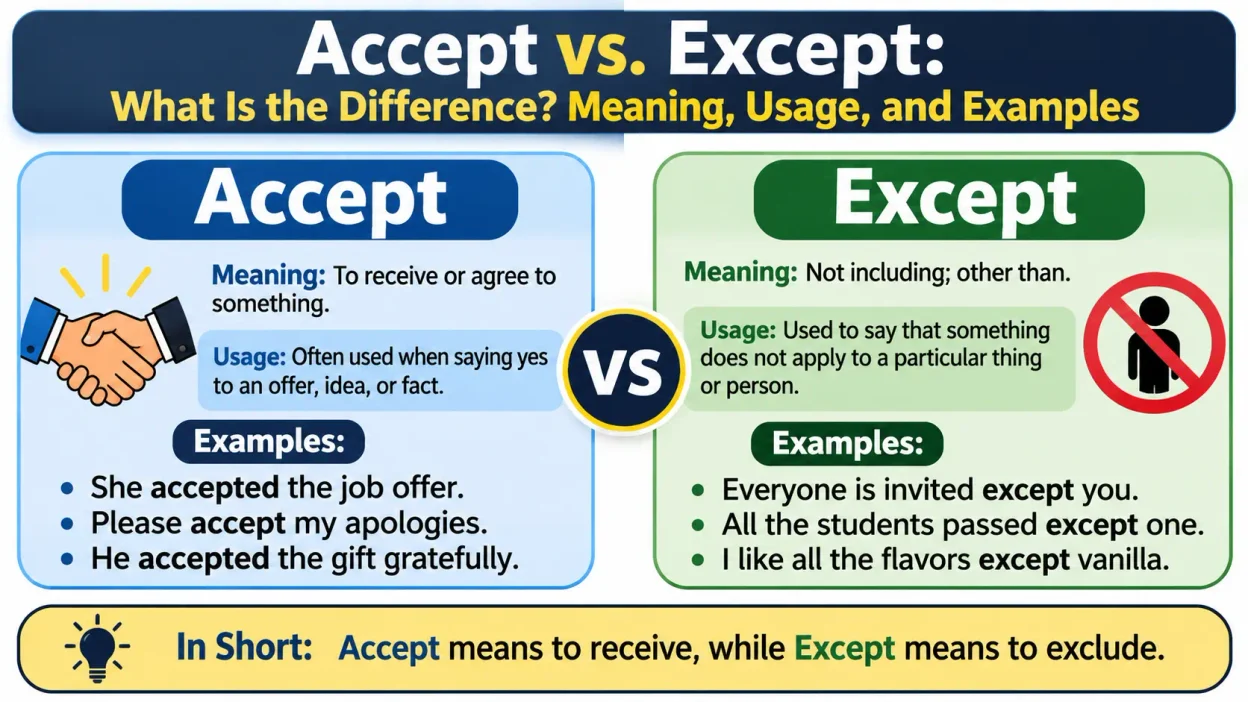
“Accept” and “except” are two commonly confused English words. They look and sound similar, but they have very different meanings and uses. Accept is a verb that means to receive, agree to, or approve something. Except usually functions as a preposition meaning “excluding” or “not including.”
For example, you might accept an invitation to a party, but everyone might attend except your brother. Although the words differ by only one letter, using the wrong one can change the meaning of a sentence.
Understanding the difference between accept and except will help you write more clearly, avoid common grammar mistakes, and communicate confidently.
What Does Accept Mean?
Accept is a verb that means to receive something willingly, agree to something, or recognize something as true or valid. It can describe receiving an offer, approving an invitation, agreeing with a decision, or acknowledging a situation.
Examples of Accept in Sentences
- She decided to accept the job offer.
- Please accept my sincere apologies.
- He accepted the invitation to dinner.
- The school does not accept late applications.
- It is important to accept responsibility for your actions.
- They accepted the results of the competition.
In each sentence, “accept” expresses receiving, agreeing, or acknowledging something.
Common Uses of Accept
1. To receive something willingly
Use accept when someone receives an object, gift, offer, or opportunity.
Example: She accepted a beautiful birthday gift from her friend.
2. To agree to an offer or invitation
Accept can describe agreeing to participate in an activity or taking an opportunity.
Example: Mark accepted the invitation to attend the conference.
3. To acknowledge something as true
Accept can also mean recognizing a fact, situation, or reality.
Example: You must accept that mistakes are part of learning.
4. To approve or allow something
Organizations and businesses may accept applications, payments, or forms.
Example: This store accepts credit cards.
What Does Except Mean?
Except is usually a preposition that means “excluding,” “not including,” or “with the exclusion of.” It identifies a person, thing, or situation that is not included in a group.
It can also function as a conjunction meaning “but” or “unless” in certain sentence structures.
Examples of Except in Sentences
- Everyone attended the meeting except Sarah.
- The shop is open every day except Sunday.
- I like all fruits except grapefruit.
- The assignment was completed by everyone except me.
- We have everything ready except the decorations.
- I would help you, except I have another appointment.
In these examples, “except” identifies something or someone that is excluded.
Common Uses of Except
1. To exclude someone or something
Use except when identifying a person or thing that is not part of a group.
Example: All the students passed the test except Daniel.
2. To identify an exception to a rule
Except can show that a general statement does not apply in one particular case.
Example: The library is open every day except public holidays.
3. To mean “but”
In some sentences, except introduces a contrasting or limiting statement.
Example: I would have called you, except my phone battery died.
4. In the phrase “except for”
The expression “except for” introduces something that differs from an otherwise general statement.
Example: The garden looks beautiful except for a few damaged flowers.
Accept vs. Except: Key Differences
The main difference between accept and except is their meaning and grammatical function. Accept is a verb related to receiving or agreeing, while except is generally used to show exclusion.
| Feature | Accept | Except |
|---|---|---|
| Main meaning | To receive or agree | To exclude or leave out |
| Part of speech | Verb | Usually a preposition; sometimes a conjunction |
| Common use | Offers, gifts, invitations, decisions | Exceptions and exclusions |
| Example | I accept your offer. | Everyone came except John. |
| Opposite idea | Reject or refuse | Include |
Easy Way to Remember the Difference
Remember this simple rule:
- Accept = Agree or receive
- Except = Exclude or leave out
If you are talking about receiving an offer, agreeing with someone, or acknowledging something, use accept.
If you are talking about leaving someone or something out, use except.
For example:
- I accept everyone’s invitation. (I agree to receive the invitations.)
- Everyone accepted the invitation except Tom. (Tom is not included.)
Accept vs. Except in Everyday Sentences
Here are additional examples that show how these words work in everyday English.
| Accept | Except |
|---|---|
| I accept your apology. | Everyone apologized except Peter. |
| She accepted the promotion. | All employees received promotions except Jack. |
| We accept cash and cards. | We accept every payment method except checks. |
| He accepted the challenge. | Nobody joined the challenge except Mia. |
| They accepted our proposal. | All proposals were approved except ours. |
These examples demonstrate why the two words cannot be used interchangeably.
Common Mistakes When Using Accept and Except
Because accept and except look and sound similar, people sometimes use them incorrectly. Here are some common mistakes and their corrections.
Mistake 1: Using Accept Instead of Except
Incorrect: Everyone came to the party accept John.
Correct: Everyone came to the party except John.
Explanation: John did not attend, so “except” is the correct word because it shows exclusion.
Mistake 2: Using Except Instead of Accept
Incorrect: I except your apology.
Correct: I accept your apology.
Explanation: The sentence describes receiving or acknowledging an apology, so “accept” is correct.
Mistake 3: Confusing Them in Business Communication
Incorrect: We except applications until Friday.
Correct: We accept applications until Friday.
Explanation: The organization is receiving applications, so the correct verb is “accept.”
Mistake 4: Confusing Them in Lists
Incorrect: I enjoy every subject accept mathematics.
Correct: I enjoy every subject except mathematics.
Explanation: Mathematics is excluded from the list of subjects the speaker enjoys.
Accept vs. Except: Grammar Rules
Understanding how each word functions grammatically can make it easier to choose the correct one.
Accept as a Verb
Accept is an action word. It changes form depending on the tense and subject.
- Present: accept
- Third-person singular: accepts
- Past tense: accepted
- Present participle: accepting
Examples:
- I accept your decision.
- She accepts the responsibility.
- They accepted the offer yesterday.
- We are accepting new members.
Except as a Preposition or Conjunction
Except does not change form like a verb. It commonly introduces an excluded person or thing.
Examples as a preposition:
- Everyone except Emma was present.
- The restaurant serves everything except breakfast.
Example as a conjunction:
- I would join you, except I have to work.
Accept vs. Except vs. Expect
Another word that people sometimes confuse with accept and except is expect. Although these words look similar, they have three different meanings.
- Accept: To receive or agree to something.
- Except: To exclude or leave something out.
- Expect: To believe that something will happen or to anticipate something.
Examples:
- I accept your invitation.
- Everyone is coming except David.
- I expect everyone to arrive on time.
Remember that “expect” is about anticipation, “accept” is about receiving or agreeing, and “except” is about exclusion.
Synonyms and Related Words
Knowing related words can help you understand the difference more easily.
Synonyms of Accept
- Receive
- Approve
- Agree
- Welcome
- Acknowledge
- Admit
- Embrace
- Take
Example: She agreed to accept the invitation.
Synonyms of Except
- Excluding
- Excluding from
- Apart from
- Other than
- Leaving out
- With the exception of
Example: Everyone was invited apart from the new employees.
Note: These synonyms are not interchangeable in every sentence. Choose one that fits the context and sentence structure.
Frequently Asked Questions (FAQs)
1. What is the main difference between accept and except?
Accept is a verb meaning to receive, agree to, or approve something. Except generally means excluding or not including someone or something.
2. Is accept a verb?
Yes. Accept is a verb used to describe receiving, agreeing to, or acknowledging something.
Example: I accept your offer.
3. Is except a preposition?
Except is most commonly used as a preposition, meaning “excluding” or “not including.” It can also function as a conjunction in certain sentences.
Example: Everyone attended except Mark.
4. How do you remember accept vs. except?
Remember that accept means to receive or agree, while except means to exclude or leave out.
A simple memory trick is: Accept an offer, but exclude someone except them from a group.
5. Can accept and except be used interchangeably?
No. They have different meanings and grammatical functions. Using one in place of the other can make a sentence incorrect or change its meaning.
6. What is the difference between accept and expect?
Accept means to receive or agree to something. Expect means to anticipate or believe something will happen.
Example: I accept your invitation, and I expect you to arrive early.
7. Which is correct: “Everyone accept John” or “Everyone except John”?
“Everyone except John” is correct when you mean that John is not included in the group.
Example: Everyone except John attended the meeting.
Conclusion
The difference between accept and except is simple once you understand their meanings. Accept is a verb that means to receive, agree to, or acknowledge something. Except is generally a preposition that means excluding or leaving something out.
Use accept when discussing offers, invitations, gifts, decisions, or responsibilities. Use except when identifying an exception or excluding someone or something from a group.
Remember the simple rule: Accept means to receive, while except means to exclude. With this distinction in mind, you can use both words correctly and avoid one of the most common English vocabulary mistakes.