The words problem and trouble are commonly used in everyday English, and both can describe difficult or unpleasant situations. However, they are not exactly the same. Understanding their differences can help you choose the right word in conversations, professional communication, and writing.
A problem is a matter, situation, or issue that needs attention or a solution. It usually refers to something specific that prevents progress or creates difficulty. Trouble, on the other hand, can describe difficulty, worry, inconvenience, conflict, or a situation in which someone experiences problems.
For example, a broken computer is a problem because it needs to be fixed. If the broken computer prevents you from completing your work on time, it may cause trouble.
In this guide, we will explore the meanings of problem and trouble, explain their differences, provide practical examples, and show you when to use each word correctly.
What Does Problem Mean?
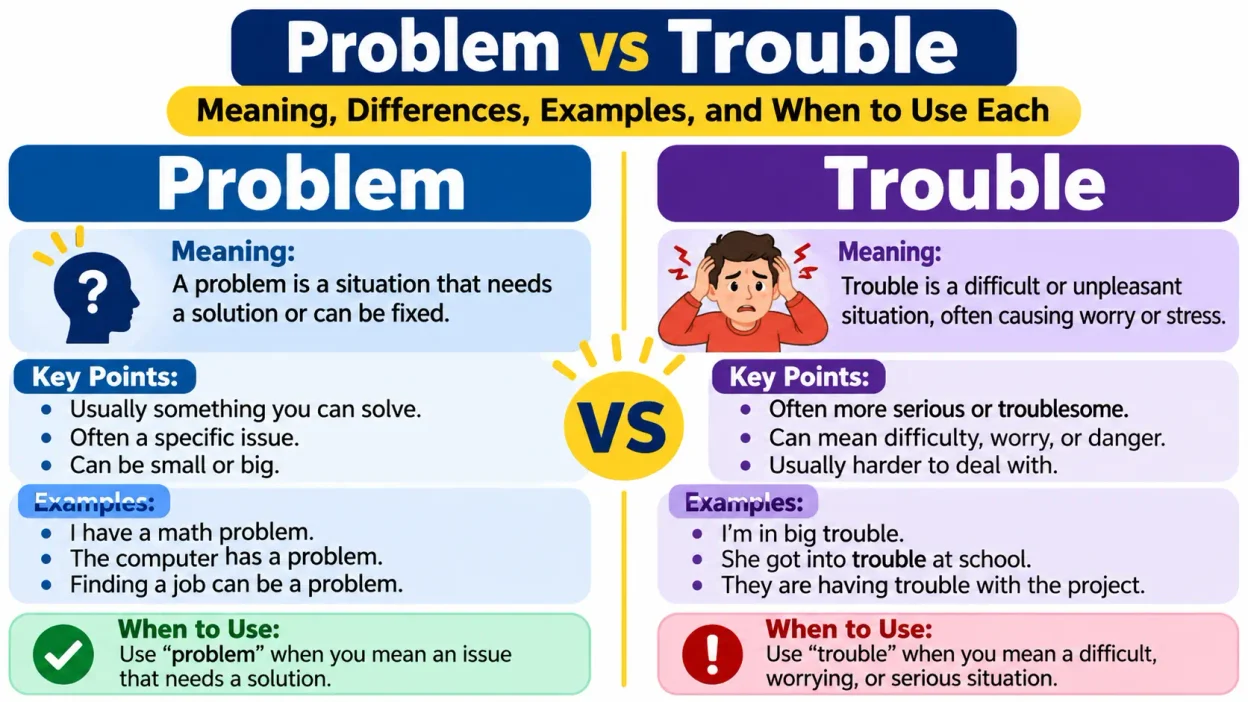
Problem is a noun that refers to a situation, issue, or difficulty that needs to be solved, addressed, or understood.
A problem usually involves something that is not working as expected or is preventing someone from achieving a particular goal.
Problems can be small or serious. They may occur in personal relationships, education, workplaces, businesses, technology, health, and everyday life.
Examples of Problem
- I have a problem with my computer.
- We need to solve this problem before the deadline.
- Traffic congestion is a serious problem in many cities.
- She discussed her financial problems with her family.
- The students found a solution to the mathematics problem.
In these examples, problem refers to a specific issue or difficulty that requires attention.
Common Types of Problems
Problems can appear in different areas of life:
- Personal problems: Difficulties involving emotions, family, or relationships.
- Financial problems: Issues related to money, debt, or expenses.
- Technical problems: Issues involving computers, software, or equipment.
- Academic problems: Difficulties with studying, learning, or completing assignments.
- Workplace problems: Challenges involving colleagues, responsibilities, or deadlines.
- Social problems: Issues affecting communities or society.
Common Expressions with Problem
- Solve a problem: Find an answer or solution to an issue.
- Face a problem: Experience a difficult situation.
- A serious problem: An issue that requires significant attention.
- Problem-solving: The process of finding solutions.
- No problem: An informal expression meaning something is acceptable or not difficult.
- The root of the problem: The original cause of an issue.
What Does Trouble Mean?
Trouble is commonly used as a noun and a verb. As a noun, it refers to difficulty, worry, inconvenience, conflict, or an unpleasant situation. As a verb, it means to cause worry, discomfort, or inconvenience.
Unlike problem, which often identifies a specific issue, trouble can describe the general experience or condition of facing difficulties.
Examples of Trouble as a Noun
- I am having trouble sleeping.
- He got into trouble at school.
- The company is experiencing financial trouble.
- We had trouble finding the hotel.
- She does not want to cause trouble for anyone.
Examples of Trouble as a Verb
- I hope I am not troubling you.
- His comments troubled his parents.
- The unexpected news troubled everyone.
- Please do not trouble yourself over this matter.
Common Types of Trouble
- Financial trouble: Difficulty managing money or meeting financial obligations.
- Legal trouble: Problems involving the law.
- Emotional trouble: Worry, distress, or emotional difficulty.
- Relationship trouble: Conflict or difficulties between people.
- Technical trouble: Difficulty using or operating technology.
- Physical trouble: Difficulty performing an activity or completing a task.
Common Expressions with Trouble
- Get into trouble: Become involved in a difficult or unpleasant situation.
- Be in trouble: Be experiencing difficulties or facing consequences.
- Have trouble doing something: Find an activity difficult.
- Cause trouble: Create difficulties or inconvenience for others.
- Go to the trouble: Make an effort to do something.
- Save someone the trouble: Prevent someone from having to make an unnecessary effort.
- Ask for trouble: Behave in a way that is likely to cause difficulties.
Problem vs Trouble: Key Differences
Although problem and trouble are related, they have different grammatical patterns and meanings.
| Basis | Problem | Trouble |
|---|---|---|
| Meaning | A specific issue or difficulty that needs attention | Difficulty, worry, inconvenience, or an unpleasant situation |
| Part of speech | Noun | Noun and verb |
| Main focus | The issue itself | The experience or condition of difficulty |
| Countability | Usually countable | Usually uncountable |
| Common use | Identifying and solving issues | Describing difficulties or causing inconvenience |
| Example | I have a problem with my phone. | I am having trouble using my phone. |
The easiest way to remember the difference: A problem is often the issue you need to solve, while trouble describes the difficulty or inconvenience you experience.
Problem vs Trouble in Example Sentences
Comparing both words in similar situations makes their differences easier to understand.
1. Technology
- Problem: There is a problem with my internet connection.
- Trouble: I am having trouble connecting to the internet.
The first sentence identifies an issue with the connection. The second describes the difficulty experienced by the speaker.
2. Education
- Problem: The student has a problem understanding the lesson.
- Trouble: The student is having trouble understanding the lesson.
Both sentences are grammatically correct. The first presents the difficulty as an issue, while the second emphasizes the student’s experience.
3. Work
- Problem: We have a problem with the project deadline.
- Trouble: We are having trouble finishing the project on time.
The first sentence identifies a project-related issue. The second describes the difficulty completing the work.
4. Relationships
- Problem: They have a serious relationship problem.
- Trouble: Their relationship has been in trouble lately.
The first identifies a specific relationship issue. The second describes a general condition of difficulty.
5. Daily Activities
- Problem: There is a problem with the car’s engine.
- Trouble: I am having trouble starting the car.
The first sentence identifies a possible mechanical issue. The second focuses on the difficulty starting the vehicle.
When to Use Problem
Use problem when referring to a specific issue, obstacle, or situation that needs attention or a solution.
It is particularly useful when identifying causes, discussing challenges, or explaining why something is not working properly.
Examples:
- We need to find a solution to this problem.
- The company is facing a major financial problem.
- Pollution is an environmental problem.
- I have a problem with the payment system.
- Her biggest problem is a lack of confidence.
Problem in Questions
Problem is also common in questions about specific difficulties.
- What is the problem?
- Do you have a problem with this decision?
- How can we solve this problem?
- Is there a problem with the application?
- What caused the problem?
When to Use Trouble
Use trouble when describing difficulty, inconvenience, worry, conflict, or the experience of struggling with something.
It is especially common in expressions such as “have trouble,” “get into trouble,” and “be in trouble.”
Examples:
- I am having trouble understanding this question.
- He got into trouble for arriving late.
- She is in financial trouble.
- We had trouble finding the correct address.
- I do not want to trouble you with unnecessary questions.
Trouble in Questions
Trouble is frequently used in questions about difficulties or inconvenience.
- Are you having trouble with your computer?
- Did you get into trouble?
- Why are you having trouble sleeping?
- Am I troubling you?
- Is the company in financial trouble?
Is Problem Countable and Trouble Uncountable?
One important grammatical difference is that problem is a countable noun, while trouble is generally an uncountable noun when referring to difficulty.
Problem as a Countable Noun
You can use problem with articles and plural forms.
- I have a problem.
- She has two problems.
- We need to address several problems.
- Every problem has a different solution.
Trouble as an Uncountable Noun
When trouble means difficulty or inconvenience, it generally does not take an indefinite article or a plural form.
- I am having trouble.
- He is in trouble.
- We experienced a lot of trouble.
- She had some trouble completing the task.
You would not normally say “I have a trouble” when referring to a general difficulty. Instead, say “I have trouble” or “I have a problem.”
However, the word troubles can be used as a plural noun in certain contexts, particularly when referring to personal worries or difficulties.
Example: She has experienced many troubles throughout her life.
Common Expressions: Problem vs Trouble
Both words appear in many common English expressions. Some of these expressions have different meanings and cannot be exchanged freely.
| Expression | Meaning | Example |
|---|---|---|
| Solve a problem | Find a solution | We must solve this problem. |
| No problem | It is acceptable or not difficult | No problem, I can help you. |
| Have a problem | Experience a specific issue | I have a problem with my laptop. |
| Have trouble | Experience difficulty | I have trouble concentrating. |
| Get into trouble | Become involved in difficulties | He got into trouble at school. |
| Be in trouble | Be in a difficult situation | The business is in trouble. |
| Cause trouble | Create difficulties | His behavior caused trouble. |
| Go to the trouble | Make a special effort | She went to the trouble of preparing dinner. |
Can Problem and Trouble Be Used Interchangeably?
Sometimes, problem and trouble can be used in similar situations, but they are not always interchangeable.
Consider these examples:
- I have a problem with my computer.
- I am having trouble with my computer.
Both sentences are correct, but they emphasize slightly different things. The first suggests that there is a particular issue with the computer. The second emphasizes the difficulty the speaker is experiencing while using it.
Now consider another example:
- He got into trouble at school.
- He got into a problem at school.
The first sentence is natural English. The second is generally incorrect or unnatural in this context.
Similarly:
- We need to solve this problem. (Natural)
- We need to solve this trouble. (Generally unnatural)
You can solve a problem, but you usually experience, face, or get into trouble.
Common Mistakes to Avoid
English learners sometimes confuse problem and trouble because both can refer to difficult situations. Here are some common mistakes and their corrections.
Mistake 1: Using an Article Before Uncountable Trouble
Incorrect: I have a trouble with my homework.
Correct: I have trouble with my homework.
Alternative: I have a problem with my homework.
When trouble refers to general difficulty, it is usually uncountable.
Mistake 2: Using Problem Instead of Trouble in Common Expressions
Incorrect: He got into a problem with his teacher.
Better: He got into trouble with his teacher.
The expression “get into trouble” is a common and natural English phrase.
Mistake 3: Using Trouble When a Specific Issue Is Intended
Less natural: We need to solve this trouble.
Correct: We need to solve this problem.
Problem is the more appropriate word when referring to a specific issue that requires a solution.
Mistake 4: Confusing Having Trouble with Being in Trouble
These expressions have different meanings:
- Having trouble: Experiencing difficulty doing something.
- Being in trouble: Being in a difficult situation or facing possible consequences.
For example:
“I am having trouble completing my assignment” means the assignment is difficult.
“I am in trouble because I did not submit my assignment” means the speaker may face consequences.
Problem vs Trouble: Quick Comparison
Here is a simple way to remember when to use each word:
- Use problem for a specific issue that needs a solution.
- Use trouble for difficulty, inconvenience, worry, or conflict.
- Use solve a problem, not usually “solve a trouble.”
- Use have trouble doing something to describe difficulty.
- Use get into trouble to describe becoming involved in an unpleasant situation.
- Remember that problem is countable, while trouble is generally uncountable when referring to difficulty.
Conclusion
The main difference between problem and trouble is that a problem usually refers to a specific issue that needs attention or a solution, while trouble describes difficulty, inconvenience, worry, or an unpleasant situation.
For example, a broken phone is a problem, while having difficulty making calls because of the broken phone is trouble.
Both words are essential in everyday English, but their grammatical patterns and common expressions are different. Learning how to use them correctly will help you express difficulties more naturally and communicate with greater confidence.
Frequently Asked Questions (FAQs)
1. What is the main difference between problem and trouble?
A problem is a specific issue or difficulty that needs to be addressed, while trouble refers to difficulty, inconvenience, worry, or an unpleasant situation.
2. Is problem the same as trouble?
No. The words are related, but they are not identical. Problem usually identifies an issue, while trouble describes the experience or condition of difficulty.
3. Is problem countable or uncountable?
Problem is a countable noun. You can say “a problem,” “two problems,” or “several problems.”
4. Is trouble countable or uncountable?
Trouble is generally uncountable when it refers to difficulty or inconvenience. For example, “I am having trouble sleeping.” However, “troubles” can be used in certain contexts to refer to different worries or difficulties.
5. Is it correct to say “I have a trouble”?
Usually, no. When referring to general difficulty, say “I have trouble.” If you mean a specific issue, say “I have a problem.”
6. What does “get into trouble” mean?
“Get into trouble” means becoming involved in an unpleasant or difficult situation, often because of something you have done.
7. What does “have trouble” mean?
“Have trouble” means experiencing difficulty doing something.
Example: I have trouble remembering people’s names.
8. Can I say “solve a trouble”?
This expression is generally unnatural in standard English. The natural expression is “solve a problem.” You can also say “deal with trouble” or “overcome difficulties.”
9. What is the difference between “in trouble” and “having a problem”?
“In trouble” means being in a difficult situation or facing possible consequences. “Having a problem” means experiencing a particular issue that needs attention.
10. Is “no problem” or “no trouble” correct?
Both expressions are correct, but they are used differently. “No problem” is a common informal response meaning something is acceptable. “No trouble” often means that something did not require much effort or cause inconvenience.
11. What is the difference between a problem and a difficulty?
A problem is an issue that may require a solution, while a difficulty is a challenge or obstacle that makes something harder to do. The words can overlap, but they emphasize different aspects.
12. Which word should I use in formal writing: problem or trouble?
Use problem when identifying a specific issue, challenge, or matter requiring a solution. Trouble is also appropriate in formal writing, especially in expressions such as “financial trouble,” “technical trouble,” or “experience trouble accessing a service.”