“Sit” and “set” are two commonly confused verbs in English. They sound similar and both can describe placing or positioning something, but they have different meanings and grammatical uses.
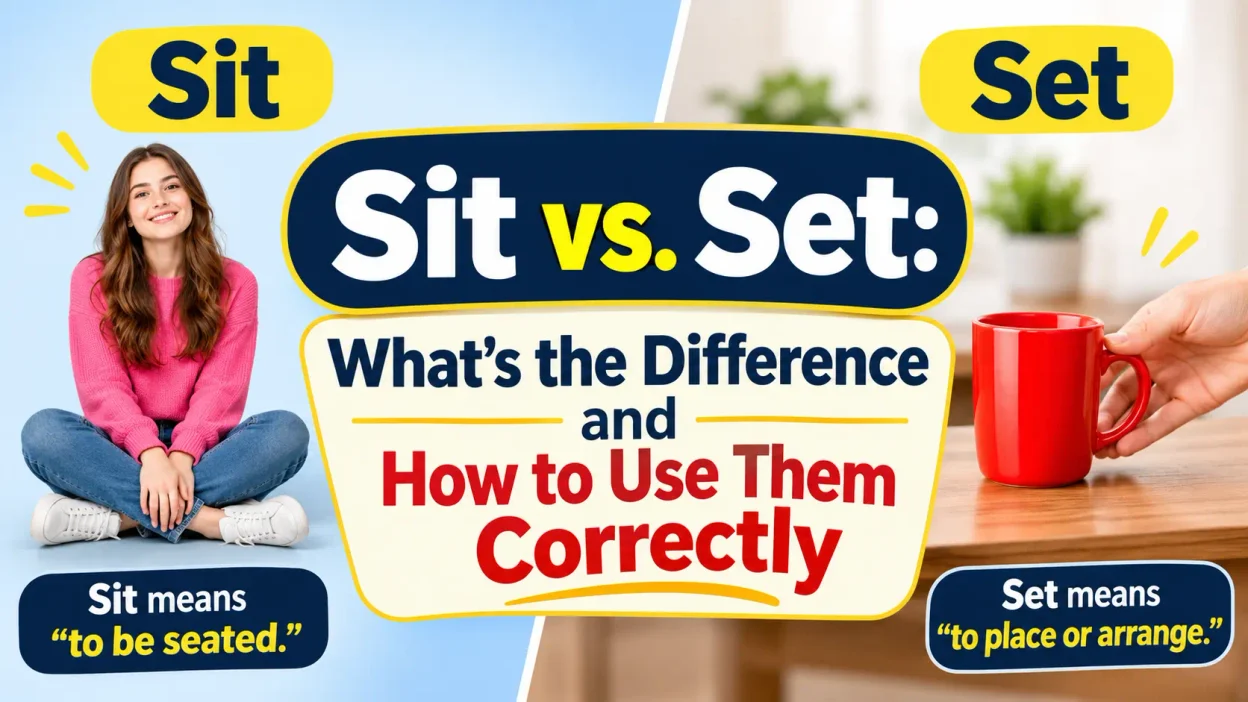
The basic difference is simple: sit means to rest in a seated position, while set means to put, place, or position something somewhere.
For example:
- Please sit on the chair.
- Please set the book on the table.
- She sat beside her friend.
- He set his phone on the desk.
The most important grammatical difference is that sit is usually an intransitive verb, meaning it does not need a direct object. Set is usually a transitive verb, meaning it normally takes a direct object.
In this guide, you will learn the meanings of sit and set, their verb forms, grammar rules, common expressions, examples, and mistakes to avoid.
1. What Does Sit Mean?
The verb sit means to rest your body in a seated position, usually with your weight supported by a chair, bench, or another surface.
It can also describe remaining in a particular position or location.
Examples:
- I like to sit near the window.
- She sits beside her mother.
- Please sit down.
- The children are sitting on the floor.
- He sat quietly in the classroom.
In these examples, the subject takes or maintains a seated position.
Common Uses of Sit
1. Taking a seated position
Use sit when someone moves into a sitting position.
Examples:
- Please sit on this chair.
- He sat beside me.
- The students sat at their desks.
2. Remaining in a seated position
Sit can describe staying seated for a period of time.
Examples:
- She sits at her desk all day.
- We sat together for an hour.
- The children are sitting quietly.
3. Being located somewhere
Sit can also describe where an object, building, or place is situated.
Examples:
- The house sits on top of a hill.
- A small village sits beside the river.
- The book sits on the shelf.
4. Taking part in an examination or meeting
In some varieties of English, particularly British English, sit can mean to take an examination.
Examples:
- She will sit her final exam next week.
- He sat the entrance examination last year.
- Students must sit for the test tomorrow.
2. What Does Set Mean?
The verb set generally means to put, place, arrange, or position something somewhere.
It can also mean to establish a rule, decide a time, adjust something, or prepare something for use.
Unlike sit, set normally takes a direct object.
Examples:
- Set the glass on the table.
- She set her bag beside the door.
- Please set the alarm for 7 a.m.
- The teacher set a deadline for the assignment.
- He set the table for dinner.
In these sentences, someone performs an action that affects an object or establishes something.
Common Uses of Set
1. Placing something somewhere
Use set when someone puts or positions an object in a particular place.
Examples:
- She set the keys on the counter.
- He set the box near the door.
- Please set your phone on the desk.
2. Establishing rules or standards
Set can mean creating or establishing a rule, goal, limit, or standard.
Examples:
- The school set new rules.
- We need to set realistic goals.
- The company set high standards for its employees.
3. Deciding a time or date
Set is commonly used when arranging a specific time, date, or schedule.
Examples:
- She set a meeting for Monday.
- I set the alarm for six o’clock.
- They set a date for the wedding.
4. Preparing or arranging something
Set can describe preparing something for a particular purpose.
Examples:
- He set the table for dinner.
- She set the stage for the performance.
- They set everything up before the guests arrived.
5. Adjusting or fixing something
Set can also mean adjusting something to a particular position or condition.
Examples:
- Set the temperature to 22 degrees.
- Please set the clock correctly.
- He set the camera to automatic mode.
3. Sit vs. Set: Key Differences
The main difference between sit and set is whether the subject takes a seated position or places something somewhere.
| Sit | Set |
|---|---|
| Means to rest in a seated position | Means to put or place something |
| Usually intransitive | Usually transitive |
| Does not normally take a direct object | Normally takes a direct object |
| Describes someone’s position | Describes an action performed on an object |
| Example: Sit on the chair. | Example: Set the bag on the chair. |
| Example: She sat quietly. | Example: She set the bag down. |
Compare These Examples
Example 1: A Chair
- Please sit on the chair.
- Please set the box on the chair.
Sit describes a person taking a seated position. Set describes placing an object on the chair.
Example 2: A Table
- The children sat at the table.
- She set the plates on the table.
The first sentence describes where the children were seated. The second describes placing the plates.
Example 3: A Book
- The book sits on the shelf.
- He set the book on the shelf.
The first sentence describes the book’s location. The second describes the action of placing it there.
4. Sit vs. Set: Verb Forms
One important difference between sit and set is their past tense and past participle forms.
| Verb Form | Sit | Set |
|---|---|---|
| Base form | Sit | Set |
| Third-person singular | Sits | Sets |
| Past simple | Sat | Set |
| Past participle | Sat | Set |
| Present participle | Sitting | Setting |
Important: Sit is an irregular verb, while set is also irregular. However, the past simple and past participle of set remain the same as its base form.
Examples of Sit in Different Tenses
Present Simple
- I sit near the window.
- She sits beside her brother.
Past Simple
- He sat on the sofa yesterday.
- We sat together during lunch.
Present Perfect
- She has sat in that chair before.
- They have sat here many times.
Present Continuous
- I am sitting in the living room.
- The students are sitting quietly.
Future Simple
- I will sit beside you.
- She will sit in the front row.
Examples of Set in Different Tenses
Present Simple
- She sets the table every evening.
- He sets his alarm before sleeping.
Past Simple
- I set the keys on the counter.
- They set a new deadline yesterday.
Present Perfect
- She has set the table.
- We have set clear goals.
Present Continuous
- He is setting the alarm.
- They are setting up the equipment.
Future Simple
- I will set the meeting time tomorrow.
- She will set the books on the shelf.
5. Sit vs. Set in Everyday English
Both verbs are used regularly in everyday conversations. Understanding their meanings can help you communicate more naturally.
At home:
- I like to sit on the sofa.
- She set the cups on the table.
- The children are sitting on the carpet.
- He set the alarm for 6 a.m.
At school:
- Students sit at their desks.
- The teacher set a difficult question.
- Please sit in your assigned seat.
- The school set new examination dates.
At work:
- I sit at my computer all day.
- The manager set a deadline.
- We sat in the conference room.
- She set up a meeting with the team.
In daily conversations:
- Can I sit here?
- Set your bag down.
- Let’s sit together.
- He set his phone beside the laptop.
6. Common Expressions with Sit
Sit appears in several common English expressions.
| Expression | Meaning | Example |
|---|---|---|
| Sit down | Take a seated position | Please sit down. |
| Sit still | Remain without moving | The children cannot sit still. |
| Sit back | Relax or avoid taking action | Sit back and enjoy the show. |
| Sit up | Straighten your upper body | Sit up straight. |
| Sit tight | Wait patiently | Sit tight; I’ll be back soon. |
| Sit around | Spend time doing very little | We sat around all afternoon. |
| Sit through | Remain until an event finishes | I had to sit through a long meeting. |
| Sit on the fence | Avoid choosing a side | He is still sitting on the fence. |
| Sit with someone | Spend time seated with someone | She sat with her grandmother. |
| Sit comfortably | Be seated in a comfortable position | Please sit comfortably. |
7. Common Expressions with Set
Set is used in many fixed expressions and phrasal verbs.
| Expression | Meaning | Example |
|---|---|---|
| Set up | Arrange or establish something | They set up a new business. |
| Set off | Begin a journey or cause something to start | We set off early. |
| Set out | Begin a journey or start doing something | She set out to achieve her goals. |
| Set aside | Save or reserve something | I set aside some money. |
| Set back | Delay progress or cost money | The repairs set us back two weeks. |
| Set down | Put something down | He set down his bag. |
| Set in | Begin and continue | Winter has set in. |
| Set an example | Demonstrate good behavior | Parents should set a good example. |
| Set a goal | Establish an objective | I set a goal for this year. |
| Set the record straight | Correct inaccurate information | She wanted to set the record straight. |
8. Sit Down vs. Set Down: What’s the Difference?
“Sit down” and “set down” look similar, but they have different meanings.
Sit down means to take a seated position.
Examples:
- Please sit down.
- She sat down beside her friend.
- The students sat down when the teacher entered.
Set down means to put or place something on a surface. It can also mean to write or formally record information.
Examples:
- Set down your bag near the door.
- He set down the glass carefully.
- The rules were set down in the agreement.
Remember:
- Sit down = Take a seat.
- Set down = Put something down.
9. Sit vs. Set: Common Mistakes to Avoid
English learners sometimes confuse these verbs because they can both describe positions and placement.
Here are common mistakes and their corrections:
| Incorrect | Correct |
|---|---|
| Please set on the chair. | Please sit on the chair. |
| She sat the book on the table. | She set the book on the table. |
| I am set on the sofa. | I am sitting on the sofa. |
| He set beside me. | He sat beside me. |
| Please sit the glass on the table. | Please set the glass on the table. |
| They have set in the front row. | They have sat in the front row. |
| She is siting near the window. | She is sitting near the window. |
| He is sit the table. | He is setting the table. |
Tips to Remember
- Use sit when a person or animal takes a seated position.
- Use set when placing or positioning something.
- Remember that sit changes to sat in the past tense.
- Remember that set stays set in the past tense.
- Check whether the verb needs a direct object.
- Learn expressions such as sit down, set up, sit tight, and set aside.
10. Is Sit Transitive or Intransitive?
Sit is usually an intransitive verb, meaning it does not normally require a direct object.
Examples:
- I sit near the window.
- She sat on the sofa.
- The children are sitting outside.
However, sit can also be used transitively in certain established expressions, particularly in British English.
Examples:
- She will sit the examination next month.
- He sat the entrance test last year.
In these examples, sit means to take or undergo an examination.
11. Is Set Transitive or Intransitive?
Set is usually a transitive verb, meaning it normally takes a direct object.
Examples:
- She set the book on the desk.
- He set the alarm for seven.
- They set a new record.
However, set can also be used intransitively in certain expressions.
Examples:
- The sun sets in the west.
- The jelly will set in the refrigerator.
- Her makeup has set.
Therefore, although the basic distinction is that sit is usually intransitive and set is usually transitive, both verbs have additional grammatical uses.
12. Sit vs. Set: Practice Exercises
Test your understanding by choosing the correct form of sit or set.
Fill in the blanks:
- Please _____ beside me.
- She _____ the keys on the table.
- The children are _____ on the floor.
- He _____ the alarm for 6 a.m.
- We _____ together during dinner yesterday.
- Please _____ your bag down.
- The students _____ in the front row.
- She is _____ the table for dinner.
- I have _____ in this chair before.
- They _____ a new deadline last week.
Answers
- Sit
- Set
- Sitting
- Sets
- Sat
- Set
- Sit
- Setting
- Sat
- Set
13. Frequently Asked Questions About Sit vs. Set
1. What is the main difference between sit and set?
Sit means to rest in a seated position, while set means to put, place, or position something somewhere.
Examples:
- Please sit here.
- Set the book on the desk.
2. Is it sit on the chair or set on the chair?
The correct expression for taking a seated position is sit on the chair.
Example: I want to sit on that chair.
3. Is it sit the book down or set the book down?
The correct expression is set the book down because you are placing an object somewhere.
Example: Please set the book down carefully.
4. What is the past tense of sit?
The past tense of sit is sat.
Example: She sat beside her mother yesterday.
5. What is the past tense of set?
The past tense of set is set.
Example: He set the phone on the table.
6. What is the past participle of sit?
The past participle of sit is sat.
Example: I have sat in this chair many times.
7. What is the past participle of set?
The past participle of set is also set.
Example: She has set the table for dinner.
8. Is sit a regular or irregular verb?
Sit is an irregular verb because its forms change from sit to sat.
Its main forms are sit, sat, and sat.
9. Is set a regular or irregular verb?
Set is an irregular verb. Its base form, past simple, and past participle are all set.
10. Do we say sit down or set down?
Both expressions are correct, but they have different meanings. Sit down means to take a seat, while set down means to put something down.
11. Is it sit up or set up?
Both are correct expressions with different meanings.
- Sit up means to straighten your upper body or move into an upright seated position.
- Set up means to arrange, establish, or prepare something.
Examples:
- Please sit up straight.
- They set up a new office.
12. Can sit and set be used interchangeably?
No. Sit and set have different meanings and grammatical uses. Sit generally describes a seated position, while set describes placing or arranging something.
Conclusion
Understanding the difference between sit vs. set can help you avoid common English grammar mistakes. Although these verbs may seem similar, they describe different actions.
Use sit when someone or something takes a seated position, as in “Sit on the chair,” “She sat beside me,” and “The children are sitting outside.”
Use set when someone places, arranges, or establishes something, as in “Set the book on the table,” “She set the alarm,” and “They set a new goal.”
Remember their verb forms: sit, sat, sat and set, set, set. With regular practice, you will find it much easier to choose the correct verb in everyday English.