
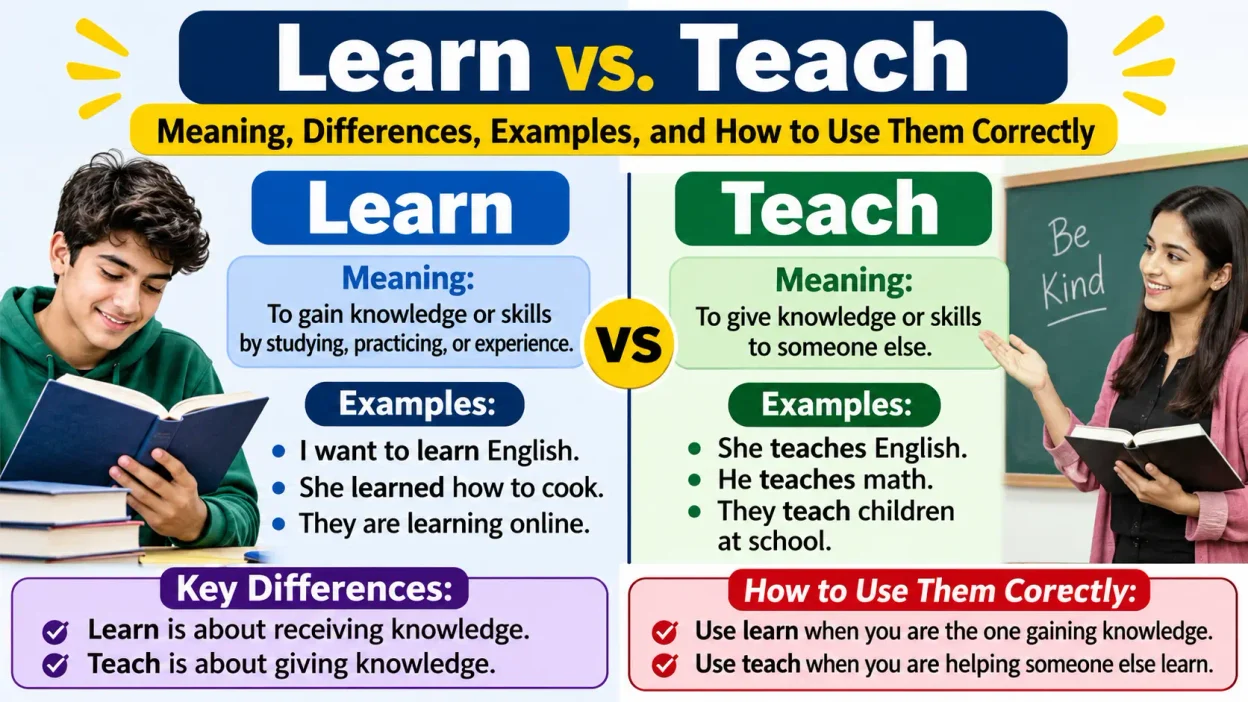
The words learn and teach are closely related, but they describe two different sides of the educational process. Both involve gaining or sharing knowledge, yet they have opposite roles in a learning situation.
Learn means to gain knowledge, information, or a skill through study, practice, or experience. Teach means to help someone gain knowledge or develop a skill by explaining, demonstrating, or providing instruction.
For example:
- I want to learn English.
- My teacher wants to teach me English.
In the first sentence, the person receives knowledge. In the second, the teacher provides knowledge.
Understanding the difference between learn and teach will help you use these verbs correctly in conversations, academic writing, and everyday communication.
What Is the Difference Between Learn and Teach?
The main difference between learn and teach is the direction in which knowledge moves.
- Learn: To gain knowledge or develop a skill.
- Teach: To give knowledge or help someone develop a skill.
| Word | Meaning | Main focus |
|---|---|---|
| Learn | To gain knowledge or a skill | Receiving knowledge |
| Teach | To give knowledge or instruction | Sharing knowledge |
Examples:
- Children learn new words at school.
- Teachers teach children new words.
- She is learning how to cook.
- Her mother is teaching her how to cook.
- I learned English from my teacher.
- My teacher taught me English.
The simplest way to remember the difference is that students learn, while teachers teach. However, anyone can learn or teach, depending on their role in a particular situation.
What Does Learn Mean?
Learn is a verb that means to gain knowledge, understanding, information, or a skill through education, practice, observation, or personal experience.
You can learn something in a classroom, from a book, through the internet, or by trying something yourself.
Examples of Learn in Sentences
- I want to learn English.
- Children learn quickly when they practice regularly.
- She is learning how to drive.
- We learned an important lesson from our mistakes.
- He wants to learn computer programming.
- They learned about different cultures at school.
- You can learn something new every day.
Common Grammar Patterns with Learn
1. Learn + something
Use this structure when mentioning the information or skill someone gains.
- I learned a new word.
- She learned the rules.
- They learned an important lesson.
2. Learn + to + verb
Use this structure when describing a new ability or skill.
- He learned to swim.
- I am learning to cook.
- She wants to learn to drive.
- They learned to speak English.
3. Learn + how to + verb
This pattern is especially common when discussing practical skills.
- I learned how to use a computer.
- She is learning how to play the piano.
- We learned how to solve the problem.
4. Learn + about + something
Use this structure when someone gains information about a subject.
- We learned about history.
- She wants to learn about photography.
- Students learn about science at school.
5. Learn from + someone or something
Use this pattern to identify the source of knowledge or experience.
- I learned English from my teacher.
- He learned from his mistakes.
- We can learn from other people’s experiences.
What Does Teach Mean?
Teach is a verb that means to give someone knowledge, information, or skills through instruction, explanation, demonstration, or practice.
A person who teaches may be a professional teacher, parent, coach, mentor, friend, or anyone who helps another person understand something.
Examples of Teach in Sentences
- My mother taught me how to cook.
- She teaches English at a local school.
- The coach teaches children how to play football.
- My father taught me an important lesson about honesty.
- They teach students mathematics.
- Can you teach me how to use this software?
- Experience teaches us many valuable lessons.
Common Grammar Patterns with Teach
1. Teach + someone + something
Use this structure when identifying the person receiving instruction and the subject being taught.
- She teaches students English.
- My father taught me patience.
- The instructor teaches beginners photography.
2. Teach + someone + to + verb
Use this structure when describing an action or skill someone helps another person develop.
- My mother taught me to cook.
- He taught his son to swim.
- The coach teaches players to work together.
3. Teach + someone + how to + verb
This structure is common when explaining practical instructions.
- Can you teach me how to drive?
- She taught us how to solve the problem.
- My brother taught me how to use a camera.
4. Teach + something
Use this pattern when referring to a subject, lesson, or concept being taught.
- They teach mathematics.
- I teach English.
- She teaches history.
5. Teach + by + method
Use this structure to describe the method of instruction.
- He teaches by giving practical examples.
- She teaches by encouraging students to ask questions.
- The instructor teaches by demonstrating each step.
Learn vs. Teach: Key Differences
Although learn and teach are connected, they are not interchangeable.
| Feature | Learn | Teach |
|---|---|---|
| Meaning | Gain knowledge or skills | Give knowledge or skills |
| Role | Learner or receiver | Teacher or instructor |
| Direction | Knowledge comes to you | Knowledge goes to someone else |
| Common structure | Learn something | Teach someone something |
| Infinitive pattern | Learn to do something | Teach someone to do something |
| Example | I learn English. | I teach English. |
| Past tense | Learned or learnt | Taught |
| Past participle | Learned or learnt | Taught |
Compare these examples:
- I learn English from my teacher.
- My teacher teaches me English.
- She learned how to cook.
- Her grandmother taught her how to cook.
- The students learned mathematics.
- The professor taught the students mathematics.
The subject and object of the sentences change depending on who is receiving and who is providing the knowledge.
Learn vs. Teach: Side-by-Side Examples
The following examples show how both verbs can describe the same educational situation.
| Learn | Teach |
|---|---|
| I learn English every day. | My teacher teaches me English. |
| Children learn new skills. | Parents teach children new skills. |
| She learned how to swim. | Her coach taught her how to swim. |
| We learn from our mistakes. | Life teaches us valuable lessons. |
| He is learning mathematics. | His professor is teaching mathematics. |
| They learned how to use the computer. | The instructor taught them how to use the computer. |
These examples make the difference clear: learning describes gaining knowledge, while teaching describes helping someone gain it.
Learn vs. Teach: What Is the Difference in Education?
In education, learning and teaching work together, but they are not the same activity.
Learning is the process through which students understand information, develop abilities, and gain experience. It can happen through reading, listening, discussion, observation, and practice.
Teaching is the process of helping students learn. Teachers explain concepts, provide examples, organize activities, answer questions, and guide students through difficult subjects.
For example:
- A teacher explains a grammar rule. This is teaching.
- A student understands and remembers the rule. This is learning.
However, learning does not always require a teacher. People can learn independently through books, videos, experiments, and personal experiences.
Similarly, teaching does not always happen in a formal classroom. Parents teach children everyday skills, coaches teach athletes, and experienced workers teach new employees.
Learned vs. Learnt: Which Spelling Is Correct?
Both learned and learnt are correct past-tense and past-participle forms of the verb learn.
The difference is mainly regional.
- Learned: More common in American English and also widely used in other varieties.
- Learnt: More common in British English, although learned is also accepted in British English.
Examples:
- I learned something new yesterday.
- I learnt something new yesterday.
Both sentences are grammatically correct.
There is also a difference in pronunciation and meaning when learned is used as an adjective meaning knowledgeable or scholarly. In that use, it is pronounced with two syllables: learn-ed.
Example:
- She is a highly learned scholar.
Teach vs. Taught: Understanding the Verb Forms
The verb teach is irregular, so its past forms do not follow the usual -ed pattern.
| Verb form | Word |
|---|---|
| Base form | Teach |
| Third-person singular | Teaches |
| Present participle | Teaching |
| Simple past | Taught |
| Past participle | Taught |
Examples:
- I teach English.
- She teaches English.
- He is teaching English.
- My father taught me English.
- I have taught English for several years.
Remember that teached is incorrect in standard English. The correct past form is taught.
Common Mistakes When Using Learn and Teach
English learners sometimes confuse these words because they are closely connected. Here are common mistakes and their corrections.
| Incorrect sentence | Correct sentence | Explanation |
|---|---|---|
| My teacher learns me English. | My teacher teaches me English. | The teacher provides knowledge. |
| I teach English from my teacher. | I learn English from my teacher. | The student receives knowledge. |
| She teached me how to cook. | She taught me how to cook. | The past form of teach is taught. |
| I am teach English. | I am learning English. | Use learning when gaining knowledge. |
| He learned me a lesson. | He taught me a lesson. | Someone provides the lesson. |
| My father teach me driving. | My father teaches me how to drive. | The verb must agree with the subject, and the structure is more natural. |
| I want to teaching English. | I want to teach English. | Use the base verb after want to. |
Easy Tips to Remember the Difference
If you often confuse learn and teach, these simple tips can help.
1. Remember the direction of knowledge.
- Learn = receive knowledge.
- Teach = give knowledge.
2. Think about your role.
If you are the student gaining information, use learn. If you are explaining something to another person, use teach.
3. Remember the sentence patterns.
- Learn something.
- Learn to do something.
- Teach someone something.
- Teach someone to do something.
4. Practice with one situation.
For example:
- I learn English.
- My teacher teaches me English.
The same subject can use both verbs, but the person performing the action changes.
5. Remember the irregular forms.
- Learn → Learned/Learnt
- Teach → Taught
This will help you avoid mistakes when speaking about past events.
Learn vs. Teach: Practice Quiz
Test your understanding by choosing the correct word in each sentence.
1. My mother wants to _____ me how to cook.
- A. learn
- B. teach
2. I want to _____ a new language.
- A. learn
- B. teach
3. The professor _____ mathematics at the university.
- A. learns
- B. teaches
4. She _____ me how to drive last year.
- A. learned
- B. taught
5. Children can _____ a lot from experience.
- A. learn
- B. teach
6. My father _____ me an important lesson about honesty.
- A. learned
- B. taught
Answers:
- B — teach
- A — learn
- B — teaches
- B — taught
- A — learn
- B — taught
Conclusion
The difference between learn and teach is simple once you understand the role each word describes. Learn means to gain knowledge, information, or a skill, while teach means to give knowledge or help someone develop a skill.
You learn English from a teacher, but the teacher teaches you English. You learn how to cook, while someone can teach you how to cook.
Remembering this difference, along with the correct grammar patterns and verb forms, will help you use both words naturally and confidently in everyday English.
Frequently Asked Questions (FAQs)
1. What is the main difference between learn and teach?
Learn means to gain knowledge or develop a skill, while teach means to provide knowledge or help someone develop a skill. A student learns, and a teacher teaches.
2. Do we learn or teach English?
It depends on your role. If you are studying English, you learn English. If you are helping another person study English, you teach English.
3. Is it correct to say “My teacher learns me English”?
No. The correct sentence is “My teacher teaches me English.” Use teach when someone gives another person knowledge or instruction.
4. What is the past tense of learn?
The past tense of learn can be learned or learnt. Both forms are correct. Learned is more common in American English, while learnt is more common in British English.
5. What is the past tense of teach?
The past tense of teach is taught.
Example: My father taught me how to ride a bicycle.
6. Can someone learn without a teacher?
Yes. People can learn independently through reading, watching educational videos, practicing, experimenting, and gaining personal experience.
7. Can someone teach without being a professional teacher?
Yes. Anyone can teach by sharing knowledge or helping someone develop a skill. Parents, friends, coaches, and experienced workers can all teach others.
8. What is the difference between learning and teaching?
Learning is the process of gaining knowledge or skills, while teaching is the process of helping someone else gain knowledge or skills.
9. Is “teached” a correct word?
No. Teach is an irregular verb, and its correct past tense and past participle forms are taught.
10. How can I remember the difference between learn and teach?
Remember this simple rule: You learn something, but you teach someone something. For example, “I learn English” and “My teacher teaches me English.”


[…] in everyday conversations, academic writing, and professional situations. In this guide, you will learn what each word means, how to use it correctly, and how to avoid common […]
[…] this guide, you will learn what award and reward mean, how they differ, and how to use each word correctly with practical […]