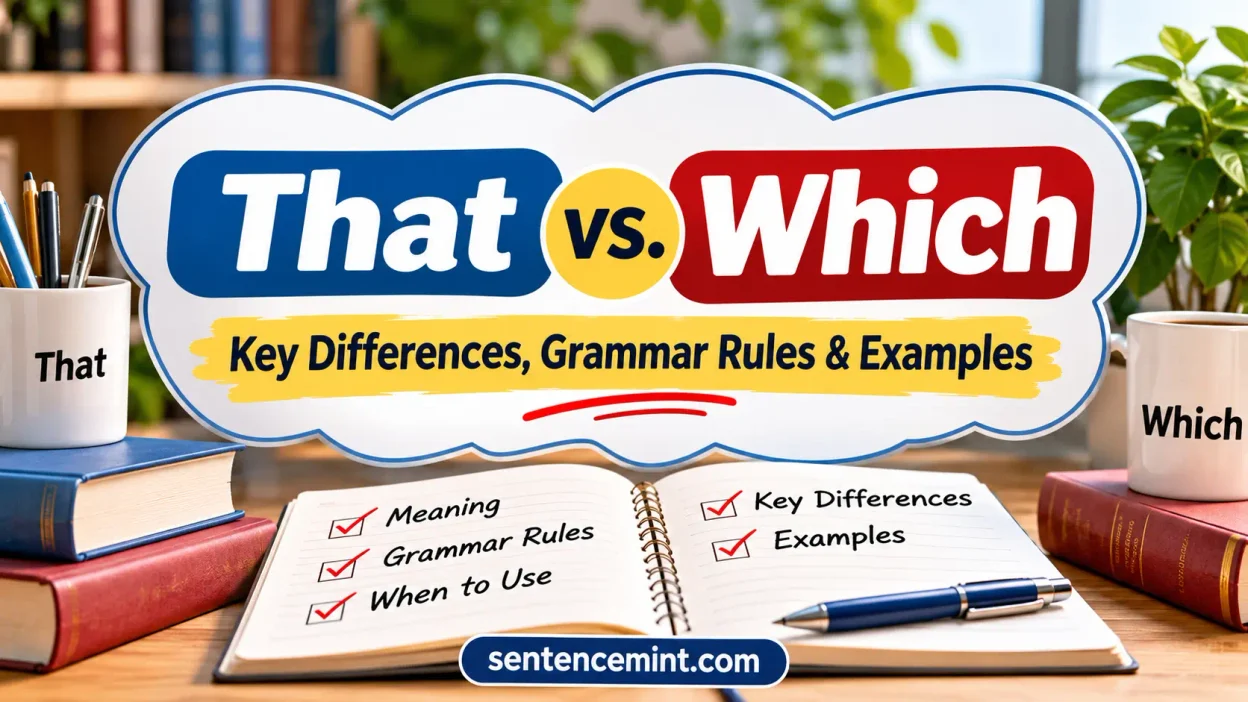
“That” and “which” are two commonly used English words that can introduce additional information about a noun. Although they sometimes appear interchangeable, they serve different purposes in many sentences. Understanding when to use each word can make your writing clearer, more accurate, and easier to read.
The main difference between that vs which is that “that” traditionally introduces essential information, while “which” often introduces extra, nonessential information. This distinction is especially important in American English grammar and punctuation.
For example:
- The book that I borrowed is interesting.
- The book, which I borrowed yesterday, is interesting.
In the first sentence, the information identifies which book is being discussed. In the second, the information provides additional detail.
This article explains the meaning, differences, grammar rules, examples, and common mistakes involving “that” and “which.”
That vs Which: Quick Answer
The traditional grammar rule is simple:
- That introduces a restrictive (essential) clause. It identifies or limits the noun being discussed. Do not use commas around this clause.
- Which introduces a nonrestrictive (nonessential) clause. It adds extra information that can be removed without changing the main meaning. Set this clause apart with commas.
Examples:
- The car that has a red door belongs to my brother.
- My car, which has a red door, belongs to my brother.
In the first sentence, “that has a red door” identifies the particular car. In the second, the phrase simply adds information about an already identified car.
What Does That Mean?
“That” is a versatile English word. It can function as a demonstrative pronoun, determiner, conjunction, or relative pronoun.
When comparing “that” with “which,” the most important use is as a relative pronoun. It introduces a restrictive relative clause that provides essential information about a noun.
Examples:
- The dress that she bought is expensive.
- The student that won the competition is my cousin.
- I like the movie that you recommended.
- The house that stands near the river is very old.
In each sentence, the clause beginning with “that” helps identify the person, object, or thing being discussed.
How to Use That in a Sentence
1. Use that for essential information
Use “that” when the information is necessary to identify the noun.
Examples:
- The phone that I purchased yesterday is already broken.
- The employee that manages this department is helpful.
- The restaurant that serves Italian food is nearby.
2. Use that without commas
Restrictive clauses are not separated from the rest of the sentence by commas.
Examples:
- The shoes that are on the table belong to Sarah.
- The book that has a blue cover is mine.
- The students that completed the assignment can leave.
3. Use that for people or things in informal and general usage
Although “who” is often preferred for people in formal writing, “that” is also commonly used for people in restrictive clauses.
Examples:
- The person that called me was polite.
- The teacher that helped us is very experienced.
For formal writing, “who” may be the more natural choice when referring to people.
What Does Which Mean?
“Which” is a relative pronoun commonly used to introduce additional information about a noun. In the traditional restrictive-versus-nonrestrictive distinction, it introduces a nonrestrictive clause that provides extra details rather than identifying the noun.
Examples:
- My laptop, which I bought last year, still works perfectly.
- The garden, which is full of flowers, looks beautiful.
- Her new car, which is very expensive, attracts attention.
- The meeting, which lasted two hours, was productive.
In these examples, the clauses beginning with “which” provide extra information. The main sentences remain understandable without them.
How to Use Which in a Sentence
1. Use which for additional information
Use “which” when the clause adds information that is not necessary to identify the noun.
Examples:
- My house, which is near the park, has a large garden.
- The book, which was published in 2020, became popular.
- His computer, which is quite old, still works well.
2. Use commas around nonessential clauses
When “which” introduces a nonrestrictive clause in the middle of a sentence, place commas around it.
Examples:
- My car, which is ten years old, needs repairs.
- The restaurant, which opened recently, is always busy.
- Our school, which has a large library, offers many activities.
3. Use which to refer to an entire preceding idea
“Which” can also refer to the meaning of an entire preceding clause or sentence.
Examples:
- She missed the train, which made her late for work.
- He forgot his appointment, which caused a problem.
- They won the final match, which surprised everyone.
That vs Which: Key Differences
The following table highlights the main differences between “that” and “which.”
| Feature | That | Which |
|---|---|---|
| Main traditional use | Essential information | Additional information |
| Clause type | Restrictive | Nonrestrictive |
| Commas | Usually no commas | Usually set off by commas |
| Identifies a noun | Yes | Not in the traditional nonrestrictive use |
| Refers to things | Yes | Yes |
| Refers to people | Possible in restrictive clauses | Generally not used for people |
| Example | The car that I bought is blue. | My car, which I bought yesterday, is blue. |
Restrictive vs Nonrestrictive Clauses
To understand “that” and “which,” it is important to know the difference between restrictive and nonrestrictive clauses.
What Is a Restrictive Clause?
A restrictive clause provides essential information about a noun. Without it, the reader may not know exactly which person or thing is being discussed.
Examples:
- The cake that is on the table is for you.
- The employee that works in the office is my friend.
- The books that have red covers belong to me.
In these sentences, the clauses identify specific cakes, employees, and books.
What Is a Nonrestrictive Clause?
A nonrestrictive clause provides additional information about a noun that is already identified. Removing the clause does not change the basic meaning of the sentence.
Examples:
- My brother, who lives in London, is visiting us.
- My car, which is black, needs cleaning.
- The Eiffel Tower, which is in Paris, attracts millions of visitors.
The additional information is useful, but it is not necessary to identify the noun.
That vs Which Examples in Sentences
Comparing similar sentences is an effective way to understand the difference.
| With That | With Which |
|---|---|
| The book that I read was exciting. | The book, which I read yesterday, was exciting. |
| The car that is parked outside is mine. | My car, which is parked outside, is mine. |
| The phone that has a cracked screen is hers. | Her phone, which has a cracked screen, is expensive. |
| The house that has a garden is beautiful. | Their house, which has a garden, is beautiful. |
| The movie that won the award is popular. | The movie, which won an award last year, is popular. |
Important: These examples demonstrate the traditional distinction. In actual usage, especially in British English, “which” can also introduce restrictive clauses without commas.
When to Use That Instead of Which
Use “that” when the information is essential to identify the noun, particularly in formal American English.
Examples:
- The shoes that I ordered have arrived.
- The restaurant that we visited was excellent.
- The student that answered the question was correct.
- The house that has a swimming pool is expensive.
- The documents that you requested are ready.
In each example, the clause helps specify which shoes, restaurant, student, house, or documents are being discussed.
When to Use Which Instead of That
Use “which” when you want to add extra information about a noun that is already clear.
Examples:
- My phone, which I bought last month, is working well.
- The museum, which is open every day, attracts many visitors.
- Her dress, which was designed in Italy, looks elegant.
- Our office, which is located downtown, is easy to find.
- The book, which contains several useful examples, is helpful.
In standard American English, these nonessential clauses should be separated by commas.
Can You Use Which Without a Comma?
Yes. In British English and some other varieties of English, “which” can introduce a restrictive clause without commas.
Example:
- The book which I borrowed from the library is interesting.
This sentence is grammatically acceptable in British English. However, in traditional American English style, writers generally prefer “that” for restrictive clauses:
- The book that I borrowed from the library is interesting.
Therefore, the choice can depend on the variety of English and the style guide being followed.
Can You Use That for People?
Yes. “That” can refer to people in restrictive relative clauses, especially in everyday English.
Examples:
- The woman that called you is my manager.
- The boy that won the race is my neighbor.
- The person that helped me was very kind.
However, “who” is generally preferred when referring to people, particularly in formal writing.
More formal alternatives:
- The woman who called you is my manager.
- The boy who won the race is my neighbor.
Common Mistakes When Using That and Which
Many writers confuse “that” and “which” because both can introduce relative clauses. The following examples show common errors and their corrections.
| Incorrect or Less Preferred in Traditional American Style | Correct or Preferred | Explanation |
|---|---|---|
| My car, that is red, is new. | My car, which is red, is new. | Use “which” for nonessential information. |
| The book, that I bought, is useful. | The book that I bought is useful. | Essential information does not need commas. |
| My phone that is expensive, works well. | My phone, which is expensive, works well. | Use commas around a nonessential clause. |
| The house which has a blue door is mine. | The house that has a blue door is mine. | “That” is preferred for restrictive clauses in traditional American style. |
| The person which called me was polite. | The person who called me was polite. | “Who” is generally used for people. |
Tips to Avoid These Mistakes
- Use “that” for information needed to identify a noun.
- Use “which” for additional information in traditional American English.
- Do not place commas around restrictive clauses.
- Use commas around nonrestrictive clauses.
- Prefer “who” when referring to people in formal writing.
- Follow the style guide required for your writing or publication.
That vs Which in American and British English
The use of “that” and “which” can vary between American and British English.
American English: Traditional American grammar generally prefers “that” for restrictive clauses and “which” for nonrestrictive clauses.
Examples:
- The car that I bought is expensive.
- My car, which I bought last year, is expensive.
British English: British English commonly allows “which” in restrictive clauses without commas.
Examples:
- The car which I bought is expensive.
- My car, which I bought last year, is expensive.
Both varieties use commas to separate nonrestrictive clauses. If you are writing for an American audience, following the traditional distinction is a safe choice.
Frequently Asked Questions (FAQs)
1. What is the main difference between that and which?
“That” traditionally introduces essential information about a noun, while “which” introduces additional, nonessential information. For example, “The car that I bought is blue” identifies a particular car, while “My car, which is blue, is new” adds extra information.
2. Should I use that or which in a sentence?
Use “that” when the clause identifies the noun and “which” when the clause adds extra information. This is the traditional rule in American English.
3. Do you put a comma before which?
Usually, yes, when “which” introduces a nonrestrictive clause. For example: “My laptop, which is new, works perfectly.” However, restrictive “which” clauses in British English generally do not take commas.
4. Can that and which be used interchangeably?
Sometimes, but not always. In British English, “which” can introduce restrictive clauses. In traditional American English, “that” is preferred for restrictive clauses, while “which” is used for nonrestrictive clauses.
5. Can that be used for people?
Yes. “That” can refer to people in restrictive clauses, such as “The person that helped me was kind.” However, “who” is often preferred in formal writing.
6. Is which used for people or things?
“Which” generally refers to things, animals, or ideas rather than people. “Who” is normally used for people.
7. What is a restrictive clause?
A restrictive clause provides essential information that identifies a noun. For example: “The phone that has a broken screen is mine.” The clause identifies which phone is being discussed.
8. What is a nonrestrictive clause?
A nonrestrictive clause adds extra information that is not essential to identify the noun. For example: “My phone, which has a broken screen, is still working.” The sentence remains understandable without the clause.
9. Can a sentence start with which?
Yes. “Which” can begin a question or a relative clause in an appropriate sentence structure.
Examples:
- Which book do you prefer?
- She missed the bus, which made her late.
10. Is it correct to use which without commas?
Yes, in restrictive clauses, particularly in British English. However, traditional American English generally prefers “that” without commas for restrictive clauses.
Conclusion
Understanding the difference between “that” and “which” is important for clear and correct English writing. Both words can introduce relative clauses, but their traditional grammatical roles are different.
Use that when the information is essential to identify a noun. Use which when you want to add extra information that can be removed without changing the main meaning. Remember that nonrestrictive “which” clauses are separated by commas.
The easiest way to remember the traditional American English rule is:
- That = Essential information (no commas).
- Which = Additional information (use commas).
By following these simple rules and practicing with examples, you can use “that” and “which” more confidently in everyday communication, academic writing, and professional content.
[…] this guide, you will learn the difference between make and do, their grammar rules, common collocations, examples, and mistakes to […]
[…] this guide, you will learn the meanings of rise and raise, their verb forms, grammar rules, common expressions, examples, and mistakes to […]
[…] this guide, you will learn the meanings of sit and set, their verb forms, grammar rules, common expressions, examples, and mistakes to […]
[…] teacher explains a grammar rule. This is […]
[…] mistakes and improve your everyday writing. In this guide, you’ll learn their meanings, grammar rules, practical examples, and simple ways to remember when to use each […]