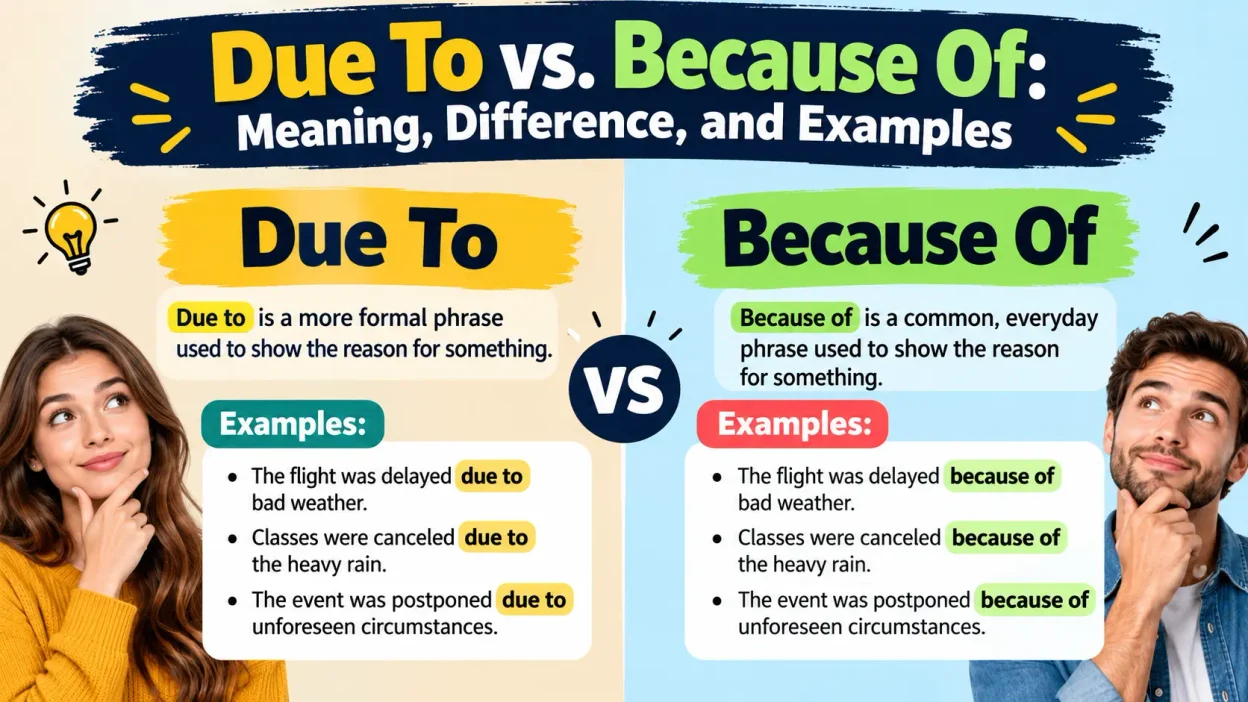
“Due to” vs. “because of” is a common English grammar topic that confuses many writers and learners. Both expressions explain the reason something happens, but they can differ in grammatical structure, emphasis, and formality.
For example:
- Due to: The flight was delayed due to bad weather.
- Because of: The flight was delayed because of bad weather.
Both sentences are understandable and widely used. In everyday English, due to and because of often have the same meaning. However, traditional grammar guidance distinguishes them by how they connect to the rest of a sentence.
Understanding this distinction can help you write more clearly, avoid common grammar mistakes, and choose the expression that fits your sentence naturally.
In this guide, you will learn the meanings of due to and because of, their grammatical differences, correct usage, common errors, and practical examples.
Quick Answer: Due To vs. Because Of
Due to and because of both mean “caused by” or “as a result of.” The main traditional distinction is that due to is often used after a noun or linking verb to describe a cause, while because of is used to explain why an action or event happens.
| Expression | Meaning | Typical use | Example |
|---|---|---|---|
| Due to | Caused by; attributable to | Often describes a condition or cause associated with a noun | The cancellation was due to rain. |
| Because of | As a result of; on account of | Explains the reason for an action or event | The match was canceled because of rain. |
In modern English, both expressions are widely used to introduce causes. The traditional distinction can be useful in formal writing, but it is not always followed in everyday usage.
What Does “Due To” Mean?
Due to is a prepositional expression meaning “caused by,” “attributable to,” or “resulting from.” It identifies the cause of a situation, condition, or event.
Traditionally, grammar guides recommend using due to when the phrase describes a noun or follows a linking verb such as be.
Examples of Due To
- The delay was due to heavy traffic.
- The school’s closure was due to a power outage.
- Her success was due to consistent effort.
- The damage was due to poor maintenance.
- The cancellation was due to unexpected circumstances.
In each example, due to identifies the cause of a condition or event.
Due To in Formal Writing
Due to is common in professional, academic, and formal writing.
Examples:
- The reduction in production was due to a shortage of raw materials.
- The meeting was postponed due to scheduling conflicts.
- The increase in costs was due to higher transportation expenses.
- The system failure was due to a technical problem.
The expression works well when you want to state a cause directly and concisely.
What Does “Because Of” Mean?
Because of is a prepositional phrase meaning “as a result of,” “on account of,” or “for the reason of.” It explains why an action, event, or situation occurs.
It is followed by a noun, pronoun, or noun phrase rather than a complete independent clause.
Examples of Because Of
- We stayed home because of the rain.
- She arrived late because of traffic.
- The event was postponed because of a scheduling conflict.
- He succeeded because of his determination.
- They canceled the trip because of unexpected expenses.
In these sentences, because of introduces the reason behind an action or event.
Because Of in Everyday English
Because of is natural in conversation, emails, school assignments, and professional communication.
Examples:
- I missed the bus because of the traffic.
- We changed our plans because of the weather.
- She could not attend because of a family emergency.
- The store closed early because of a power outage.
It is a clear and versatile way to explain why something happened.
Due To vs. Because Of: Key Differences
Although these expressions frequently overlap, their traditional grammatical uses are slightly different.
1. Grammatical Structure
The traditional distinction focuses on the relationship between the cause phrase and the rest of the sentence.
Due to is traditionally associated with a noun or a linking verb.
Example:
- The cancellation was due to heavy rain.
Here, due to heavy rain describes the cause of the cancellation.
Because of more directly explains the reason an action or event occurred.
Example:
- The organizers canceled the event because of heavy rain.
Here, because of heavy rain explains why the organizers canceled the event.
Modern English speakers commonly use due to in both kinds of sentences, particularly in formal and journalistic writing.
2. Meaning
Both expressions identify a cause.
- The delay was due to fog.
- The delay occurred because of fog.
The meaning is almost identical. The difference lies mainly in sentence structure and emphasis, not in the underlying cause.
3. Formality
Both expressions are acceptable in formal and informal English.
Due to often sounds slightly more formal or concise, while because of can sound more conversational and direct. Neither expression is inherently incorrect in professional writing.
4. Sentence Placement
Both phrases can appear at the beginning or later in a sentence.
Examples:
- Due to the storm, the school closed early.
- Because of the storm, the school closed early.
- The school closed early due to the storm.
- The school closed early because of the storm.
All four sentences are widely understandable. In the first two, a comma separates the introductory phrase from the main clause.
5. Traditional Grammar Preference
Some traditional grammar guides recommend due to after a linking verb and prefer because of when explaining the cause of an action.
For example:
- Traditional preference: The delay was due to an accident.
- Traditional preference: The train stopped because of an accident.
This distinction is useful when following a strict style guide. However, modern standard English frequently uses due to in the second construction as well.
When to Use Due To
Use due to when you want to identify the cause of a condition, result, or event. It is particularly natural in sentences built around a noun such as delay, failure, cancellation, or increase.
Examples
1. Describing a delay
The flight delay was due to mechanical problems.
2. Explaining a failure
The equipment failure was due to improper installation.
3. Identifying a cause of success
Her improvement was due to regular practice.
4. Explaining a change
The increase in sales was due to effective marketing.
5. Writing a formal report
The interruption was due to a temporary network outage.
A Simple Test for Due To
Ask whether the phrase can naturally describe the cause of a noun or condition.
- The problem was due to a lack of preparation.
- The closure was due to severe weather.
If the construction sounds natural and clearly identifies the cause, due to is a good choice.
When to Use Because Of
Use because of when you want to explain why an action or event happened. It is especially useful when the sentence focuses on what someone did or what occurred.
Examples
1. Explaining an action
We postponed the picnic because of the rain.
2. Explaining a person’s behavior
He left early because of a personal commitment.
3. Explaining a decision
They rejected the proposal because of its high cost.
4. Describing a result
The roads were closed because of flooding.
5. Explaining an absence
She missed class because of illness.
A Simple Test for Because Of
Ask yourself, “Why did this happen?”
- Why did we postpone the picnic? Because of the rain.
- Why did she miss class? Because of illness.
If because of clearly introduces the reason, it is a natural choice.
Due To vs. Because Of: Example Sentences
The following examples show how both expressions can communicate the same cause.
| Using due to | Using because of |
|---|---|
| The delay was due to traffic. | We were late because of traffic. |
| The cancellation was due to rain. | They canceled the event because of rain. |
| The failure was due to a technical issue. | The system stopped because of a technical issue. |
| The improvement was due to practice. | She improved because of regular practice. |
| The closure was due to repairs. | The shop closed because of repairs. |
| The damage was due to flooding. | The road was damaged because of flooding. |
| The change was due to new regulations. | They changed the policy because of new regulations. |
| The increase was due to higher demand. | Prices increased because of higher demand. |
Notice that the first column often describes a noun or condition, while the second often explains an action or event. This is a helpful traditional pattern, not an absolute rule.
Can You Start a Sentence With Due To or Because Of?
Yes. Both expressions can appear at the beginning of a sentence when they introduce the cause.
Starting With Due To
- Due to heavy snow, the airport temporarily closed.
- Due to a technical problem, the website was unavailable.
- Due to unexpected expenses, the company revised its budget.
Starting With Because Of
- Because of heavy snow, the airport temporarily closed.
- Because of a technical problem, the website was unavailable.
- Because of unexpected expenses, the company revised its budget.
A comma is generally used after an introductory phrase when it helps separate that phrase from the main clause.
For clearer writing, make sure the introductory phrase relates logically to the main sentence.
Due To vs. Because: What Is the Difference?
It is important not to confuse due to and because of with because.
Because is a conjunction that introduces a clause containing a subject and a verb.
Examples:
- We stayed home because it was raining.
- She left early because she felt unwell.
- The match was canceled because the field was flooded.
Because of is followed by a noun or noun phrase.
Examples:
- We stayed home because of the rain.
- She left early because of an illness.
- The match was canceled because of flooding.
Due to is also followed by a noun phrase.
Examples:
- The delay was due to rain.
- Her absence was due to illness.
- The cancellation was due to flooding.
Compare these structures:
| Expression | Correct example |
|---|---|
| Because + clause | We left because it was late. |
| Because of + noun phrase | We left because of the late hour. |
| Due to + noun phrase | Our early departure was due to the late hour. |
A common error is using because of directly before a complete clause.
Incorrect: We stayed home because of it was raining.
Correct: We stayed home because it was raining.
Also correct: We stayed home because of the rain.
Common Mistakes With Due To and Because Of
Although both phrases are straightforward, writers sometimes use them incorrectly.
Mistake 1: Using Because Of Before a Complete Clause
Incorrect: The game was canceled because of it was raining.
Correct: The game was canceled because it was raining.
Also correct: The game was canceled because of the rain.
Why? Because introduces a clause, while because of introduces a noun phrase.
Mistake 2: Assuming Due To Is Always Incorrect at the Beginning
Incorrect claim: A sentence can never begin with due to.
Correct: Due to the storm, the flight was delayed.
Why? Starting a sentence with due to is widely accepted in modern English. Traditional style preferences may vary, but the position alone does not make it incorrect.
Mistake 3: Confusing Due To With Due
Incorrect: The payment is due to Friday.
If you mean the payment must be made by Friday, write:
Correct: The payment is due Friday.
If you mean the payment was caused by a particular factor, write:
Correct: The increase was due to higher costs.
Why? Due can mean expected or required at a particular time, while due to can express a cause.
Mistake 4: Using Both Expressions Unnecessarily
Wordy: The delay occurred due to the fact that the road was closed.
Clearer: The delay occurred because the road was closed.
Also clear: The delay was due to the road closure.
Why? Direct wording is often easier to understand.
Mistake 5: Treating the Expressions as Completely Different in Meaning
It is misleading to claim that due to and because of always express different kinds of causes.
Example:
- The cancellation was due to rain.
- The cancellation happened because of rain.
Both communicate the same basic reason.
Why? Their main distinction is traditionally grammatical, and actual usage overlaps considerably.
Due To vs. Because Of in Academic and Professional Writing
Both expressions are suitable for academic work, business reports, and professional communication.
The best choice depends on sentence structure, clarity, and any style guide you are expected to follow.
In Academic Writing
- The observed variation was due to differences in sample size.
- The results changed because of an adjustment to the experimental procedure.
Both are clear. In academic work, the most important goal is to identify the cause accurately and avoid implying causation when the evidence supports only an association.
In Business Writing
- The project delay was due to resource constraints.
- We revised the schedule because of a supplier delay.
Both expressions work naturally in business communication.
In News and Reports
- The road closure was due to flooding.
- Officials closed the road because of flooding.
The first focuses on the cause of the closure; the second emphasizes the action taken by officials.
Quick Rules to Remember
Use these simple guidelines to choose the right expression.
- Use because before a complete clause: “because the road was closed.”
- Use because of before a noun phrase: “because of the road closure.”
- Use due to to identify a cause, particularly after a noun or linking verb.
- Remember that modern English often uses due to and because of interchangeably.
- Follow a required style guide if you are writing for a school, publication, or organization with specific rules.
- Prefer the sentence that expresses the cause most clearly and naturally.
Frequently Asked Questions
1. What is the difference between due to and because of?
Both expressions mean “caused by” or “as a result of.” Traditionally, due to is often used to describe a noun or condition, while because of explains why an action or event occurred. In modern English, their uses overlap considerably.
2. Is due to grammatically correct?
Yes. Due to is a standard English expression used to identify a cause. Some traditional grammar guides recommend particular sentence structures, but modern English commonly uses the phrase in a variety of constructions.
3. Is because of more correct than due to?
No. Neither expression is universally more correct. Both are standard when used appropriately. The best choice depends on the sentence, intended meaning, and any applicable style requirements.
4. Can I start a sentence with due to?
Yes. For example: “Due to heavy rain, the event was postponed.” This construction is widely used. Some formal style guides may prefer alternative wording in particular contexts.
5. Can I start a sentence with because of?
Yes. For example: “Because of the storm, the school closed early.” A comma commonly follows the introductory phrase.
6. Is due to formal or informal?
Due to is common in both formal and informal English, although it can sound concise and formal in reports or professional writing.
7. Is because of followed by a noun or a verb?
Because of is followed by a noun, pronoun, or noun phrase. If you want to introduce a complete clause with a subject and verb, use because instead.
- Correct: We left because of the rain.
- Correct: We left because it was raining.
8. What is another way to say due to?
Depending on the context, alternatives include because of, owing to, as a result of, caused by, and attributable to. Each alternative may have slightly different grammatical requirements.
9. Can due to and because of be used in the same sentence?
Yes, when each phrase serves a clear purpose. However, using both to express the same cause unnecessarily can make writing repetitive.
10. Which phrase should I use in an exam?
If your exam follows traditional grammar guidance, use due to when describing the cause of a noun or condition and because of when explaining the reason for an action. If the exam tests standard modern usage, both may be acceptable depending on the sentence.
Conclusion
The difference between due to and because of is mainly a matter of grammatical structure and emphasis. Both expressions communicate cause and are widely accepted in modern English.
Traditionally, due to is associated with nouns and conditions, as in “The delay was due to rain.” Because of is often used to explain actions and events, as in “The match was canceled because of rain.” However, these patterns are not absolute, and the expressions frequently overlap.
The most important rule is to use because before a complete clause and because of before a noun phrase. When choosing between due to and because of, focus on clarity, natural phrasing, and any style requirements that apply to your writing.
With practice, you can use both expressions confidently in conversations, academic assignments, emails, and professional documents.