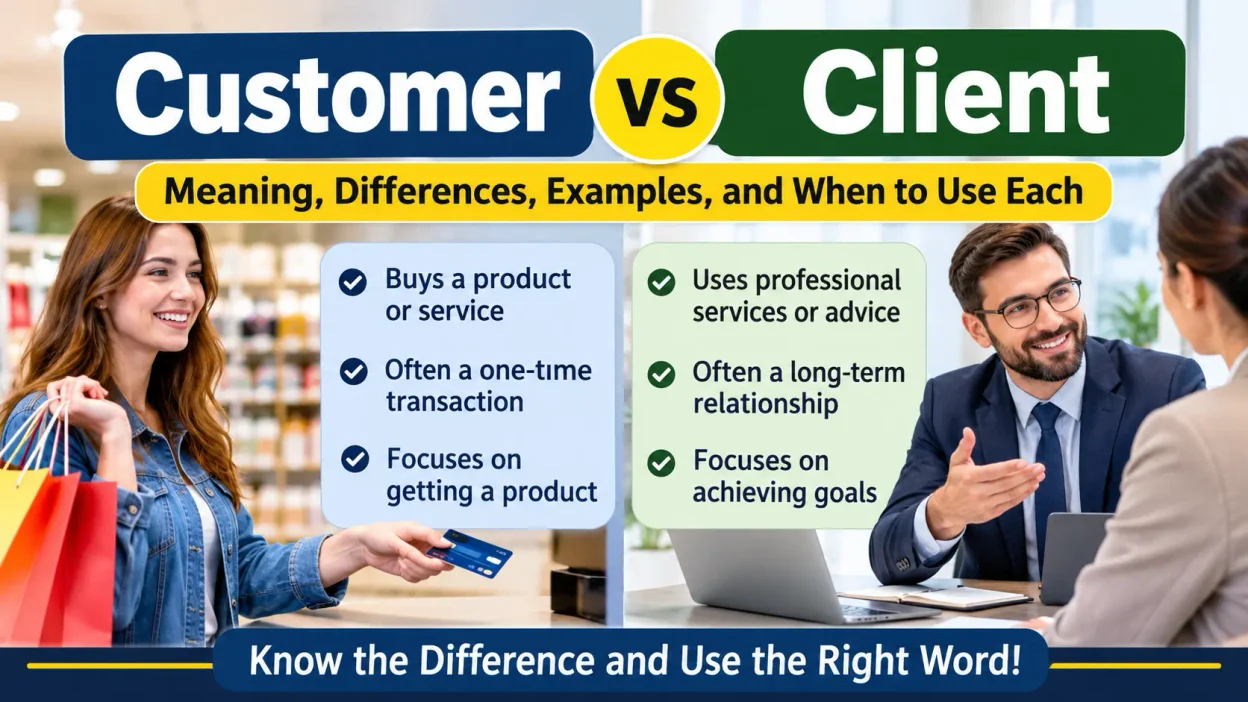
The words customer and client are often used interchangeably because both describe people or organizations that purchase products or services. However, they have slightly different meanings and are commonly used in different business situations.
A customer usually purchases goods or services from a business, often through individual transactions. A client, on the other hand, typically receives professional services, advice, or ongoing support from a person or company.
For example, someone buying a pair of shoes from a store is a customer, while someone hiring a lawyer for legal representation is a client.
Understanding the difference between customer and client can help you communicate more professionally, write clearly, and choose the correct term in business, marketing, and everyday conversations.
In this guide, we will explain their meanings, differences, examples, and common mistakes so you can use both words confidently.
What Does Customer Mean?
A customer is a person or organization that buys goods or services from a business.
The word is commonly used in retail, restaurants, supermarkets, online shopping, and other businesses that sell products or provide services directly to buyers.
A customer may make a single purchase or buy from the same business repeatedly. The relationship does not necessarily involve ongoing personal attention or professional advice.
Examples:
- A customer buys groceries from a supermarket.
- A customer orders coffee from a café.
- A customer purchases a laptop from an electronics store.
- A customer buys clothes from an online retailer.
- A customer pays for a haircut at a salon.
In each example, the person is purchasing a product or service from a business.
Characteristics of a Customer
A customer relationship often has the following characteristics:
- Purchases: Customers buy products or services.
- Transactions: The relationship may involve individual purchases.
- Convenience: Customers often value price, availability, and ease of purchase.
- Limited interaction: Some purchases require little personal communication.
- Repeat business: Customers may return to buy from the same company.
However, customers can also develop long-term relationships with businesses, especially when they receive excellent service and consistent value.
What Does Client Mean?
A client is a person or organization that receives professional services, advice, or specialized support from an individual or business.
The word is especially common in industries where services involve expertise, consultation, planning, or an ongoing professional relationship.
For example, someone who hires an accountant to prepare financial statements is a client. Similarly, a company that works with a marketing agency on a long-term campaign is a client of that agency.
Examples:
- A client hires a lawyer for legal advice.
- A client works with an accountant to manage taxes.
- A client receives financial planning services from an advisor.
- A client hires a designer to create a website.
- A client works with a consultant to improve business operations.
In these situations, the relationship usually involves more than simply purchasing a product. It may require communication, professional judgment, and personalized attention.
Characteristics of a Client
A client relationship often includes:
- Professional services: Clients receive specialized knowledge or expertise.
- Personalized attention: Services may be tailored to individual needs.
- Ongoing communication: Clients and service providers often communicate regularly.
- Long-term relationships: Many client relationships continue over months or years.
- Trust: Clients often depend on professional guidance and confidentiality.
Not every client relationship is long-term, however. A person can be a client even when they purchase a professional service only once.
Customer vs Client: Key Differences
The main difference between a customer and a client is the type of relationship they have with a business or service provider.
A customer generally purchases goods or services, while a client typically receives professional or specialized services.
| Basis | Customer | Client |
|---|---|---|
| Meaning | A person or organization that buys goods or services | A person or organization that receives professional services |
| Main focus | Purchasing products or services | Receiving expertise, advice, or personalized support |
| Relationship | Often transactional | Often service-oriented and relationship-based |
| Duration | Can be one-time or ongoing | Often ongoing, but can also be temporary |
| Personalization | May be standardized | Often tailored to individual needs |
| Communication | May be limited | Often involves regular interaction |
| Common industries | Retail, restaurants, supermarkets, e-commerce | Law, accounting, consulting, design, financial planning |
| Example | Someone buying a phone | Someone hiring a lawyer |
Simple distinction: A customer buys something from a business, while a client usually works with a professional or service provider to receive specialized assistance.
Customer vs Client Examples in Everyday Situations
Understanding how these words are used in real-life situations makes their differences easier to remember.
| Situation | Correct term | Explanation |
|---|---|---|
| Buying groceries from a store | Customer | The person purchases products. |
| Hiring a lawyer | Client | The person receives legal services. |
| Ordering food from a restaurant | Customer | The person purchases a meal. |
| Hiring a business consultant | Client | The person receives professional advice. |
| Buying shoes online | Customer | The person completes a retail transaction. |
| Working with a financial advisor | Client | The person receives personalized financial guidance. |
| Hiring a graphic designer for a project | Client | The designer provides a specialized service. |
| Purchasing a movie ticket | Customer | The person buys admission. |
| Hiring an accountant | Client | The accountant provides professional services. |
| Buying a product from a pharmacy | Customer | The person purchases a product. |
These examples show that the nature of the service or transaction usually determines which term is more appropriate.
When to Use Customer
Use customer when referring to someone who purchases products or services from a business.
It is particularly appropriate in retail and other transaction-focused environments.
1. Retail Businesses
Retail stores generally refer to people who purchase their products as customers.
Example:
- The store offers discounts to its regular customers.
- Every customer receives a receipt after purchasing an item.
2. Restaurants and Cafés
People who purchase meals, snacks, or drinks are usually called customers.
Example:
- The restaurant serves hundreds of customers every day.
- The café provides free Wi-Fi for its customers.
3. Online Shopping
E-commerce businesses commonly use customer to describe people who purchase products through their websites or applications.
Example:
- The company provides free shipping to new customers.
- Customers can track their orders online.
4. Customer Service
The term is also common when discussing assistance provided to people who buy from a company.
Example:
- Our customer service team is available around the clock.
- The company takes customer complaints seriously.
When to Use Client
Use client when referring to someone who receives professional, specialized, or personalized services.
It is especially appropriate when expertise and an ongoing working relationship are important.
1. Legal Services
Lawyers generally refer to the people or organizations they represent as clients.
Example:
- The attorney met with her client to discuss the case.
- The law firm protects its clients’ confidential information.
2. Accounting and Financial Services
Accountants and financial advisors commonly use client because they provide professional guidance.
Example:
- The accountant prepared tax documents for his client.
- The financial advisor reviews each client’s investment goals.
3. Consulting Services
Business consultants work with clients to solve problems and improve performance.
Example:
- The consultant presented a new strategy to the client.
- Our agency works with clients in several industries.
4. Creative and Professional Services
Designers, architects, photographers, and marketing agencies often use client to describe the people who hire them.
Example:
- The designer discussed the client’s preferences before starting the project.
- The agency developed a marketing campaign for its client.
Can Someone Be Both a Customer and a Client?
Yes. A person or organization can be both a customer and a client, depending on the relationship and services involved.
For example, someone who purchases a laptop from a technology company is a customer. If that same person later hires the company’s consulting team for specialized IT support, they may also be considered a client.
Similarly, a business may purchase software as a customer and receive ongoing professional implementation services as a client.
The distinction depends on the nature of the relationship, not simply the identity of the person or company.
Customer Relationship vs Client Relationship
Although both relationships involve a business providing value to another person or organization, they often differ in how they develop.
Customer Relationship
A customer relationship may focus primarily on making a purchase and ensuring a satisfactory experience.
Businesses often build customer relationships through:
- Competitive pricing.
- Product quality.
- Convenient purchasing options.
- Customer support.
- Loyalty programs.
- Discounts and promotions.
For example, a supermarket may encourage customers to return through affordable prices and a rewards program.
Client Relationship
A client relationship often involves a deeper level of communication and personalized service.
Businesses may build client relationships through:
- Professional expertise.
- Individual attention.
- Long-term planning.
- Trust and confidentiality.
- Regular communication.
- Customized solutions.
For example, a consulting firm may work with a client for several months to develop and implement a business strategy.
However, these distinctions are not absolute. Retail customers may receive highly personalized service, while some professional clients may have brief, transactional relationships.
Customer vs Client in Business and Marketing
Both terms are important in business communication, but they are generally used in different contexts.
Customer in Marketing
Marketing teams often use the word customer when discussing people who purchase products or services.
Common expressions include:
- Customer satisfaction.
- Customer experience.
- Customer retention.
- Customer loyalty.
- Customer behavior.
- Customer acquisition.
- Customer feedback.
For example:
“The company introduced a loyalty program to improve customer retention.”
Client in Professional Services
Professional service businesses often use client when discussing people or organizations receiving specialized assistance.
Common expressions include:
- Client relationship.
- Client management.
- Client consultation.
- Client portfolio.
- Client expectations.
- Client onboarding.
- Client confidentiality.
For example:
“The consulting firm developed a personalized strategy to meet its client’s expectations.”
Customer vs Client vs Consumer
Another word commonly confused with customer and client is consumer.
A consumer is the person who uses or consumes a product or service. A customer is the person or organization that purchases it.
A client, meanwhile, is someone who receives professional services or specialized support.
Consider this example:
A mother buys a box of cereal for her child. The mother is the customer because she makes the purchase, while the child is the consumer because they eat the cereal.
If the mother hires a nutrition consultant for personalized dietary guidance, she becomes the consultant’s client.
| Word | Meaning | Example |
|---|---|---|
| Customer | Person or organization that purchases goods or services | Someone buying cereal |
| Client | Person or organization receiving professional services | Someone hiring a consultant |
| Consumer | Person who uses or consumes a product or service | Someone eating the cereal |
The same person can be a customer and consumer, or a client and consumer, depending on the situation.
Common Mistakes When Using Customer and Client
Although the words are related, using them interchangeably can sometimes make business communication less precise.
Here are some common mistakes to avoid.
Mistake 1: Calling Every Buyer a Client
Not every person who purchases something is a client.
Incorrect or less natural: The supermarket provides special discounts to its clients.
Better: The supermarket provides special discounts to its customers.
Customer is the more natural choice for ordinary retail purchases.
Mistake 2: Calling Professional Service Recipients Customers
Using customer is not always grammatically wrong, but client is often more appropriate for professional relationships.
Less natural: The lawyer discussed the contract with her customer.
Better: The lawyer discussed the contract with her client.
Mistake 3: Assuming Every Client Relationship Is Permanent
A client relationship does not have to last for years.
Example: A person who hires a lawyer for a single consultation can still be called a client.
The word describes the nature of the professional relationship, not necessarily its duration.
Mistake 4: Confusing Customer with Consumer
The person who purchases a product is not always the person who uses it.
Example: A father buys a toy for his daughter. He is the customer, while his daughter is the consumer.
Mistake 5: Thinking the Terms Have Completely Separate Meanings
Both customers and clients pay for goods or services. The difference is mainly related to the type of relationship and the context in which the words are used.
Easy Ways to Remember the Difference
If you have trouble deciding whether to use customer or client, consider the following simple rules:
- Use customer for someone who buys a product or makes a typical business purchase.
- Use client for someone who receives professional advice, expertise, or personalized services.
- Use consumer for someone who actually uses or consumes a product or service.
A helpful memory trick is:
Customer = Purchase
Client = Professional relationship
Consumer = Usage
These simple associations can help you choose the correct word in most everyday and business situations.
Frequently Asked Questions
1. What is the main difference between a customer and a client?
A customer is someone who purchases goods or services from a business, while a client typically receives professional services, advice, or specialized support. The difference mainly relates to the nature of the business relationship.
2. Is a customer the same as a client?
Not exactly. Both terms describe people or organizations that obtain goods or services, but customer is more common in retail and transaction-based businesses, while client is generally used for professional and personalized services.
3. Is a client always a customer?
In a broad commercial sense, a client is also someone who pays for or obtains a service. However, businesses generally use client to emphasize a professional or service-based relationship rather than an ordinary purchasing transaction.
4. Can a person be both a customer and a client?
Yes. Someone can be a customer when purchasing a product and a client when receiving specialized professional services from the same company.
5. Is a patient a customer or a client?
The word patient is generally preferred in healthcare because it describes someone receiving medical care. Some healthcare organizations may use customer or client in particular service contexts, but patient is the standard term for clinical care.
6. Are students customers or clients?
Students are generally called students, learners, or pupils. In some educational business contexts, they may also be described as customers or clients, depending on the relationship with the institution or service provider.
7. Is a lawyer’s customer called a client?
Yes. A person or organization receiving legal representation or advice from a lawyer is normally called a client.
8. Are restaurant visitors customers or clients?
Restaurant visitors who purchase meals are generally called customers or guests. Customer is particularly common in business and marketing discussions, while guest may sound more welcoming in hospitality settings.
9. What is the difference between customer service and client service?
Customer service usually refers to assistance provided to people purchasing from a business. Client service generally refers to support and communication provided to people receiving professional or specialized services.
10. Which word is more professional: customer or client?
Neither word is automatically more professional. The correct choice depends on the industry and relationship. Customer is standard in retail, while client is common in professional services such as law, accounting, and consulting.
11. What is the difference between a customer, client, and consumer?
A customer purchases goods or services, a client receives professional or specialized services, and a consumer uses or consumes a product or service. One person may fit more than one category.
12. Can a business have both customers and clients?
Yes. A company that sells products and also provides consulting or specialized services may have both customers and clients. The terms depend on what people receive from the business.
Conclusion
The difference between customer and client mainly comes down to the type of relationship a person has with a business.
A customer typically purchases products or services, while a client usually receives professional expertise, advice, or personalized support. Customers are common in retail, restaurants, and online shopping, whereas clients are common in law, accounting, consulting, and other professional industries.
Remember the simple distinction: a customer makes a purchase, while a client generally develops a service-based relationship with a professional or organization. Understanding this difference will help you choose the right word in everyday conversations, professional writing, and business communication.