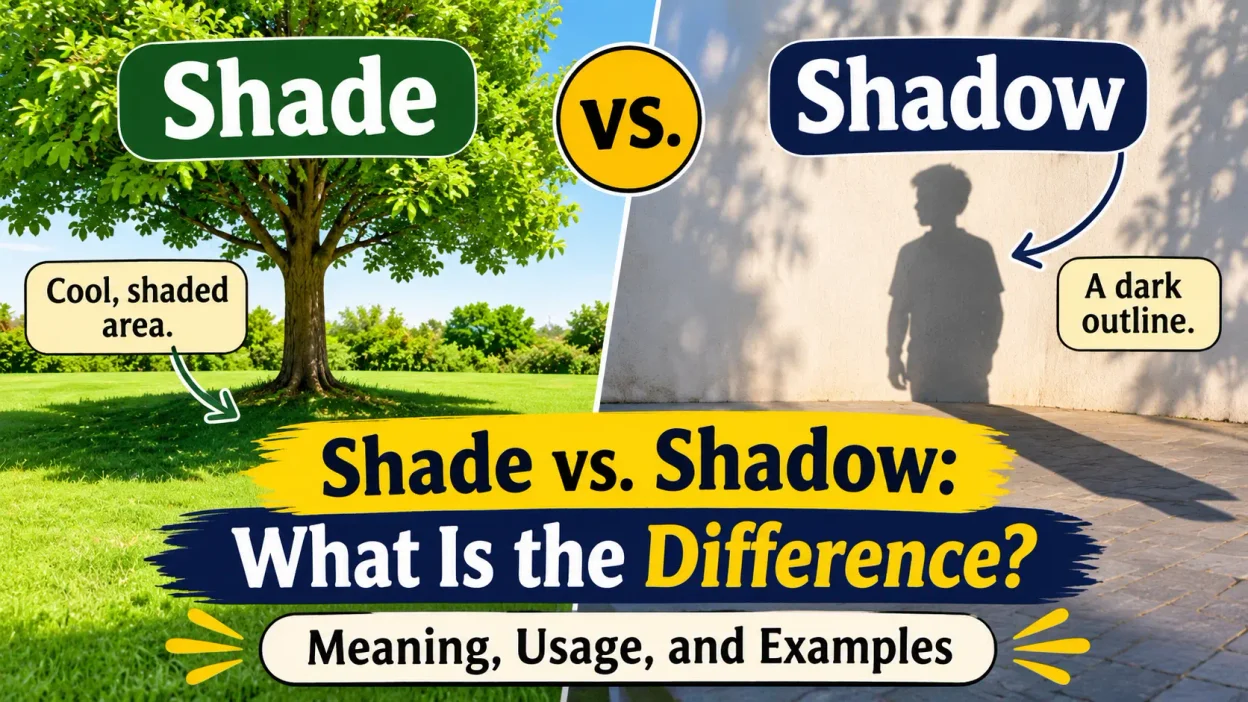
Shade and shadow are two commonly confused English words because both relate to the absence or reduction of direct sunlight. However, they have different meanings and uses. Understanding the difference between shade vs. shadow can help you choose the correct word when describing light, darkness, and everyday situations.
The word shade generally refers to an area protected from direct sunlight or a reduction in brightness. It can also describe a particular variation of a color. In contrast, shadow refers to a dark shape or area created when an object blocks light.
For example, you can sit in the shade of a tree to escape the sun, but the tree casts a shadow on the ground. Although the two words are closely related, they are not interchangeable in every situation.
Shade vs. Shadow: Quick Difference
The main difference between shade and shadow is that shade is an area of reduced sunlight or brightness, while a shadow is a dark shape formed when an object blocks light.
| Word | Meaning | Example |
|---|---|---|
| Shade | An area protected from direct sunlight or a variation of color | We sat in the shade of a large tree. |
| Shadow | A dark shape formed when an object blocks light | My shadow appeared on the wall. |
Easy way to remember:
- Shade = Shelter from sunlight: You look for shade when you want to stay cool.
- Shadow = Shape created by blocked light: An object casts a shadow when it blocks light.
What Does Shade Mean?
The word shade is primarily a noun, although it can also be used as a verb. As a noun, it refers to an area where direct sunlight is blocked or reduced, making the environment cooler or less bright.
Shade can also refer to a particular variation of a color, a slight difference in meaning, or a protective covering that reduces light.
As a verb, shade means to block light, darken an area, or add shading to an image or drawing.
Examples of Shade in Sentences
- We sat under a tree to enjoy the cool shade.
- The children played in the shade during the afternoon.
- I prefer a lighter shade of blue for my bedroom.
- She used a pencil to shade the drawing.
- The curtains shade the room from bright sunlight.
- The garden provides plenty of shade during summer.
Different Meanings of Shade
The word shade has several meanings depending on the context.
1. Protection from sunlight: An area where direct sunlight is blocked.
Example: We moved into the shade to escape the heat.
2. Variation of color: A particular version or degree of a color.
Example: She chose a beautiful shade of green for the walls.
3. Slight difference: A small distinction in meaning, feeling, or quality.
Example: There is a shade of sadness in his voice.
4. Window covering: A covering used to reduce or block light.
Example: She lowered the window shade before going to sleep.
5. Subtle criticism or insult: In informal language, shade can refer to an indirect or disrespectful remark.
Example: He threw shade at his colleague during the meeting.
Common Phrases With Shade
- In the shade: In an area protected from direct sunlight.
- A shade of color: A particular variation of a color.
- Throw shade: To criticize or insult someone indirectly.
- Shade of meaning: A subtle difference in meaning.
- Window shade: A covering used to control incoming light.
- Shade tree: A tree that provides protection from sunlight.
- Fifty shades of: An informal expression suggesting many variations or differences.
What Does Shadow Mean?
The word shadow is mainly a noun, although it can also function as a verb. As a noun, it refers to a dark area or shape created when an object blocks light from reaching a surface.
Shadows can appear on walls, floors, roads, buildings, and other surfaces. Their size, shape, and direction depend on the position of the light source and the object blocking it.
As a verb, shadow can mean to cast a shadow over something, follow someone closely, or observe a person to learn how they perform a task.
Examples of Shadow in Sentences
- The tree cast a long shadow across the garden.
- My shadow followed me along the sidewalk.
- The clouds created shadows over the mountains.
- The building’s shadow covered the parking area.
- A detective shadowed the suspect for several hours.
- She noticed a strange shadow moving across the wall.
Different Meanings of Shadow
The word shadow can be used in both literal and figurative ways.
1. Dark shape created by blocked light: The visible dark area formed when an object interrupts light.
Example: The lamp created a shadow on the ceiling.
2. Darkness or gloom: A condition that suggests sadness, uncertainty, or fear.
Example: A shadow of sadness appeared on her face.
3. Something that follows or accompanies another thing: A person or object that remains close to someone or something.
Example: The little dog followed its owner like a shadow.
4. A hidden or less visible aspect: Something that remains unnoticed or concealed.
Example: The investigation revealed a shadow of doubt surrounding the decision.
5. Following someone professionally: Observing a person at work to learn about their responsibilities.
Example: The student will shadow a doctor during the hospital placement.
Common Phrases With Shadow
- Cast a shadow: To create a dark shape by blocking light.
- Under someone’s shadow: To be overshadowed by another person’s achievements or influence.
- Shadow of doubt: A small amount of uncertainty.
- Like a shadow: Following someone closely.
- Shadow boxing: Practicing boxing movements without an opponent.
- Shadow cabinet: A group of opposition politicians who monitor government departments.
- A shadow of one’s former self: Someone who has become much weaker or less successful than before.
Shade vs. Shadow: Key Differences Explained
Although shade and shadow are related to light and darkness, their meanings are different.
| Feature | Shade | Shadow |
|---|---|---|
| Main meaning | An area protected from direct light | A dark shape caused by blocked light |
| Common association | Coolness and reduced brightness | Darkness and obstruction |
| Appearance | Often covers a broader area | Usually follows the shape of an object |
| Color meaning | A variation of a color | Not commonly used to describe color variations |
| As a verb | To block light or add tonal effects | To cast a shadow or follow someone |
| Example | We rested in the shade. | The tree cast a shadow. |
The simplest distinction is that shade describes an area with reduced direct sunlight, while shadow describes the dark shape produced when an object blocks light.
How Are Shade and Shadow Formed?
Shade and shadow are connected because both involve the blocking or reduction of light. However, they describe different aspects of this process.
How Shade Is Formed
Shade occurs when an object, structure, or covering blocks direct sunlight or reduces the amount of light reaching an area.
For example, a tree provides shade beneath its branches. A roof creates shade over a porch, while curtains can shade a room from bright sunlight.
Shade is especially useful outdoors because it can reduce direct solar exposure and make an area more comfortable.
How a Shadow Is Formed
A shadow forms when an object blocks light from reaching a surface.
For example, when sunlight hits a tree, the tree blocks some of the light. A dark outline or area appears on the ground behind it.
The appearance of a shadow depends on several factors:
- The position of the light source.
- The size and shape of the object.
- The distance between the object and the surface.
- The direction and intensity of the light.
A shadow may change throughout the day as the position of the sun changes.
Shade vs. Shadow: Examples in Everyday Life
Understanding how these words appear in everyday situations makes their differences easier to remember.
| Situation | Correct Word | Example |
|---|---|---|
| Sitting beneath a tree | Shade | We enjoyed lunch in the shade. |
| A tree’s dark outline on the ground | Shadow | The tree cast a shadow on the grass. |
| Choosing a color for a wall | Shade | I like this shade of yellow. |
| A person blocking sunlight | Shadow | His shadow appeared on the pavement. |
| Covering a window from sunlight | Shade | She pulled down the window shade. |
| A building’s dark outline | Shadow | The building’s shadow stretched across the road. |
| Protecting plants from strong sunlight | Shade | These flowers grow well in partial shade. |
Shade vs. Shadow in Art and Photography
Shade and shadow are important concepts in drawing, painting, and photography because they help create depth, contrast, and realistic images.
Shade in Art
In art, shade refers to darker tones created by reducing the brightness of a color or adding black to it. Artists use different shades to show depth, texture, and variation.
For example, an artist may use several shades of green to create a realistic image of leaves.
Shadow in Art
A shadow is the dark area created when an object blocks light. Artists use shadows to show the position of objects, the direction of light, and the three-dimensional appearance of a scene.
For example, a painter may add a shadow beneath a chair to make it appear grounded rather than floating.
Shade and Shadow in Photography
Photographers use shade to control harsh sunlight and create softer lighting conditions. They also use shadows to add contrast, depth, atmosphere, and visual interest.
Although both are useful artistic tools, shade generally describes the lighting environment or tonal variation, while shadow describes the dark area formed by blocked light.
Shade vs. Shadow: Symbolic Meanings
Beyond their literal meanings, shade and shadow also have symbolic associations in literature, art, and everyday expression.
Shade symbolism may represent:
- Protection and comfort.
- Rest and relaxation.
- Privacy and shelter.
- Subtle differences and hidden meanings.
- Relief from difficult conditions.
Shadow symbolism may represent:
- Mystery and secrecy.
- Fear and uncertainty.
- Hidden emotions.
- The unknown or unconscious mind.
- Sadness, loss, or difficult experiences.
These meanings are not fixed. Writers and artists use both words in different ways depending on the message they want to communicate.
Common Mistakes When Using Shade and Shadow
Because these words are closely related, they are sometimes used incorrectly. The following examples show common mistakes and their corrections.
| Incorrect Sentence | Correct Sentence |
|---|---|
| We sat in the shadow of the tree to stay cool. | We sat in the shade of the tree to stay cool. |
| The tree provided a cool shadow. | The tree provided cool shade. |
| I like this shadow of blue. | I like this shade of blue. |
| The sun created a shade on the wall. | The sun created a shadow on the wall. |
| The building’s shade stretched across the road. | The building’s shadow stretched across the road. |
| She lowered the window shadow. | She lowered the window shade. |
Some expressions can use either word in particular contexts, but the meaning may change. For example, sitting in the shade emphasizes protection from sunlight, while standing in someone’s shadow suggests being overshadowed by that person’s influence or achievements.
Shade vs. Shadow: Easy Memory Tricks
If you sometimes confuse shade and shadow, these simple memory tips can help.
1. Remember Shade and Shelter
Shade provides shelter from direct sunlight.
Example: We rested in the shade of a tree.
2. Remember Shadow and Shape
A shadow is a dark shape created when an object blocks light.
Example: The dog cast a shadow on the ground.
3. Think About Color
When discussing a variation of a color, use shade.
Example: This shade of red looks beautiful.
4. Think About Light and Objects
When describing the dark outline created by an object blocking light, use shadow.
Example: The lamp created a shadow on the wall.
Shade vs. Shadow: Practice Quiz
Test your understanding by choosing the correct word in each sentence.
1. We sat in the _____ of a large tree to escape the heat.
- A. Shade
- B. Shadow
2. The building cast a long _____ across the street.
- A. Shade
- B. Shadow
3. She prefers a lighter _____ of pink.
- A. Shade
- B. Shadow
4. My _____ appeared on the wall when I stood near the lamp.
- A. Shade
- B. Shadow
5. The curtains provide enough _____ to keep the room cool.
- A. Shade
- B. Shadow
6. The dog followed its owner like a _____.
- A. Shade
- B. Shadow
Answers: 1. Shade, 2. Shadow, 3. Shade, 4. Shadow, 5. Shade, 6. Shadow.
Frequently Asked Questions About Shade vs. Shadow
1. What is the main difference between shade and shadow?
Shade refers to an area protected from direct sunlight or a reduction in brightness. Shadow refers to a dark shape created when an object blocks light from reaching a surface.
2. Is shade the same as shadow?
No. Although both are related to blocked light, they have different meanings. Shade generally describes an area with reduced direct sunlight, while shadow describes the dark shape formed by an object blocking light.
3. Do trees provide shade or shadow?
Trees can provide both. The area beneath their branches is called shade, while the dark shape created by their branches on the ground is called a shadow.
4. Do you sit in the shade or in the shadow?
The natural expression is sit in the shade when referring to a place protected from direct sunlight. However, you may also use “in the shadow of a building” when describing its physical shadow.
5. What does shade mean in colors?
In color terminology, shade refers to a particular variation of a color. For example, dark blue, navy blue, and midnight blue are different shades of blue.
6. What does shadow mean in photography?
In photography, a shadow is a dark area created when an object blocks light. Photographers use shadows to add contrast, depth, shape, and atmosphere to an image.
7. Can shade be used as a verb?
Yes. Shade can mean to block direct light or make something darker. For example, “The trees shade the garden” or “She shaded the drawing with a pencil.”
8. Can shadow be used as a verb?
Yes. Shadow can mean to cast a shadow over something or follow someone closely. For example, “The clouds shadowed the mountains” or “The student shadowed a doctor.”
9. What does “throw shade” mean?
“Throw shade” is an informal expression meaning to criticize, insult, or disrespect someone indirectly, often through sarcastic comments.
10. What does “under someone’s shadow” mean?
Being under someone’s shadow means being overshadowed by another person’s reputation, achievements, influence, or success. It often suggests that someone struggles to receive recognition because another person is more prominent.
Conclusion: Shade vs. Shadow
Understanding the difference between shade and shadow becomes easy when you remember their connection with light. Shade refers to an area protected from direct sunlight or a particular variation of a color, while shadow describes the dark shape created when an object blocks light.
You use shade when talking about sitting beneath a tree, protecting a room from sunlight, or choosing a color. You use shadow when describing the dark outline of a person, tree, or building.
Remember this simple rule: Shade provides shelter from sunlight, while a shadow is the shape created by blocked light. Knowing this distinction will help you use both words correctly in everyday conversations, writing, art, and photography.