
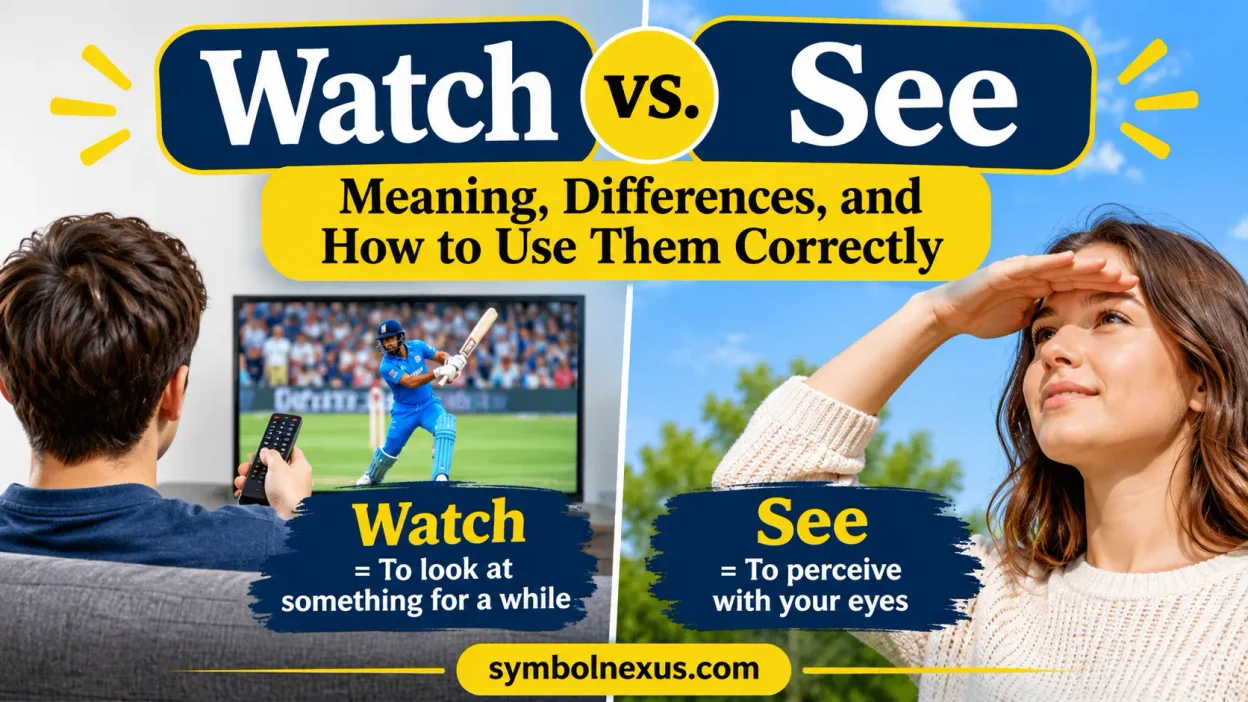
The words watch and see are closely related because both involve the sense of sight. However, they are not interchangeable in every situation. The main difference is that see usually means to notice or become aware of something with your eyes, while watch means to look at something carefully over a period of time.
For example, you might see a bird flying across the sky without trying, but you watch the bird as it flies from one tree to another.
Understanding the difference between watch and see can help you communicate more clearly, avoid common grammar mistakes, and choose the correct word in everyday conversations.
Quick Answer: What Is the Difference Between Watch and See?
The main difference between watch and see is the level of attention and intention involved.
- See means to notice something using your eyes, often without making a deliberate effort.
- Watch means to look at something attentively, usually because it is moving, changing, or continuing over time.
Examples:
- I can see the mountains from my window.
- We will watch the football match tonight.
- Did you see that shooting star?
- She likes to watch birds in the garden.
In simple terms, you generally see something when it enters your vision, but you watch something when you pay attention to it.
1. What Does “See” Mean?
The verb see means to notice, recognize, or become aware of something through your eyes. It often describes natural or unintentional vision, although it can also refer to deliberately looking at or meeting someone.
Examples:
- I can see the ocean from here.
- Did you see my keys?
- She saw a beautiful rainbow yesterday.
- I cannot see anything in the dark.
- We saw an interesting painting at the museum.
In these examples, the emphasis is on noticing or visually experiencing something rather than continuously observing it.
Common Uses of See
1. Noticing something visually
- I see a cat outside.
- Can you see the sign?
2. Recognizing someone or something
- I saw my old teacher at the supermarket.
- Do you see the difference between these pictures?
3. Meeting someone
- I am going to see my doctor tomorrow.
- She sees her grandparents every weekend.
4. Understanding something
In informal English, see can also mean to understand.
- I see what you mean.
- Now I see why you were upset.
2. What Does “Watch” Mean?
The verb watch means to look at something carefully and pay attention to its movement, activity, or development over a period of time.
Unlike see, watching usually involves deliberate attention.
Examples:
- I watch television every evening.
- The children watched the birds playing.
- We watched the sun set over the ocean.
- He watched the football game with his friends.
- She watched the baby while her mother was cooking.
The word watch is especially common when talking about entertainment, sports, people, animals, and activities that continue for some time.
Common Uses of Watch
1. Watching entertainment
- We watched a movie last night.
- He watches television after work.
2. Observing movement
- I watched the dog running across the field.
- They watched the train leave the station.
3. Paying attention to an activity
- The teacher watched the students during the test.
- She watched him carefully.
4. Monitoring something
- Watch the temperature while the food is cooking.
- The doctor watched the patient’s condition.
3. Watch vs. See: Key Differences
Although both verbs relate to vision, they communicate different kinds of attention.
| Feature | See | Watch |
|---|---|---|
| Basic meaning | Notice with your eyes | Look at attentively |
| Attention | Often unintentional | Usually intentional |
| Duration | Can be brief or immediate | Usually continues over time |
| Movement | Not necessary | Often involves movement or change |
| Common examples | See a bird, see a sign | Watch a bird, watch a match |
| Focus | Visual awareness | Active observation |
Remember: Seeing is often passive, while watching is generally active.
4. When Should You Use “See”?
Use see when you want to describe noticing something, recognizing something visually, or experiencing something through your sight.
A. When Something Appears in Your Vision
Use see when you notice something without necessarily looking for it.
- I saw a butterfly near the window.
- She saw a strange light in the sky.
- We saw a deer while driving home.
B. When Asking Whether Someone Notices Something
- Can you see that building?
- Do you see the problem?
- Did you see the message on the board?
C. When Talking About Movies or Performances as Experiences
English speakers commonly use see when referring to attending a film, play, or performance.
- We saw a movie last weekend.
- I want to see that new play.
- Have you seen the latest documentary?
Here, see refers to the experience of viewing or attending something, not necessarily the act of observing every moment.
D. When Talking About Understanding
- I see your point.
- Now I see what happened.
- I see why this decision is important.
5. When Should You Use “Watch”?
Use watch when you intentionally observe something, especially when it involves movement, activity, or change.
A. When Observing Something Moving
- We watched the birds flying overhead.
- He watched the car disappear around the corner.
- The children watched the butterflies.
B. When Watching Sports
- They watched the cricket match together.
- I watch football every weekend.
- We watched our team win the final.
C. When Viewing Television and Online Videos
- She watches YouTube videos in her free time.
- I watched a documentary about wildlife.
- They watch television after dinner.
D. When Monitoring Someone or Something
- Watch the children while they play.
- The security guard watched the entrance.
- Please watch the food so it does not burn.
6. Watch vs. See in Everyday Sentences
The difference becomes clearer when both words are used in similar situations.
| Situation | Correct sentence | Explanation |
|---|---|---|
| A bird in the garden | I saw a bird in the garden. | You noticed it. |
| Observing the bird | I watched the bird building its nest. | You paid attention over time. |
| A football match | We watched the match. | You followed the action. |
| Attending a film | We saw a movie yesterday. | You experienced the movie. |
| A shooting star | I saw a shooting star. | You noticed it briefly. |
| A sunset | We watched the sunset. | You observed it as it happened. |
| A person at the store | I saw my friend at the store. | You noticed your friend. |
| Someone working | I watched him repair the car. | You observed the activity. |
7. Can You Use “Watch” and “See” in the Same Sentence?
Yes. Both words can appear in one sentence when they describe different aspects of an experience.
Examples:
- I saw a man watching the birds.
- We saw the children watching television.
- She watched the movie and saw several familiar actors.
- I saw him watching the football match.
- They watched the sunset and saw the sky change colors.
In these sentences, see describes noticing someone or something, while watch describes the activity of observing.
8. Watch vs. See: Differences in Grammar
Both watch and see are verbs, but their grammatical patterns can differ.
A. Watch + Object
The verb watch commonly takes a direct object.
- I watch television.
- She watched the children.
- They are watching a movie.
B. See + Object
The verb see also takes a direct object.
- I see a bird.
- She saw her friend.
- We are seeing the results.
C. Watch + Object + -ing Verb
Use this structure when describing someone observing an activity in progress.
- I watched him running.
- She watched the children playing.
- We watched the dog sleeping.
D. See + Object + Base Verb or -ing Verb
The verb see can also describe witnessing an action.
- I saw him cross the road.
- I saw him crossing the road.
The first sentence presents the action as a complete event. The second emphasizes that you witnessed the action while it was happening.
E. Watch Out vs. See
These expressions have different meanings:
- Watch out! means be careful or pay attention to possible danger.
- See usually means notice, understand, or visually recognize something.
Example:
- Watch out! There is a car coming.
- I can see the car coming.
9. Watch vs. See in Different Contexts
The correct choice often depends on what you want to communicate.
Movies and Television
Both words are possible, but they emphasize different things.
- I watched a movie last night. (Focus on the activity of viewing.)
- I saw a movie last night. (Focus on the experience of viewing or attending it.)
Sports
Watch is usually more natural when describing following a game.
- We watched the cricket match.
- Did you watch the final?
Nature
Use see for noticing and watch for observing.
- I saw an eagle in the sky.
- I watched the eagle flying over the mountains.
People
Use see when you notice or meet someone. Use watch when you observe their actions.
- I saw my neighbor yesterday.
- I watched my neighbor painting his house.
10. Common Mistakes When Using Watch and See
English learners sometimes confuse these words because both involve eyesight. Here are common mistakes and their corrections.
Mistake 1: Using “watch” when you mean simply noticing something
Incorrect: I watched a bird outside my window for a second.
More natural: I saw a bird outside my window.
Why? See is generally more appropriate when you simply notice something briefly.
Mistake 2: Using “see” when describing deliberate observation
Less natural: I saw the children playing in the park for an hour.
More natural: I watched the children playing in the park for an hour.
Why? Watch better communicates continuous attention.
Mistake 3: Confusing “watch a movie” and “see a movie”
Both are correct:
- We watched a movie at home.
- We saw a movie at the cinema.
The difference is mainly emphasis and context, not grammatical correctness.
Mistake 4: Forgetting the correct verb form
Incorrect: I am watch television.
Correct: I am watching television.
Incorrect: She see a bird yesterday.
Correct: She saw a bird yesterday.
Mistake 5: Using “watch” for understanding
Incorrect: I watch what you mean.
Correct: I see what you mean.
Why? See can mean understand, but watch does not have this meaning.
11. Watch vs. See vs. Look: What Is the Difference?
Another common source of confusion is the word look. All three verbs relate to vision, but their meanings are different.
| Word | Meaning | Example |
|---|---|---|
| See | Notice something with your eyes | I see a plane. |
| Watch | Observe something carefully over time | I watch the plane taking off. |
| Look | Direct your eyes toward something | Look at that plane! |
See
You notice something visually, sometimes without intending to.
Example: I can see the moon.
Watch
You pay attention to something as it moves or changes.
Example: I watched the moon rise.
Look
You intentionally direct your eyes toward something.
Example: Look at the moon!
Easy way to remember:
- See = notice.
- Watch = observe.
- Look = direct your eyes.
12. Watch vs. See: Synonyms and Related Words
Understanding related vocabulary can help you use these verbs more naturally.
| Word | Meaning | Example |
|---|---|---|
| Observe | Notice or study carefully | We observed the birds. |
| Notice | Become aware of something | I noticed a small detail. |
| View | Look at or examine something | We viewed the exhibition. |
| Glance | Look briefly | She glanced at the clock. |
| Stare | Look for a long time, often fixedly | He stared at the painting. |
| Gaze | Look steadily, often with admiration | They gazed at the stars. |
| Witness | See an event happen | She witnessed the accident. |
These words are related to seeing and watching, but each has its own meaning and appropriate context.
13. Simple Tips to Remember the Difference
If you struggle to choose between watch and see, remember these practical tips:
- Use see when something catches your attention naturally.
- Use watch when you deliberately observe an activity.
- Use see when talking about understanding something.
- Use watch when following sports, videos, or moving objects.
- Use see when talking about meeting someone.
- Use either word for movies, depending on the context and intended emphasis.
The most important distinction is that see describes visual awareness, while watch describes attentive observation.
14. Frequently Asked Questions (FAQs)
1. What is the main difference between watch and see?
See means to notice something with your eyes, while watch means to observe something carefully over time. For example, you see a bird in a tree but watch it building a nest.
2. Is it correct to say “watch a movie” or “see a movie”?
Both expressions are correct. Watch a movie emphasizes the activity of viewing it, while see a movie often emphasizes the experience of viewing or attending it.
3. Do you watch or see television?
The natural expression is watch television. For example: “I watch television every evening.”
4. Should I say “I saw a bird” or “I watched a bird”?
Both can be correct, depending on the situation. Say “I saw a bird” when you noticed it. Say “I watched a bird” when you observed it for some time.
5. Can see mean understand?
Yes. In informal English, see can mean understand or recognize an idea.
Example: “I see what you mean.”
6. Why do we say “watch out” instead of “see out”?
Watch out is an established expression meaning to be careful or alert to danger. “See out” does not have the same meaning.
7. What is the difference between watch, see, and look?
See means notice something, watch means observe it attentively, and look means direct your eyes toward it.
8. Is “I watched him cross the road” correct?
Yes. It means you observed him completing the action of crossing the road. You can also say “I watched him crossing the road” to emphasize the action in progress.
9. Can I say “I saw him watching me”?
Yes. This sentence is grammatically correct. It means you noticed that another person was looking at you attentively.
10. Which word should English learners use for sports?
Use watch when talking about following a sporting event.
Example: “We watched the cricket match yesterday.”
Conclusion
The difference between watch and see is mainly about attention and intention. See means to notice or become aware of something through your eyes, while watch means to observe something carefully, usually as it moves, develops, or continues over time.
For example, you might see a bird flying past your window, but you watch it as it builds a nest. Both words are essential in everyday English, and understanding their differences will help you speak and write more naturally.
Remember this simple rule: You see what enters your vision, but you watch what you pay attention to.



[…] means feeling concern, sorrow, or compassion for someone who is experiencing hardship. Empathy means understanding or sharing another person’s feelings by trying to see a situation from their […]