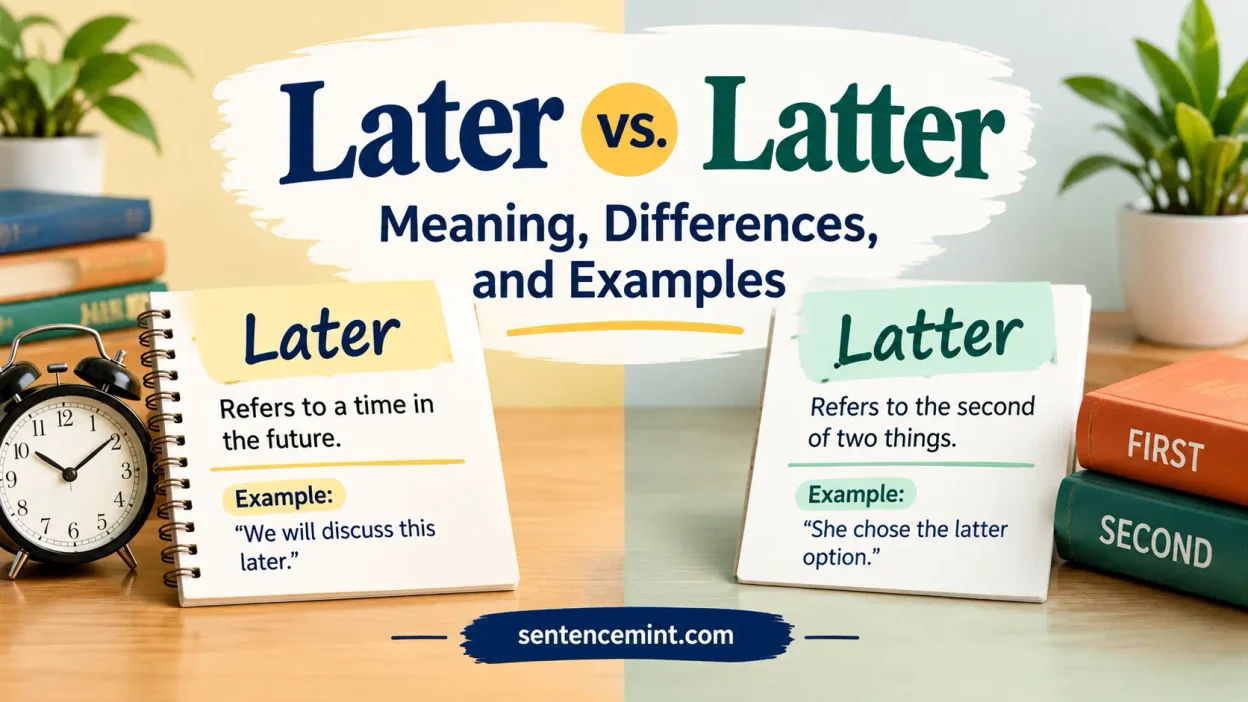
Featured Image Prompt: Create a premium 800×450 HD educational grammar blog image titled “Later vs. Latter: What’s the Difference?” Show two clean, contrasting panels: one representing a clock and a future timeline for “LATER,” and the other showing two choices with the second option highlighted for “LATTER.” Use a modern editorial layout, readable centered title, strong contrast, balanced spacing, and a polished American English learning website aesthetic. Ensure all text is correctly spelled, fully visible, and free from watermarks or clutter.
Image Alt Text: Later vs latter grammar comparison showing time and the second of two choices
Later vs. Latter: What’s the Difference?
Quick Answer: Later means “at a time after now or another point in time.” Latter usually refers to the second of two people or things mentioned, or to the later part of a period. For example, “I’ll call you later” refers to a future time, while “I prefer tea to coffee; the latter is less expensive” refers to coffee, the second option mentioned.
The difference between later vs. latter can be confusing because the words look similar and both relate to the idea of something coming after something else. However, they serve different purposes in English.
Use later when talking about time, a future event, or something that happens afterward. Use latter when identifying the second of two previously mentioned options or describing a period closer to its end.
For example:
- I’ll finish my homework later.
- We can choose between the red shirt and the blue shirt. I prefer the latter.
The first sentence refers to a future time. The second identifies the blue shirt as the second option.
Understanding these meanings will help you avoid common writing mistakes and use both words confidently in everyday American English.
Later vs. Latter: Quick Comparison
| Feature | Later | Latter |
|---|---|---|
| Main meaning | After a particular time | The second of two things mentioned |
| Time reference | Future or afterward | Nearer to the end of a period |
| Part of speech | Adverb or adjective | Adjective or pronoun-like noun use |
| Example | I’ll see you later. | I chose the latter option. |
| Common phrase | Later today | The latter half |
| Opposite or comparison | Earlier | Former, when referring to the first of two options |
The simplest rule is to remember that later is about when, while latter is about which one.
What Does Later Mean?
Later refers to a time after the present moment or after another event. It can function as an adverb or an adjective.
As an adverb, it describes when something happens. As an adjective, it describes something scheduled for a future time or occurring after something else.
Later as an Adverb
Examples:
- I’ll call you later.
- She arrived later than expected.
- We learned the truth several years later.
- He later became a successful writer.
- Let’s discuss the problem later.
In these sentences, later tells us when something happens. It may refer to a future time or a point after an event already mentioned.
Later as an Adjective
Examples:
- We booked a later flight.
- The details will appear in a later chapter.
- You can submit the form at a later date.
- The later version of the software includes additional features.
Here, later describes a flight, chapter, date, or version that comes after another one.
Later in Everyday Conversation
People frequently use later when making plans or saying goodbye.
Examples:
- See you later!
- I’ll finish the report later today.
- Can we talk about this later?
- Let’s meet later this afternoon.
In informal American English, “See you later” is a common way to say goodbye. It usually means that the speaker expects to see the other person again, although it does not always specify exactly when.
What Does Latter Mean?
Latter has two main uses. It can refer to the second of two people or things already mentioned, or to the later part of a period.
It is more common in formal, academic, and professional writing than in casual conversation.
Latter as the Second of Two Options
Use latter to identify the second of two items mentioned in a sentence or passage.
Examples:
- I can travel by train or bus. I prefer the latter.
- She offered me a laptop or a tablet, and I chose the latter.
- The company considered two plans. The latter was more affordable.
- We discussed grammar and vocabulary, but the latter received more attention.
In the first example, train is the first option and bus is the second. Therefore, the latter means the bus.
This meaning is closely connected to the word former, which refers to the first of two things mentioned.
Latter as the Later Part of a Period
The word latter can also describe a period closer to its end.
Examples:
- The latter half of the movie was more exciting.
- She became more confident in the latter years of her career.
- The project faced several challenges in its latter stages.
- The latter part of the year was unusually busy.
In these examples, latter does not identify the second of two choices. Instead, it describes the part of a period that comes closer to the end.
Former vs. Latter: Understanding the Pair
To understand latter, it helps to learn its common counterpart: former.
When you mention two people, things, or options, former refers to the first one, and latter refers to the second one.
Consider this example:
“Anna and Maria applied for the position. The former had more experience, while the latter had stronger technical skills.”
Here:
- Former: Anna, the first person mentioned.
- Latter: Maria, the second person mentioned.
Another example:
“I enjoy both swimming and cycling, but the former is easier on my schedule.”
In this sentence, the former means swimming because it appears first.
The distinction is useful in formal writing, but you should make sure the two options are easy to identify. If a paragraph mentions several people or items, repeating the names may be clearer than using former and latter.
When Should You Use Later?
Use later whenever you mean that something happens after a particular time, event, or stage.
1. When Referring to the Future
Examples:
- I’ll send you the file later.
- We can discuss the budget later this week.
- She plans to visit her family later this year.
Each sentence refers to a time that has not yet arrived.
2. When Comparing Two Times
Examples:
- The second train arrives later than the first.
- He finished the assignment later than his classmates.
- The meeting started later than scheduled.
Here, later compares the timing of two events.
3. When Describing a Subsequent Event
Examples:
- The researchers published their findings two years later.
- She moved to Chicago and later opened her own business.
- We discovered the mistake much later.
These sentences describe events that occurred after an earlier event.
4. When Describing Something More Recent or Subsequent
Examples:
- Later editions included additional information.
- The later chapters explain the main character’s decision.
- A later announcement clarified the new policy.
In these examples, later identifies something that came after an earlier version, chapter, or announcement.
When Should You Use Latter?
Use latter when you need to identify the second of two previously mentioned things or describe the later part of a period.
1. When Choosing Between Two Options
Examples:
- We can eat at home or order takeout. I prefer the latter.
- He could accept the promotion or remain in his current role. He chose the latter.
- The store sells cotton and polyester shirts. The latter costs less.
In each example, the latter refers to the second option.
2. When Discussing Two People or Ideas
Examples:
- The teacher compared two approaches, and the latter seemed more effective.
- The first speaker discussed history, while the latter focused on technology.
- Both arguments were reasonable, but the latter was easier to support with evidence.
The word helps avoid repeating a name or phrase, provided the reference is clear.
3. When Referring to the End of a Period
Examples:
- The latter half of the semester was more demanding.
- He traveled extensively during the latter years of his life.
- The business expanded rapidly in the latter part of the decade.
Here, latter describes a later section of time.
Later vs. Latter in Example Sentences
The following examples show how the words work in context.
| Sentence | Correct word | Why? |
|---|---|---|
| I’ll complete the assignment _____. | Later | It refers to a future time. |
| She chose the _____ of the two proposals. | Latter | It identifies the second proposal. |
| We met again three years _____. | Later | It means after three years. |
| The _____ half of the book was more interesting. | Latter | It describes the later part of a period or sequence. |
| I’ll call you _____ this evening. | Later | It refers to a future time. |
| He compared two methods and preferred the _____. | Latter | It identifies the second method. |
| The company released a _____ version of its app. | Later | It describes a subsequent version. |
| The _____ stages of the competition were difficult. | Latter | It describes stages nearer to the end. |
These examples demonstrate why the words cannot usually replace each other. Their meanings overlap only in the broad idea of something coming afterward.
Common Mistakes With Later and Latter
Because the words look and sound similar, writers sometimes confuse them. Here are common mistakes and their corrections.
| Incorrect sentence | Correct sentence | Explanation |
|---|---|---|
| I’ll finish it latter. | I’ll finish it later. | The sentence refers to a future time. |
| I prefer the later of the two options. | I prefer the latter of the two options. | Latter identifies the second option. |
| The latter version was released next year. | The later version was released next year. | Later describes a subsequent version. |
| We enjoyed the later half of the movie. | We enjoyed the latter half of the movie. | Latter half refers to the part nearer the end. |
| I’ll see you latter. | I’ll see you later. | The expression refers to a future meeting. |
Some expressions involving later and latter may be grammatically possible in different contexts, but the examples above show the most natural choices for their intended meanings.
Is It “The Later” or “The Latter”?
Both expressions can be correct, but they mean different things.
Use the latter to refer to the second of two options or to something previously mentioned.
Example: “We considered a hotel and a rental home. The latter was cheaper.”
Use the later when an adjective is needed to identify something occurring at a more advanced time than another event or option.
Example: “The later appointment works better for me.”
In the first sentence, the latter means the rental home. In the second, the later appointment means the appointment scheduled for a later time.
Is Latter the Same as Last?
No. Latter generally refers to the second of two things mentioned or to the later part of a period. Last usually identifies the final item in a sequence.
For example:
- “Between tea and coffee, I prefer the latter.” Here, latter means coffee.
- “Of the five options, I prefer the last.” Here, last means the fifth and final option.
Although people sometimes use latter loosely to refer to the final item in a longer list, the clearest standard usage is to reserve it for the second of two items. If you are referring to the final item in a list of three or more, use last or name the item directly.
How to Remember the Difference Between Later and Latter
Use these simple memory tips:
- Later = time: Think of “See you later.”
- Latter = second: Think of the second option in a pair.
- Later today: Something will happen in the future.
- The latter option: The second option mentioned.
- The latter half: The part closer to the end of a period.
A useful question to ask is: “Am I talking about when something happens, or which of two things I mean?”
If you are talking about when, choose later. If you are identifying the second of two things, choose latter.
Practice Quiz: Later or Latter?
Choose the correct word to complete each sentence.
- I’ll send you the details _____.
- We can travel by car or train. I prefer the _____.
- The _____ chapters explain the main problem.
- She returned home two days _____.
- The _____ part of the meeting focused on questions.
- He compared two proposals and selected the _____.
- Can we talk about this _____?
- The business grew quickly in the _____ years of the decade.
Answers and Explanations
- Later — It refers to a future time.
- Latter — It identifies the second option, train.
- Later — It describes chapters that come after earlier chapters.
- Later — It means after two days.
- Latter — It describes the part nearer to the end of the meeting.
- Latter — It refers to the second proposal.
- Later — It refers to a future conversation.
- Latter — It describes the later part of the decade.
Frequently Asked Questions
What is the main difference between later and latter?
Later refers to a time after now or another event. Latter usually refers to the second of two things mentioned or the later part of a period.
Is later or latter correct?
Both words are correct English words. The right choice depends on your meaning. Use later for time and latter for the second of two options or the later part of a period.
Can I use later and latter interchangeably?
No. They have different meanings in standard usage. For example, “I’ll call you later” is correct when talking about a future call, while “I chose the latter” is correct when selecting the second of two options.
What is the difference between former and latter?
Former refers to the first of two people or things mentioned, while latter refers to the second. For example, “I like apples and oranges, but the former are easier to pack” means apples.
Does latter mean the end?
Not exactly. Latter can describe the part of a period closer to its end, as in “the latter half of the year.” It can also identify the second of two things previously mentioned.
Is “latter half” correct?
Yes. “The latter half” is a standard expression for the second or later part of a period, such as the latter half of a movie, year, or century.
How do I remember later vs. latter?
Remember that later is about time, as in “I’ll do it later.” Latter points to the second of two things, as in “I prefer the latter.”
Conclusion
The difference between later vs. latter is simple once you focus on their meanings. Later refers to a future time, a subsequent event, or something that comes afterward. Latter identifies the second of two things mentioned or describes the later part of a period.
Use “I’ll call you later” when talking about a future action. Use “I chose the latter” when referring to the second of two options. These two examples capture the main distinction and can help you choose the correct word in everyday conversation, school assignments, and professional writing.
When in doubt, remember this rule: later is about time; latter is about the second of two things.