The words stationary and stationery are commonly confused in English because they sound exactly alike but have completely different meanings. Although they differ by only one letter, using the wrong spelling can change the meaning of a sentence.
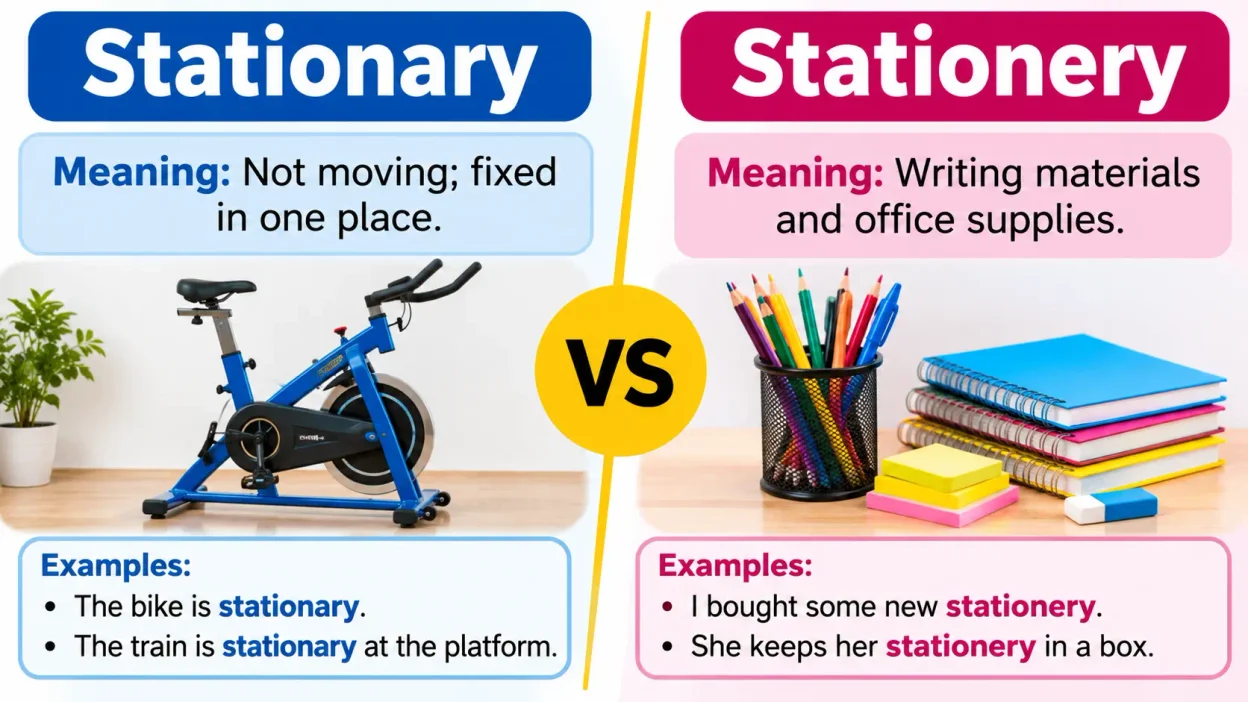
The easiest way to remember the difference is that stationary means not moving or staying in one place, while stationery refers to writing materials and office supplies such as paper, envelopes, pens, notebooks, and greeting cards.
For example, a stationary car is a car that is not moving, while stationery is something you use to write a letter.
Understanding stationary vs. stationery is important for students, writers, office workers, and anyone who wants to improve their English spelling and grammar. In this guide, you will learn their meanings, grammatical uses, examples, common mistakes, and simple tricks to remember which word to use.
Stationary vs. Stationery: Quick Difference
The main difference between stationary and stationery is their meaning and part of speech.
| Word | Part of Speech | Meaning | Example |
|---|---|---|---|
| Stationary | Adjective | Not moving; remaining in one place | The car remained stationary. |
| Stationery | Noun | Writing materials and office supplies | I bought new stationery for school. |
Stationary describes something that is still or not moving. Stationery names items used for writing, printing, and office communication.
What Does Stationary Mean?
The word stationary is an adjective that means fixed in one position, not moving, or remaining in the same place.
It describes people, objects, vehicles, or situations that are not changing their physical position.
1. Stationary Means Not Moving
The most common meaning of stationary is something that is not moving.
It is often used to describe vehicles, machines, people, and objects that remain still.
Examples:
- The car remained stationary at the traffic signal.
- The train was stationary for several minutes.
- The guard stood stationary near the entrance.
- The bicycle was stationary against the wall.
- The aircraft remained stationary on the runway.
In these examples, stationary indicates that something is not moving.
2. Stationary Means Fixed in One Position
Stationary can also describe something that stays in a particular location rather than moving from place to place.
Examples:
- The stationary camera recorded the entire event.
- The equipment must remain stationary during the experiment.
- A stationary desk cannot be moved easily.
- The machine has a stationary base.
This meaning is common in technical, scientific, and everyday contexts.
3. Stationary in Science and Mathematics
The word stationary is also used in scientific and mathematical contexts.
In physics, a stationary object is one that is at rest relative to a specified reference frame. In mathematics, a stationary point is a point on a function’s graph where the derivative is zero, although it is not necessarily a maximum or minimum.
Examples:
- The scientist observed a stationary object.
- The graph contains a stationary point.
- The experiment requires stationary conditions.
- The object appeared stationary relative to the observer.
These uses all relate to the idea of remaining still or having no change in position.
What Does Stationery Mean?
The word stationery is a noun that refers to writing materials, paper products, and office supplies.
It includes items used for writing letters, taking notes, organizing documents, and completing everyday office or school tasks.
1. Stationery Means Writing Materials
Stationery commonly includes paper, notebooks, envelopes, pens, pencils, and other writing-related supplies.
Examples:
- I bought new stationery for the school year.
- She keeps her stationery in a desk drawer.
- The office ordered stationery for its employees.
- My favorite stationery includes colorful notebooks and pens.
In these sentences, stationery refers to writing and office materials.
2. Stationery Includes Office Supplies
Stationery is also used to describe materials required for everyday office work.
Common stationery items include:
- Notebooks and writing pads.
- Pens and pencils.
- Envelopes and letter paper.
- Sticky notes.
- Paper clips and folders.
- Printer paper.
- Business cards and letterheads.
Examples:
- The company provides stationery to all employees.
- We need to purchase more stationery for the office.
- The stationery cupboard is almost empty.
- She organized the office stationery before the meeting.
3. Personalized and Decorative Stationery
Stationery can also refer to specially designed writing materials used for personal or professional communication.
Examples include personalized letterheads, wedding invitations, greeting cards, thank-you notes, and decorative writing paper.
Examples:
- She ordered personalized stationery for her business.
- The wedding invitations were printed on elegant stationery.
- He sent a handwritten note on beautiful stationery.
- The company uses branded stationery for official letters.
Stationary vs. Stationery: Key Differences
Although these words sound alike, their meanings, grammatical roles, and uses are different.
| Feature | Stationary | Stationery |
|---|---|---|
| Part of speech | Adjective | Noun |
| Meaning | Not moving or staying in one place | Writing materials and office supplies |
| Describes | People, objects, vehicles, or conditions | Paper, pens, notebooks, envelopes, and similar items |
| Related idea | Stillness or position | Writing and communication |
| Example | The bus remained stationary. | She purchased new stationery. |
The key is to remember that stationary describes a condition, while stationery names a collection of materials.
Stationary vs. Stationery Examples in Sentences
The following examples show how both words are used correctly in everyday English.
Examples Using Stationary
- The car remained stationary during the entire inspection.
- The teacher asked the students to keep their desks stationary.
- A stationary bicycle is useful for indoor exercise.
- The camera remained stationary throughout the recording.
- The bus was stationary because of heavy traffic.
- The machine must remain stationary while the technician repairs it.
- The guard stood stationary outside the building.
- The aircraft remained stationary before takeoff.
Examples Using Stationery
- I bought new stationery for my office.
- She keeps her stationery neatly arranged.
- The students brought their stationery to class.
- We ordered personalized stationery for the company.
- The shop sells notebooks, pens, and other stationery.
- My sister loves collecting colorful stationery.
- The teacher asked us to bring basic stationery supplies.
- He wrote the invitation on beautiful stationery.
Common Mistakes When Using Stationary and Stationery
Because stationary and stationery are homophones, people often confuse their spellings.
Here are some common mistakes and their corrections.
| Incorrect Sentence | Correct Sentence |
|---|---|
| I bought new stationary for school. | I bought new stationery for school. |
| The car remained stationery. | The car remained stationary. |
| She keeps her stationary in a drawer. | She keeps her stationery in a drawer. |
| The bus was stationery at the stop. | The bus was stationary at the stop. |
| We need more stationary for the office. | We need more stationery for the office. |
| The bicycle remained stationery. | The bicycle remained stationary. |
Why Do People Confuse These Words?
There are several reasons why stationary and stationery are frequently mixed up:
- Identical pronunciation: Both words sound the same in standard English.
- Similar spelling: They differ by only one letter.
- Related historical origins: Both words are connected to the Latin word stationarius, associated with standing or being in a fixed position.
- Different meanings: Their modern uses are distinct, even though their spellings are similar.
The best way to avoid mistakes is to focus on the meaning of the sentence rather than relying on pronunciation.
Easy Tricks to Remember Stationary vs. Stationery
You can remember the difference between these words using a few simple spelling tricks.
1. Stationary Has an “A” for At Rest
The word stationary contains the letter “a.”
Think of the phrase “at rest.”
A stationary object is at rest because it is not moving.
Stationary = At rest or not moving.
Example: The car remained stationary outside the house.
2. Stationery Has an “E” for Envelope
The word stationery contains the letter “e.”
Think of envelope, which is a common stationery item.
Stationery = Envelopes and writing materials.
Example: I purchased new stationery for writing letters.
3. Remember the Difference Through Meaning
Ask yourself what you are describing:
- If you mean something is not moving, use stationary.
- If you mean paper, pens, notebooks, or office supplies, use stationery.
4. Use a Simple Memory Sentence
Remember this sentence:
“The stationary car stopped outside the stationery shop.”
Here:
- Stationary describes the car because it is not moving.
- Stationery refers to the writing supplies sold in the shop.
This sentence helps you remember both spellings and meanings together.
Stationary vs. Stationery in Different Contexts
Understanding how these words work in different situations can make them easier to use.
In Education
Use stationary to describe something that remains still.
Example:
- The students kept the equipment stationary during the experiment.
Use stationery when referring to school supplies.
Example:
- Students should bring their stationery to class.
In Business and Offices
Use stationary to describe equipment or objects that remain in one position.
Example:
- The stationary camera monitors the office entrance.
Use stationery for office writing materials.
Example:
- The company ordered stationery for its employees.
In Transportation
Stationary is commonly used to describe vehicles that are not moving.
Examples:
- The train remained stationary for ten minutes.
- The car was stationary at the red light.
Stationery is generally unrelated to transportation unless discussing writing supplies carried or used by someone.
In Everyday Life
Stationary describes a condition of stillness.
Example:
- The dog remained stationary while waiting for its owner.
Stationery refers to writing materials.
Example:
- I keep my stationery in a small box on my desk.
What Is the Difference Between Stationery and Office Supplies?
Stationery and office supplies are closely related terms, but they are not always identical.
Stationery traditionally refers to writing materials and paper products, including notebooks, envelopes, letterheads, pens, and pencils.
Office supplies is a broader term that includes stationery as well as other materials used to operate an office, such as printer cartridges, staplers, calculators, cleaning supplies, and organizational equipment.
For example:
- Pens and notebooks are stationery.
- A printer cartridge is an office supply, but it is not usually considered stationery.
Therefore, stationery is generally a category within the wider group of office supplies.
Frequently Asked Questions
1. What is the main difference between stationary and stationery?
Stationary means not moving or remaining in one position. Stationery refers to writing materials and office supplies such as pens, paper, notebooks, and envelopes.
2. Is it stationary or stationery for school supplies?
The correct word is stationery because it refers to items such as notebooks, pens, pencils, and paper used by students.
Example: I need to buy stationery before school starts.
3. Is a car stationary or stationery?
A car that is not moving is described as stationary.
Example: The car remained stationary at the traffic light.
4. Are stationary and stationery homophones?
Yes. Stationary and stationery are homophones because they have the same pronunciation but different spellings and meanings.
5. How do you remember stationary vs. stationery?
Remember that stationary has an “a” for “at rest,” while stationery has an “e” for “envelope.” Stationary means not moving, and stationery means writing materials.
6. Is stationery a noun or an adjective?
Stationery is a noun. It refers to writing materials and office supplies.
Example: The store sells beautiful stationery.
7. Is stationary a noun or an adjective?
Stationary is primarily an adjective. It describes something that is not moving or changing position.
Example: The vehicle remained stationary.
8. Can stationary be used for a person?
Yes. Stationary can describe a person who is standing or remaining in one position without moving.
Example: The guard remained stationary near the entrance.
9. What is personalized stationery?
Personalized stationery refers to writing materials customized with someone’s name, initials, logo, or personal design. It may include letterheads, envelopes, notepaper, and business cards.
10. What is the plural of stationery?
Stationery is generally an uncountable noun, so it does not normally have a plural form. You can say “pieces of stationery” or “stationery items” when referring to individual products.
Conclusion
The difference between stationary and stationery is simple once you understand their meanings. Stationary is an adjective that describes something that is not moving or remains in one position. Stationery is a noun that refers to writing materials and office supplies, including paper, pens, notebooks, and envelopes.
Although both words sound exactly alike, they cannot be used interchangeably. Remember the easy trick: stationary has “a” for “at rest,” while stationery has “e” for “envelope.”
With this simple distinction, you can confidently use both words in school assignments, professional writing, emails, and everyday conversations.