“So” and “such” are commonly used English words that add emphasis to descriptions. Both can express a strong degree or intensity, but they follow different grammatical patterns. Because their meanings are closely related, English learners often confuse them.
For example, we say “so beautiful” but “such a beautiful day.” Both expressions emphasize beauty, yet their sentence structures are different.
Understanding the difference between so vs such will help you write clearer sentences and speak more naturally. In this guide, you will learn what each word means, how to use it, and how to avoid common mistakes.
So vs Such: Quick Answer
The main difference between so and such is the type of word or phrase they emphasize.
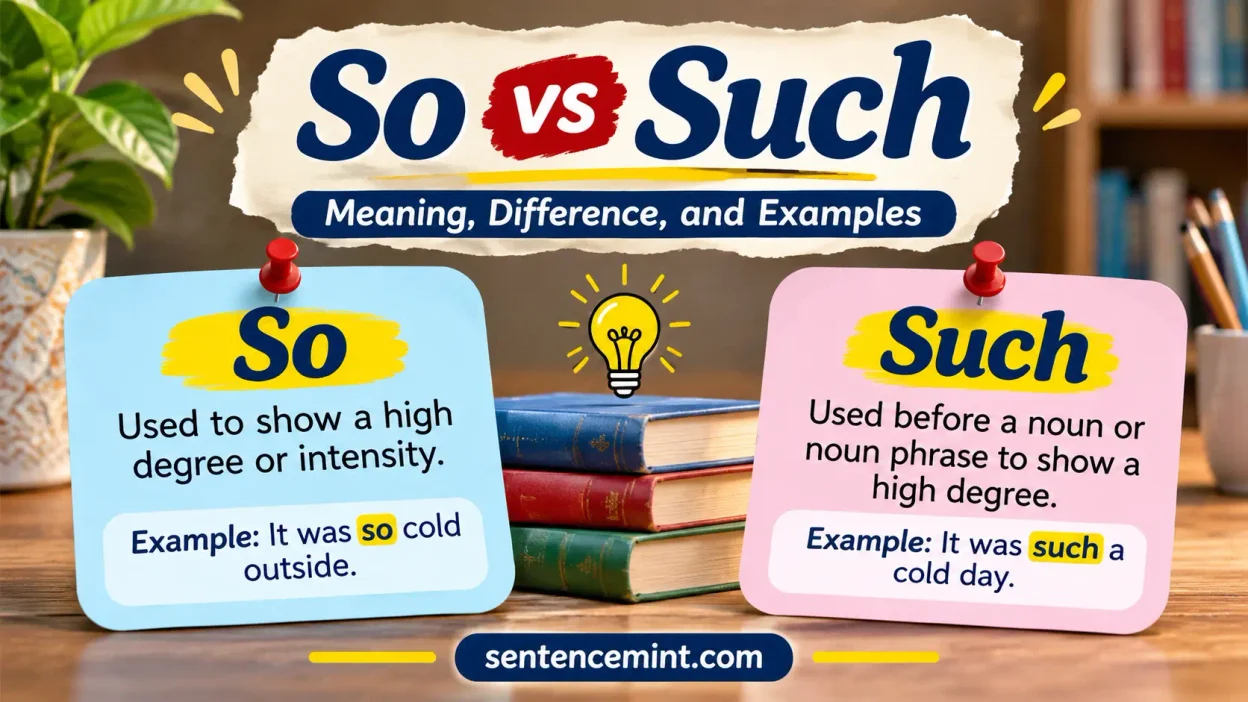
- So usually comes before an adjective or adverb to emphasize its degree.
- Such usually comes before a noun phrase to emphasize the type or quality of something.
Examples:
- The movie was so interesting.
- It was such an interesting movie.
- She speaks so clearly.
- She is such a clear speaker.
Both words can communicate strong feelings or descriptions, but their grammatical structures are different.
What Does So Mean?
“So” is an adverb commonly used to emphasize an adjective or another adverb. It shows that something has a high degree of a particular quality.
It can also introduce a result or express a reason in certain sentence structures.
Examples of so:
- The weather is so cold today.
- Your explanation was so helpful.
- He runs so quickly.
- I am so happy to see you.
- The exam was so difficult.
In these examples, “so” emphasizes the adjectives or adverbs that follow it.
How to Use So in a Sentence
1. So + adjective
Use “so” before an adjective to emphasize a quality.
Examples:
- This book is so interesting.
- The coffee is so hot.
- She looks so beautiful.
- The room is so clean.
2. So + adverb
Use “so” before an adverb to emphasize how an action happens.
Examples:
- He speaks so politely.
- You worked so carefully.
- The children played so happily.
- She drives so slowly.
3. So + much/many/little/few + noun
“So” can also intensify quantity words.
Examples:
- There is so much work to do.
- She has so many friends.
- We have so little time.
- There are so few opportunities.
4. So + adjective/adverb + that
Use this structure to show a result.
Examples:
- It was so cold that we stayed inside.
- He was so tired that he fell asleep immediately.
- She spoke so quietly that nobody heard her.
What Does Such Mean?
“Such” is a determiner used before a noun or noun phrase to emphasize its quality, type, or degree.
It often communicates that something is particularly impressive, unusual, extreme, or noticeable.
Examples of such:
- It was such a beautiful day.
- She is such a kind person.
- They had such an amazing experience.
- He made such a big mistake.
- We received such good news.
Unlike “so,” which generally emphasizes an adjective or adverb directly, “such” usually introduces a noun phrase.
How to Use Such in a Sentence
1. Such + a/an + adjective + singular countable noun
Use “such” before an article, adjective, and singular countable noun.
Examples:
- It was such a wonderful idea.
- She is such an intelligent student.
- He bought such a beautiful house.
- That was such an exciting game.
Remember that the article “a” or “an” comes after “such.”
2. Such + adjective + plural noun
When the noun is plural, do not use “a” or “an.”
Examples:
- They are such friendly people.
- We had such wonderful experiences.
- Those are such beautiful flowers.
- They asked such difficult questions.
3. Such + adjective + uncountable noun
Use “such” before an adjective and an uncountable noun without an article.
Examples:
- It was such good advice.
- We had such terrible weather.
- She showed such great patience.
- They gave us such useful information.
4. Such + noun
“Such” can also come directly before a noun when the context makes its meaning clear.
Examples:
- I have never seen such beauty.
- We should avoid such behavior.
- Such problems require careful attention.
5. Such + noun phrase + that
Use this structure to describe a strong quality or degree that produces a result.
Examples:
- It was such a difficult test that many students failed.
- She is such a talented singer that everyone enjoys her performances.
- They had such bad weather that the event was canceled.
So vs Such: Key Differences
Although “so” and “such” both add emphasis, they are used in different grammatical structures.
| Feature | So | Such |
|---|---|---|
| Main use | Emphasizes degree | Emphasizes a quality or type |
| Part of speech | Usually an adverb | Usually a determiner |
| Common structure | So + adjective/adverb | Such + noun phrase |
| With singular countable nouns | So + adjective + a/an + noun | Such + a/an + adjective + noun |
| With plural nouns | So many/few + noun | Such + adjective + plural noun |
| With uncountable nouns | So much/little + noun | Such + adjective + uncountable noun |
| Example | So beautiful | Such a beautiful place |
So vs Such Examples in Sentences
Comparing similar sentences is one of the easiest ways to understand the difference.
| With So | With Such |
|---|---|
| It is so beautiful. | It is such a beautiful place. |
| She is so intelligent. | She is such an intelligent girl. |
| The food was so delicious. | It was such delicious food. |
| He is so kind. | He is such a kind man. |
| The movie was so interesting. | It was such an interesting movie. |
| They are so friendly. | They are such friendly people. |
| The weather is so bad. | We are having such bad weather. |
| The task was so difficult. | It was such a difficult task. |
Notice that the “such” examples generally include a noun phrase, while the “so” examples often emphasize an adjective directly.
When to Use So Instead of Such
Use “so” when you want to emphasize an adjective or adverb without introducing a noun phrase.
Examples:
- The baby is so cute.
- This lesson is so easy.
- She sings so beautifully.
- The traffic is so heavy.
- I am so excited about the trip.
Use “so” when the emphasis is on how strong a quality or action is.
When to Use Such Instead of So
Use “such” when you want to emphasize a noun or a complete noun phrase.
Examples:
- It was such a lovely evening.
- He is such a helpful teacher.
- They are such hardworking employees.
- We received such wonderful news.
- She has such beautiful hair.
Use “such” when the noun itself is an important part of the description.
Common Mistakes When Using So and Such
English learners sometimes mix the grammatical patterns of “so” and “such.” Here are common mistakes and their corrections.
| Incorrect | Correct | Explanation |
|---|---|---|
| It is such beautiful. | It is so beautiful. | Use “so” before an adjective alone. |
| She is so a nice girl. | She is such a nice girl. | Use “such” before a noun phrase. |
| It was so an interesting book. | It was such an interesting book. | “Such” comes before the article. |
| They are so friendly people. | They are such friendly people. | Use “such” before an adjective and plural noun. |
| We had so bad weather. | We had such bad weather. | “Such” is used before an adjective and uncountable noun. |
| There are such many options. | There are so many options. | Use “so many” before plural countable nouns. |
Tips to Avoid These Mistakes
- Use so before an adjective or adverb: “so beautiful,” “so quickly.”
- Use such before a noun phrase: “such a beautiful flower.”
- Remember the article pattern: “such a good idea,” not “so a good idea.”
- Use “so much” with uncountable nouns and “so many” with plural countable nouns.
- Use “such” with plural and uncountable nouns when an adjective describes them.
So Much vs Such Much
“So much” is correct when emphasizing a large quantity of an uncountable noun. “Such much” is generally incorrect in standard English.
Examples:
- I have so much homework.
- There is so much noise outside.
- She spends so much time studying.
To use “such” with a quantity, choose a noun phrase such as “such a large amount.”
Example:
- We received such a large amount of information.
So Many vs Such Many
“So many” is the standard expression used before plural countable nouns to emphasize a large number.
Examples:
- There are so many books in this library.
- She has so many responsibilities.
- Why are there so many people here?
“Such many” is not normally used in standard English. Instead, you can say “such a large number of.”
Example:
- There were such a large number of visitors that we needed extra staff.
Is It So Good or Such Good?
Both expressions can be correct, depending on the sentence structure.
- So good: Use “so” before the adjective “good.”
- Such good: Use “such” before “good” when it describes a noun.
Examples:
- The food is so good.
- It is such good food.
- She is so good at English.
- She has such good English skills.
The key is whether “good” is used alone as an adjective or as part of a noun phrase.
Is It So Beautiful or Such Beautiful?
The correct choice depends on the structure of the sentence.
- So beautiful is correct when “beautiful” is used as an adjective.
- Such beautiful is correct when it describes a plural or uncountable noun.
Examples:
- The garden is so beautiful.
- They are such beautiful flowers.
- It is such beautiful scenery.
For a singular countable noun, use “such a” or “such an”:
- It is such a beautiful garden.
Frequently Asked Questions (FAQs)
1. What is the main difference between so and such?
“So” usually emphasizes an adjective or adverb, while “such” emphasizes a noun phrase. For example, “so beautiful” and “such a beautiful place.”
2. Is it so good or such good?
“So good” is correct when “good” is used as an adjective by itself. “Such good” is correct when it describes a noun, as in “such good food.”
3. Can we use so and such in the same sentence?
Yes. Both words can appear in one sentence when they perform different grammatical roles.
Example: “It was such a beautiful day that we felt so happy.”
4. Is such followed by a noun?
Yes. “Such” usually comes before a noun or noun phrase.
Example: “She is such a talented artist.”
5. Is so followed by an adjective?
Usually, yes. “So” commonly comes before an adjective or adverb to emphasize its degree.
Example: “The movie was so exciting.”
6. Can we say so many or such many?
“So many” is correct in standard English. “Such many” is generally incorrect.
Example: “There are so many students in the classroom.”
7. Can we say so much or such much?
“So much” is correct when referring to a large quantity of an uncountable noun. “Such much” is not standard English.
Example: “I have so much work today.”
8. What is the difference between so a and such a?
“Such a” is used before an adjective and a singular countable noun, as in “such a beautiful house.” “So a” is generally incorrect in this structure. However, “so” can appear before an adjective followed by an article and noun in a different pattern: “so beautiful a house.”
9. What is the difference between so that and such that?
“So … that” and “such … that” both introduce results. Use “so” before an adjective or adverb and “such” before a noun phrase.
Examples:
- It was so cold that we stayed home.
- It was such a cold day that we stayed home.
10. Are so and such interchangeable?
No, they are not directly interchangeable in most sentences because they follow different grammatical patterns. However, they can express similar emphasis when the sentence is restructured.
Conclusion
“So” and “such” both add emphasis, but their grammatical uses are different. Use so before adjectives and adverbs, as in “so beautiful” or “so quickly.” Use such before noun phrases, as in “such a beautiful place” or “such friendly people.”
Remember these simple patterns:
- So + adjective/adverb: so happy, so carefully.
- Such + a/an + adjective + singular noun: such a nice person.
- Such + adjective + plural or uncountable noun: such beautiful flowers, such good advice.
- So many/much + noun: so many books, so much time.
Once you understand these patterns, choosing between “so” and “such” becomes much easier.