
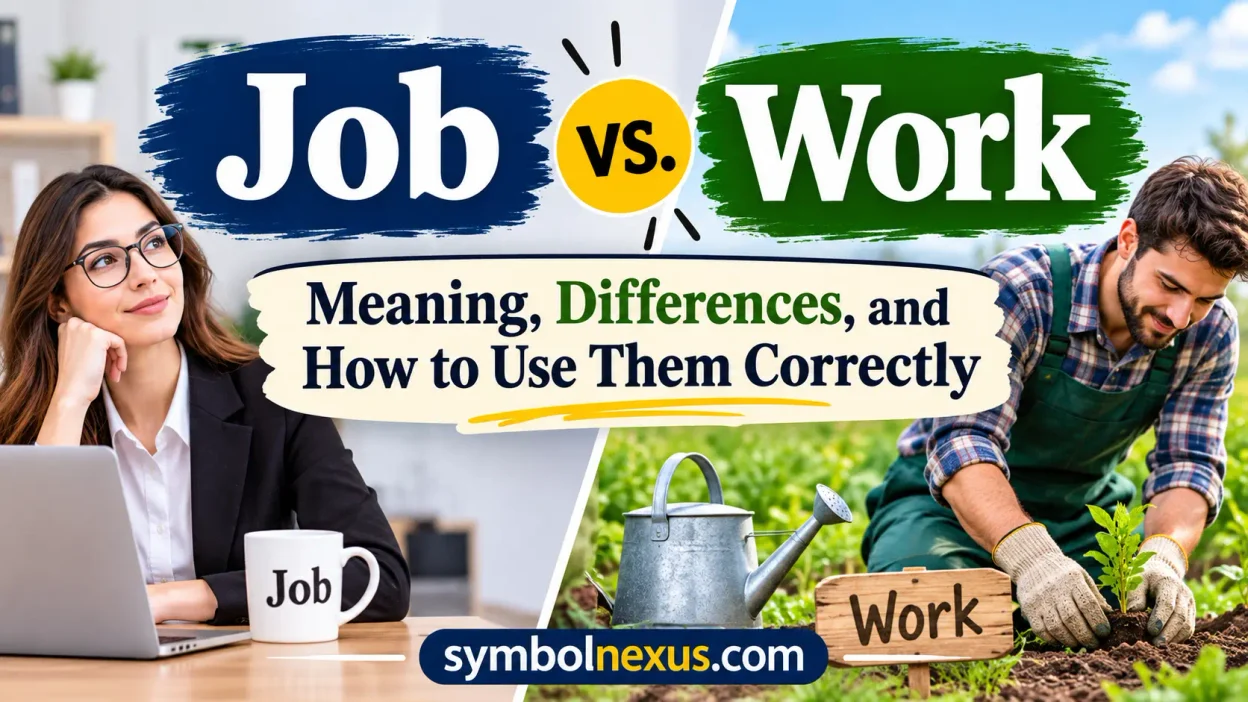
The words job and work are commonly used in everyday English, especially when talking about employment, responsibilities, and professional activities. Although they are closely related, they do not mean exactly the same thing.
A job is a specific position or role that someone performs, usually in exchange for payment. Work is a broader word that describes activities, tasks, or efforts performed to achieve something. Work can be paid or unpaid, while a job generally refers to a particular employment position.
For example, you might have a job as a teacher, but preparing lessons, grading papers, and helping students are all part of your work.
Understanding the difference between job and work will help you use both words correctly in conversations, professional communication, and everyday writing.
Quick Answer: What Is the Difference Between Job and Work?
The main difference between job and work is that job is a specific position or occupation, while work refers to the activities or tasks someone performs.
- Job: A regular position or role, usually performed to earn money.
- Work: An activity, task, or effort performed to accomplish something.
Examples:
- I have a new job at a marketing company.
- I have a lot of work to finish today.
- She is looking for a job.
- He goes to work at 8 a.m.
In simple terms, a job is what you do professionally, while work is the activity you perform.
1. What Does “Job” Mean?
The word job is a noun that refers to a specific position, occupation, or role that a person performs, usually in exchange for money.
A job often involves regular responsibilities, a workplace, working hours, and an employer. However, the word can also describe a particular task or piece of work that needs to be completed.
Examples:
- My brother has a job at a bank.
- She got her first job after graduation.
- He wants to find a better-paying job.
- My job involves helping customers.
- The company offered me a full-time job.
In these examples, job refers to a person’s employment or a particular professional role.
Common Uses of Job
1. Talking about employment
- I am looking for a job.
- She recently changed jobs.
- He has a part-time job.
2. Describing someone’s profession or position
- Her job is to manage the office.
- My father’s job involves repairing machines.
- He has a demanding job.
3. Referring to a specific task
- You did a great job.
- Cleaning the garage is a difficult job.
- This is an important job to complete.
4. Discussing career opportunities
- I applied for a new job.
- The company advertised several job openings.
- She received a job offer yesterday.
2. What Does “Work” Mean?
The word work can function as both a noun and a verb. It generally refers to physical or mental effort used to accomplish a task, produce something, or earn money.
As a noun, work describes an activity, effort, or amount of tasks. As a verb, it describes performing an activity or doing a job.
Examples:
- I have a lot of work today.
- She works in a hospital.
- They work hard to achieve their goals.
- He finished his work before lunch.
- My mother works from home.
Unlike job, the word work does not necessarily refer to a specific employment position. It can describe professional responsibilities, household tasks, school assignments, creative activities, and other efforts.
Common Uses of Work
1. Talking about professional activities
- I work in a software company.
- She works as a nurse.
- He works with international clients.
2. Describing tasks and responsibilities
- I have some work to finish.
- She completed all her work.
- There is too much work this week.
3. Talking about physical or mental effort
- Hard work leads to improvement.
- Writing a book requires a lot of work.
- The project took months of work.
4. Describing whether something functions
- My computer does not work.
- This method works well.
- The new machine works perfectly.
3. Job vs. Work: Key Differences
Although both words can relate to employment, their meanings and grammatical uses are different.
| Feature | Job | Work |
|---|---|---|
| Part of speech | Noun | Noun and verb |
| Basic meaning | A specific position or task | Activity, effort, or tasks |
| Countable? | Usually countable | Usually uncountable as a noun |
| Payment | Usually paid employment | Can be paid or unpaid |
| Scope | More specific | Broader meaning |
| Example | I have a job. | I have work to do. |
| Plural form | Jobs | Works in specific meanings |
Remember: You can have a job, but you do work. A job is usually a specific role, while work describes the activities involved.
4. When Should You Use “Job”?
Use job when referring to a specific employment position, occupation, or individual task.
A. When Talking About Employment
Use job when discussing a position that someone has or wants.
- She found a new job.
- I need a job after graduation.
- He works two jobs to support his family.
B. When Describing a Professional Role
Use job when explaining someone’s responsibilities or position.
- My job is to teach English.
- His job involves managing a team.
- Her job requires excellent communication skills.
C. When Discussing Job Opportunities
Use job in expressions related to employment and career development.
- I applied for a job yesterday.
- There are several job opportunities available.
- He received a job offer from a large company.
D. When Referring to a Specific Task
The word job can also describe a particular piece of work.
- You did an excellent job.
- Painting the entire house is a big job.
- This is a difficult job, but we can finish it.
5. When Should You Use “Work”?
Use work when talking about activities, efforts, responsibilities, or tasks in general.
A. When Talking About Daily Responsibilities
- I have a lot of work to do today.
- She finished her work early.
- He is busy with office work.
B. When Describing Employment Activities
- I work at a school.
- My sister works in a hospital.
- They work for an international company.
C. When Discussing Physical or Mental Effort
- Building a house requires hard work.
- Learning a language takes time and work.
- The team put a lot of work into the project.
D. When Describing Functionality
Use work as a verb when discussing whether something operates correctly.
- My phone is not working.
- Does this printer work?
- The new system works perfectly.
6. Is “Job” Countable and “Work” Uncountable?
One of the most important grammar differences between these words is countability.
Job Is a Countable Noun
You can use job with numbers, articles, and plural forms.
Examples:
- I have a job.
- She has two jobs.
- He applied for three jobs.
- This is an interesting job.
You can also use a or an before a singular countable noun.
Work Is Usually an Uncountable Noun
When work refers to general tasks or activities, it is usually uncountable.
Examples:
- I have a lot of work.
- She needs more work.
- He finished his work.
- There is too much work today.
Avoid using a directly before work when referring to general tasks.
Incorrect: I have a work to do.
Correct: I have work to do.
However, you can use expressions such as:
- A piece of work
- A lot of work
- Some work
- A great deal of work
Important exception: Work can be countable when it refers to creative or literary works, such as paintings, books, or musical compositions.
Example: The museum displays several works by famous artists.
7. Job vs. Work in Everyday Sentences
Here are examples showing how these words are used in common situations.
| Situation | Job | Work |
|---|---|---|
| Employment | I have a new job. | I work at a bank. |
| Career | She wants a better job. | She works hard for her career. |
| Daily tasks | This job is difficult. | I have difficult work today. |
| Workplace | He got a job at a school. | He goes to work every morning. |
| Responsibilities | My job includes teaching. | My work includes preparing lessons. |
| Employment search | I am looking for a job. | I need work. |
Notice that both words can appear in similar contexts, but their meanings are not always identical.
8. Common Expressions with Job
English speakers use job in many common expressions. Learning these phrases can improve your everyday communication.
| Expression | Meaning | Example |
|---|---|---|
| Get a job | Find employment | She wants to get a job. |
| Apply for a job | Request consideration for a position | I applied for a job online. |
| Job offer | An offer of employment | He received a job offer. |
| Job interview | A meeting with an employer | I have a job interview tomorrow. |
| Full-time job | Employment with regular full-time hours | She has a full-time job. |
| Part-time job | Employment with fewer hours | He works a part-time job. |
| Dream job | An ideal occupation | Teaching is her dream job. |
| Job security | The likelihood of keeping employment | Job security is important to many workers. |
| Job satisfaction | How happy someone feels with their job | Flexible hours can improve job satisfaction. |
| Do a good job | Perform a task well | You did a good job. |
9. Common Expressions with Work
The word work also appears in many everyday English expressions.
| Expression | Meaning | Example |
|---|---|---|
| Go to work | Travel to one’s workplace | I go to work at 9 a.m. |
| At work | At one’s workplace or occupied with tasks | She is at work right now. |
| Work hard | Make a strong effort | They work hard every day. |
| Work from home | Perform professional tasks at home | He works from home. |
| Work overtime | Work beyond normal hours | I had to work overtime yesterday. |
| Out of work | Unemployed | He has been out of work for months. |
| Work experience | Knowledge gained through working | She has five years of work experience. |
| Work-life balance | Balance between professional and personal life | Work-life balance is important. |
| Work on something | Spend time improving or completing something | I am working on a project. |
| Work well | Function or perform successfully | This plan works well. |
10. Job vs. Work: Common Grammar Mistakes
English learners sometimes use job and work incorrectly because they have similar meanings. Here are some common mistakes and their corrections.
Mistake 1: Using “A” Before Uncountable Work
Incorrect: I have a work today.
Correct: I have work today.
Why? When work refers to general tasks or activities, it is uncountable and does not normally take a.
Mistake 2: Using “Works” for General Tasks
Incorrect: I have many works to complete.
Correct: I have a lot of work to complete.
Why? General work is uncountable. Use works only in particular contexts, such as artistic or literary works.
Mistake 3: Confusing “Go to Job” and “Go to Work”
Incorrect: I go to job every morning.
Correct: I go to work every morning.
Why? The natural expression is go to work. You can say go to my job when referring to a specific position or workplace.
Mistake 4: Using “Job” Instead of “Work” in General Statements
Less natural: I have a lot of jobs to finish today.
More natural: I have a lot of work to finish today.
Why? When referring to general responsibilities or tasks, work is usually more appropriate.
Mistake 5: Forgetting That “Work” Can Be a Verb
Incorrect: She work in a hospital.
Correct: She works in a hospital.
Why? In the present simple tense, add -s to the verb when the subject is he, she, or it.
11. Job vs. Work vs. Career: What Is the Difference?
Another word that is often confused with job and work is career. Although all three are related to professional life, they have different meanings.
| Word | Meaning | Example |
|---|---|---|
| Job | A specific position or occupation | She has a job as a designer. |
| Work | Activities or tasks performed | She has a lot of design work. |
| Career | A person’s long-term professional journey | She wants a career in design. |
Job
A job is a particular position someone holds.
Example: He got a job as a graphic designer.
Work
Work refers to the tasks and activities involved in doing that job.
Example: He has several design projects to work on.
Career
A career describes a person’s professional development over time, often involving different jobs and experiences.
Example: She has built a successful career in education.
Easy way to remember:
- Job = Position
- Work = Activity
- Career = Professional journey
12. Job vs. Work in Different Situations
The choice between job and work depends on the situation.
In Professional Conversations
Use job when discussing a position or employment opportunity.
- What is your job?
- I am looking for a new job.
Use work when discussing tasks or professional activities.
- What kind of work do you do?
- I have a lot of work this week.
In Education
Use work when referring to assignments, research, or academic tasks.
- I have some homework to finish.
- She is working on her research.
Use job when referring to student employment.
- He has a part-time job while studying.
In Household Activities
Use work for unpaid household responsibilities.
- Housework takes several hours.
- I have a lot of cleaning work to do.
You can also use job for a specific household task.
- Cleaning the kitchen is a difficult job.
In Business
Use job for a specific position.
- The company advertised a new job.
Use work for business activities and responsibilities.
- We have important work to complete before the deadline.
13. Simple Tips to Remember the Difference
If you find it difficult to choose between job and work, remember these practical tips:
- Use job when referring to a specific position or occupation.
- Use work when discussing activities, tasks, or effort.
- Remember that job is countable, so you can say “one job” or “two jobs.”
- Remember that work is usually uncountable when referring to general activities.
- Use go to work when talking about traveling to your workplace.
- Use work as a verb when describing professional or other activities.
- Use career when talking about someone’s long-term professional journey.
The easiest rule is that a job is a position, while work is what you do.
14. Frequently Asked Questions (FAQs)
1. What is the main difference between job and work?
A job is a specific position or occupation, usually performed for payment. Work refers to the activities, tasks, or effort involved in doing something.
2. Is job countable or uncountable?
Job is a countable noun. You can say one job, two jobs, or several jobs.
3. Is work countable or uncountable?
Work is usually uncountable when it refers to general tasks or activities. However, it can be countable when referring to creative or literary works.
4. Can I say “I have a work”?
Usually, no. When referring to general tasks, say “I have work.” You can say “I have a piece of work” when referring to a specific task.
5. Is “go to work” or “go to job” correct?
“Go to work” is the standard expression when talking about going to your workplace. “Go to my job” is also possible when referring to a specific position or workplace.
6. Can job and work be used interchangeably?
Not always. A job usually refers to a particular position, while work describes activities or tasks. Their meanings sometimes overlap, but their grammatical uses are different.
7. What is the difference between job, work, and career?
A job is a specific employment position, work refers to activities and tasks, and a career is a person’s long-term professional journey.
8. Can work be used as a verb?
Yes. Work is both a noun and a verb.
Examples:
- Noun: I have a lot of work.
- Verb: I work in an office.
9. What does “out of work” mean?
“Out of work” means unemployed or without a job.
Example: He has been out of work since January.
10. Which is correct: “I have a job” or “I have work”?
Both are correct, but they mean different things. “I have a job” means you have an employment position. “I have work” means you have tasks or responsibilities to complete.
Conclusion
The difference between job and work is simple once you understand their meanings and grammatical uses. A job is usually a specific employment position or occupation, while work refers to the activities, responsibilities, and effort involved in completing tasks.
For example, you may have a job as a teacher, but preparing lessons, grading assignments, and helping students are all part of your work.
Remember that job is a countable noun, while work is generally an uncountable noun when referring to activities. Understanding this distinction will help you avoid common grammar mistakes and communicate more naturally in English.


[…] “Do a job” means to perform a task or complete work. […]
[…] example, getting a job abroad is a possibility if it could happen someday. Receiving a job offer from an international company is an opportunity because it gives you a concrete chance to […]