Price and prize are two commonly confused English words because they differ by only one letter and have similar pronunciations. However, their meanings and uses are completely different. Understanding the difference between price vs. prize can help you avoid spelling mistakes and communicate more clearly in writing and conversation.
The word price refers to the amount of money required to buy something or the value assigned to a product or service. In contrast, prize refers to something valuable that someone wins or receives as a reward for an achievement, competition, or special accomplishment.
For example, you pay the price of a new phone, but you may win a prize in a competition. Although both words can relate to value, one is primarily about cost, while the other is about reward.
Price vs. Prize: Quick Difference
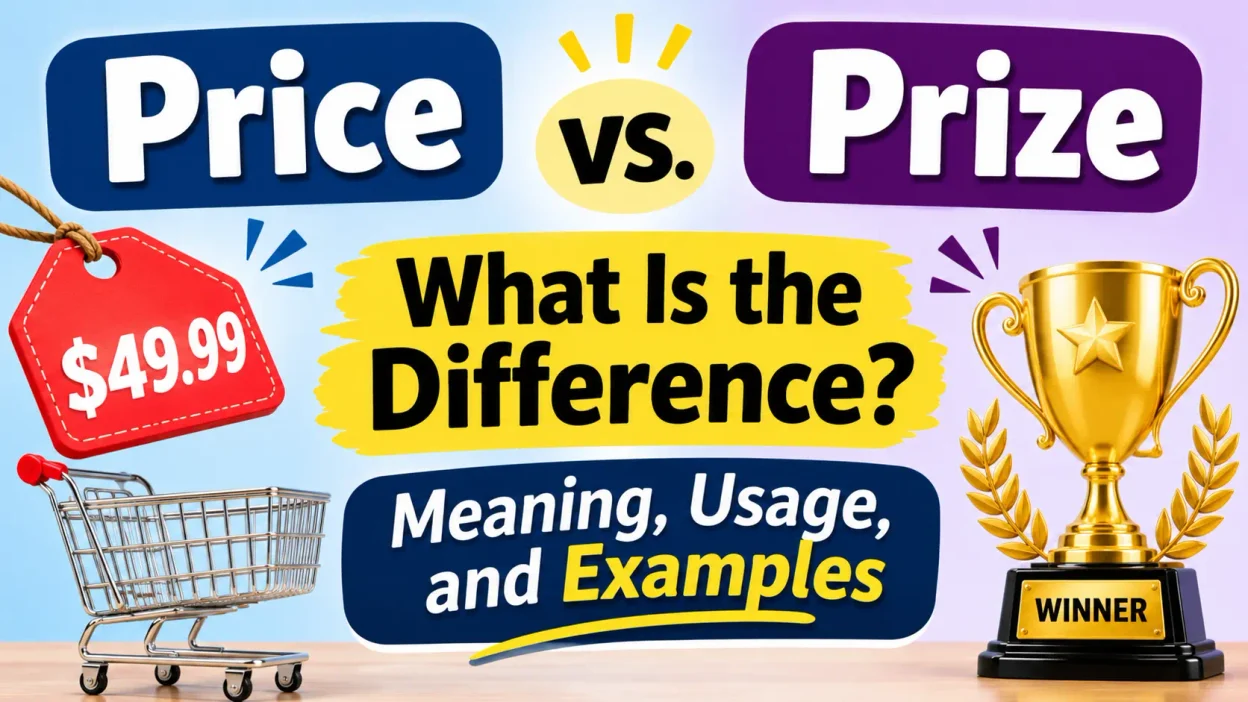
The main difference between price and prize is that price means the cost of something, while prize means a reward or award given to someone for winning or achieving something.
| Word | Meaning | Example |
|---|---|---|
| Price | The amount of money something costs | The price of the jacket is $50. |
| Prize | A reward given to a winner | She won first prize in the competition. |
Easy way to remember:
- Price = Pay: You pay a price when you purchase something.
- Prize = Win: You win a prize when you achieve something or succeed in a competition.
What Does Price Mean?
The word price is a noun and sometimes a verb. As a noun, it refers to the amount of money that must be paid to purchase a product, service, or experience. It can also refer to the value or consequence of something.
As a verb, price means to determine or set the amount that something costs.
Examples of Price in Sentences
- The price of this laptop is higher than I expected.
- We need to compare the prices before buying a new refrigerator.
- The store reduced the price of its winter collection.
- The price of groceries has increased recently.
- The company plans to price its new product competitively.
- She asked the salesperson about the price of the necklace.
Different Meanings of Price
Although price most commonly refers to money, it can also have figurative meanings.
1. Monetary cost: The amount paid to purchase something.
Example: The price of the tickets is $25 each.
2. Cost or consequence: Something unpleasant that must be experienced to achieve a particular result.
Example: He achieved success, but it came at the price of his personal happiness.
3. Value or sacrifice: The effort, loss, or sacrifice associated with achieving something.
Example: Freedom sometimes comes at a great price.
Common Phrases With Price
The word price appears in several familiar English expressions.
- At any price: Regardless of the cost or consequences.
- Price tag: A label showing how much something costs.
- Market price: The current amount something sells for in the market.
- Asking price: The amount a seller wants for an item.
- Pay the price: Experience the consequences of an action.
- Price range: The range of costs for a product or service.
- Worth the price: Valuable enough to justify its cost.
What Does Prize Mean?
The word prize is a noun and a verb. As a noun, it refers to something awarded to a person for winning a competition, achieving a goal, or performing exceptionally well.
A prize can be money, a trophy, a medal, a scholarship, a gift, or another form of recognition.
As a verb, prize means to value or appreciate something highly.
Examples of Prize in Sentences
- She won the first prize in the spelling competition.
- The winner received a cash prize of $1,000.
- His greatest prize was the recognition of his hard work.
- The school awarded a special prize to the best student.
- The athlete hopes to win an Olympic prize.
- I prize honesty and kindness above material possessions.
Different Meanings of Prize
The word prize can be used in more than one way.
1. Award or reward: Something given to a winner or someone who achieves a particular goal.
Example: The team received a prize for its outstanding performance.
2. Something highly valued: An object, quality, or achievement considered especially important.
Example: Her grandmother’s old necklace is a treasured prize in the family.
3. To value highly: As a verb, prize means to appreciate or regard something as valuable.
Example: He prizes his independence more than anything else.
Common Phrases With Prize
- First prize: The award given to the winner who finishes in first place.
- Prize money: Money awarded to a competition winner.
- Prize winner: A person who receives a prize.
- Prize possession: Something considered extremely valuable.
- Prize draw: A competition in which winners are selected through a draw.
- Highly prized: Considered very valuable or desirable.
- Prize-winning: Having won an award or competition.
Price vs. Prize: Key Differences Explained
Although price and prize look and sound similar, their meanings, grammatical uses, and contexts make them easy to distinguish.
| Feature | Price | Prize |
|---|---|---|
| Part of speech | Noun and verb | Noun and verb |
| Main meaning | Cost or amount charged | Award, reward, or something valued |
| Common action | Pay or set | Win, award, or value |
| Related concept | Buying and selling | Competition and achievement |
| Example | What is the price of this watch? | She won a prize for her painting. |
| Verb example | The store priced the product at $20. | He prizes his family’s traditions. |
The easiest distinction is to remember that price is generally connected with purchasing, while prize is generally connected with winning or valuing something.
Price vs. Prize: Pronunciation Difference
Price and prize have slightly different initial sounds, even though their spelling is almost identical.
- Price: /praɪs/ — begins with the unvoiced /p/ sound and ends with /s/.
- Prize: /praɪz/ — begins with the unvoiced /p/ sound and ends with the voiced /z/.
Both words have the same vowel sound, as in my and time. The main pronunciation difference is the final consonant: price ends with an /s/ sound, while prize ends with a /z/ sound.
Practicing the final sounds can help you distinguish these words when speaking.
When to Use Price
Use price when discussing the cost, monetary value, or consequences associated with something.
Common situations include:
- Asking how much a product costs.
- Comparing the costs of different items.
- Discussing discounts and sales.
- Setting the selling price of a product.
- Describing the consequences of a decision.
Examples:
- What is the price of this smartphone?
- The restaurant increased the price of its meals.
- We found a beautiful dress at a reasonable price.
- The company lowered its prices to attract customers.
- He paid a high price for his mistake.
When to Use Prize
Use prize when referring to an award, reward, or something that someone values highly.
Common situations include:
- Winning a competition.
- Receiving an award for an achievement.
- Giving someone recognition.
- Describing something precious or valuable.
- Expressing how much you appreciate something.
Examples:
- She won a prize for her excellent performance.
- The winner received a gold medal as the main prize.
- The school organized a prize-giving ceremony.
- His greatest prize was the opportunity to help others.
- They prize honesty and loyalty in their friendship.
Common Mistakes With Price and Prize
Because these words differ by only one letter, writers sometimes use them incorrectly. The following examples show common mistakes and their correct forms.
| Incorrect Sentence | Correct Sentence |
|---|---|
| What is the prize of this phone? | What is the price of this phone? |
| She won the first price. | She won the first prize. |
| The prize of the house is too high. | The price of the house is too high. |
| He received a price for his achievement. | He received a prize for his achievement. |
| The shop reduced its prize. | The shop reduced its price. |
| This is my most valuable price. | This is my most valuable prize. |
Remember that you pay a price to purchase something, but you receive or win a prize as a reward.
Price vs. Prize: Easy Memory Tricks
If you find it difficult to remember which word to use, these simple tricks can help.
1. Remember Price and Pay
Both words begin with the letter P. Think of price as the money you pay for something.
Example: I paid a reasonable price for my shoes.
2. Remember Prize and Win
A prize is something you may win after a competition or achievement.
Example: He won a prize for his excellent work.
3. Think About Buying vs. Winning
If you are buying something, use price. If you are winning something, use prize.
- Buying a car = Price.
- Winning a trophy = Prize.
4. Practice With Short Sentences
Repeating simple examples can help you remember the difference:
- What is the price?
- Who won the prize?
- The price is too high.
- The prize is beautiful.
Price vs. Prize: Practice Quiz
Test your understanding by choosing the correct word in each sentence.
1. The _____ of this television is $500.
- A. Price
- B. Prize
2. She won the first _____ in the writing competition.
- A. Price
- B. Prize
3. The store reduced the _____ of its products.
- A. Price
- B. Prize
4. The winner received a special _____ for outstanding performance.
- A. Price
- B. Prize
5. We paid a high _____ for the concert tickets.
- A. Price
- B. Prize
Answers: 1. Price, 2. Prize, 3. Price, 4. Prize, 5. Price.
Frequently Asked Questions About Price vs. Prize
1. What is the main difference between price and prize?
Price refers to the amount of money something costs, while prize refers to an award or reward given for winning or achieving something.
2. Is price a noun or a verb?
Price can be both a noun and a verb. As a noun, it means the cost of something. As a verb, it means to set or determine the cost of a product or service.
3. Is prize a noun or a verb?
Prize can also function as both a noun and a verb. As a noun, it means an award or something valuable. As a verb, it means to value or appreciate something highly.
4. How do you remember the difference between price and prize?
Remember that you pay a price when buying something, but you win a prize when receiving an award. This simple connection makes the difference easy to remember.
5. Can prize mean something valuable?
Yes. Prize can describe something considered especially valuable or important. For example, “Her freedom is her greatest prize.”
6. Can price have a meaning other than money?
Yes. Price can refer to the consequences or sacrifices associated with an action. For example, “He achieved success at the price of his health.”
7. What is the pronunciation difference between price and prize?
Price is pronounced /praɪs/, ending with an /s/ sound. Prize is pronounced /praɪz/, ending with a /z/ sound.
8. Is it first price or first prize?
The correct expression is first prize. It refers to the award given to the winner who achieves first place in a competition.
9. Is it the price of a product or the prize of a product?
The correct expression is the price of a product because it refers to the amount of money required to purchase it.
10. What does “highly prized” mean?
“Highly prized” means something is considered very valuable, desirable, or important. For example, “Honesty is a highly prized quality.”
Conclusion: Price vs. Prize
Understanding the difference between price and prize is simple once you recognize what each word represents. Price refers to the cost or monetary value of something, while prize refers to an award, reward, or something considered highly valuable.
You use price when discussing purchases, expenses, discounts, and financial value. You use prize when talking about competitions, achievements, awards, and treasured possessions.
Remember this easy rule: You pay a price, but you win a prize. Keeping this distinction in mind will help you choose the correct word and avoid common spelling and vocabulary mistakes.