
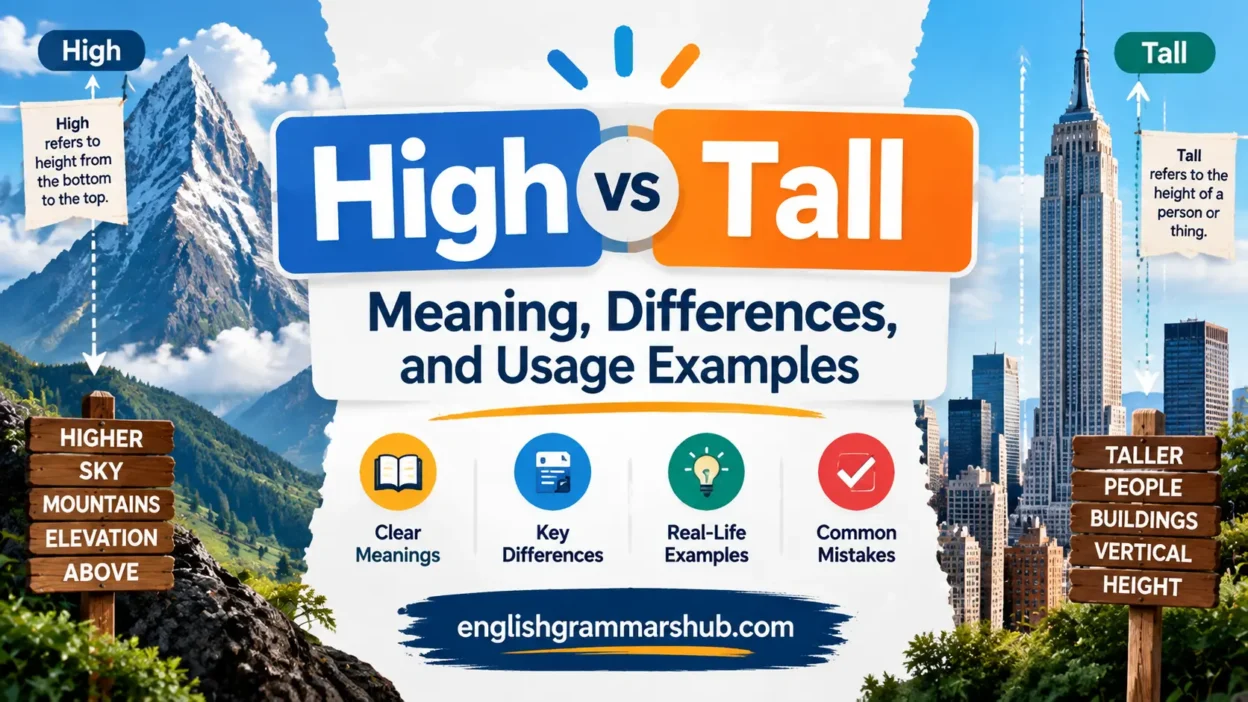
Feature Image Prompt:
Create a professional 800×450 editorial grammar image for a US English website. Show a clear comparison between “High” and “Tall” using a split-screen layout. Left side: a tall person, tall tree, and tall skyscraper labeled “TALL = Physical Height.” Right side: airplane in the sky, high mountain, and high shelf labeled “HIGH = Distance Above Ground.” Use a modern minimalist educational design, clean typography, blue and white color palette, crisp icons, and a professional language-learning style.
Alt Text:
High vs tall comparison showing the difference between physical height and elevation in English.
High vs Tall: Meaning, Difference, and Correct Usage
Introduction
The words high and tall are often confused because both describe something related to height. When something extends upward, English speakers may wonder which word sounds correct.
For example:
- My brother is very tall.
- The airplane is flying high.
Both sentences describe something above a normal level, but the words focus on different ideas.
The main difference is:
Tall describes the physical height of a person, animal, tree, building, or object. High describes the position of something above the ground or a normal level.
Understanding this difference helps you choose the correct word naturally in everyday American English.
Quick Answer
Use tall when you describe how high something is from bottom to top, especially people and vertical objects.
Use high when you describe something located far above the ground or a measurement that reaches a high level.
Examples:
✅ She is very tall.
✅ The tower is extremely tall.
✅ The bird flew high into the sky.
✅ The shelf is too high to reach.
A simple memory trick:
Tall = the size of something upward.
High = the position or level above something.
Why People Confuse Them
The confusion happens because both words connect to the idea of height.
A person standing 6 feet tall is physically large from head to toe. A plane flying thousands of feet above the ground is high because of its position.
The difference is not only about measurement. It is about perspective.
Compare:
- The building is tall.
- The building is high.
The first sentence describes the building itself. It focuses on the structure’s vertical size.
The second sentence focuses more on the building’s elevation or how far upward it reaches.
In normal American English, people usually use tall for buildings, people, and objects with a strong vertical shape.
Key Differences At A Glance
| Context | Best Choice | Why |
|---|---|---|
| A person’s height | Tall | People are described by their body height |
| A skyscraper | Tall | The building extends upward |
| A tree | Tall | Trees grow vertically |
| A shelf on a wall | High | The shelf’s location is above the ground |
| A plane in the sky | High | The plane is elevated |
| Temperature | High | It describes a level |
| Price | High | It describes amount or level |
| Mountain elevation | High | It describes height above sea level |
Feature Comparison
| Feature | High | Tall |
|---|---|---|
| Main meaning | Above a surface or normal level | Large vertical height |
| Common with people | Rare | Very common |
| Common with buildings | Sometimes | Very common |
| Used for levels | Yes | No |
| Used for prices and numbers | Yes | No |
| Focus | Position | Physical size |
Meaning and Usage Difference
How to Use High
High describes something that is above the ground, above another object, or above an expected level.
It can describe physical locations:
- The plane is flying high.
- The picture is hanging high on the wall.
- The bird climbed high into the sky.
It can also describe levels or amounts:
- The temperature is high today.
- The company has high standards.
- The price is too high.
In these examples, high does not describe physical size. It describes a level, amount, or position.
How to Use Tall
Tall describes something with great vertical height.
It is commonly used for:
People
- My sister is very tall.
- He became taller during his teenage years.
Buildings
- Chicago has many tall buildings.
- That is the tallest tower in the area.
Trees
- The tall pine trees covered the hillside.
Objects
- She drank a tall glass of water.
- They built a tall fence around the property.
Tall usually suggests that something is narrow compared with its height.
Tone, Context, and Formality
Both high and tall are common everyday English words. Neither one is more formal than the other.
The correct choice depends on the situation.
Situations Where Tall Sounds Natural
Use tall for things that have a clear vertical shape:
- tall person
- tall athlete
- tall building
- tall tree
- tall tower
Examples:
- The basketball player is very tall.
- They moved into a tall apartment building.
Situations Where High Sounds Natural
Use high for things that describe location, position, or level:
- high ceiling
- high mountain
- high shelf
- high temperature
- high speed
Examples:
- The airplane reached a high altitude.
- The books are on a high shelf.
Which One Should You Use?
Ask yourself:
Am I describing the height of the thing itself, or where it is located?
If you describe the thing:
→ Use tall
Examples:
- a tall man
- a tall building
- a tall tree
If you describe its position:
→ Use high
Examples:
- a high shelf
- a high window
- a high mountain
When One Choice Sounds Wrong
Some combinations sound unnatural because English speakers normally use one word.
Talking About People
Incorrect:
❌ My father is very high.
Correct:
✅ My father is very tall.
People have physical height, so tall is the natural choice.
Talking About Airplanes
Incorrect:
❌ The airplane is very tall in the sky.
Correct:
✅ The airplane is flying very high.
The airplane’s location matters, not its size.
Talking About Shelves
Incorrect:
❌ The shelf is tall on the wall.
Correct:
✅ The shelf is high on the wall.
The shelf’s position is above the ground.
Cases Where Both Can Work
Some objects can use both words depending on meaning.
Example:
Tall mountain
This focuses on the mountain’s physical height.
High mountain
This focuses on the mountain’s elevation.
Another example:
Tall building
The building has many floors and great vertical height.
High building
The building reaches a high position above the ground.
Common Mistakes (and Quick Fixes)
Mistake 1: Using High for People
Wrong:
❌ She is high.
Correct:
✅ She is tall.
A person’s height is described with tall.
Mistake 2: Using Tall for Levels
Wrong:
❌ The temperature is tall today.
Correct:
✅ The temperature is high today.
Temperature describes a level, not physical height.
Mistake 3: Using High for Physical Height
Wrong:
❌ He is a high man.
Correct:
✅ He is a tall man.
High does not describe a person’s body height.
Mistake 4: Confusing Tall and High Buildings
Both may appear possible, but the meaning changes.
- The building is tall.
→ The structure has great height. - The building is high above the valley.
→ The location is elevated.
Everyday Examples
Tall Examples
- My brother is taller than me.
- The tall trees provide shade in the summer.
- That tall building is easy to recognize.
- She bought a tall coffee cup.
- The athlete is known for being tall.
High Examples
- The plane disappeared high into the clouds.
- The painting is hanging high above the sofa.
- The mountain has a high peak.
- The company has high expectations.
- The repair cost was higher than expected.
Dictionary-Style Word Details
Verb
High:
High is not commonly used as a verb in standard modern US English for this comparison.
Tall:
Tall is not commonly used as a verb in standard modern US English.
Both words are mainly adjectives.
Noun
High:
High can work as a noun in some situations.
Example:
- The stock market reached a new high.
Here, high means a peak or highest point.
Tall:
Tall is not commonly used as a noun in standard US English.
Synonyms
High
Closest plain alternatives:
- elevated
- raised
- upper
- lofty
Examples:
- high shelf → elevated shelf
- high level → elevated level
Tall
Closest plain alternatives:
- towering
- large in height
- vertical
Examples:
- tall building → towering building
High and tall are not exact synonyms because they describe different relationships with height.
Example Sentences
High
- The eagle flew high above the mountains.
- The apartment has high ceilings.
- The company reported high profits.
Tall
- The basketball player is very tall.
- A tall tree stood beside the road.
- They built a tall fence around the yard.
Word History
Both high and tall have long histories in English. Their meanings developed through common language use over time.
Today, their main difference is based on how English speakers view height:
- Tall focuses on vertical size.
- High focuses on elevation, position, or level.
Phrases Containing
High
Common phrases include:
- high level
- high quality
- high speed
- high temperature
- high above
- high pressure
Tall
Common phrases include:
- tall building
- tall person
- tall tree
- tall glass
- stand tall
Conclusion
The difference between high vs tall is easier when you focus on the idea being described.
Use tall for the physical height of people, trees, buildings, and vertical objects.
Use high for things that are above the ground or describe a level, amount, or position.
Remember:
Tall describes how big something is upward.
High describes how far upward something is located.
With this simple distinction, you can choose the correct word naturally in American English.