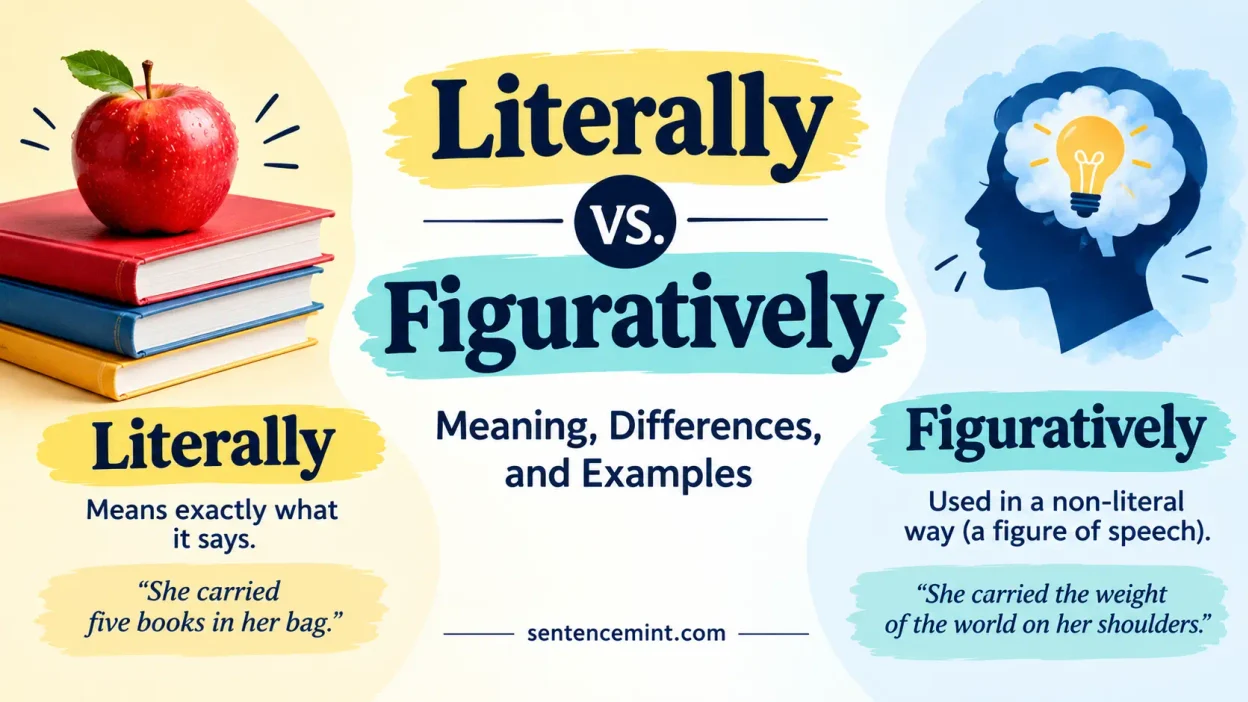
Featured Image Prompt: Create a premium 800×450 HD educational grammar blog featured image titled “Literally vs. Figuratively: What’s the Difference?” Divide the design into two clear sections. On the left, show a person standing in actual rain labeled “LITERALLY.” On the right, show a person with a cloud over their head symbolizing stress labeled “FIGURATIVELY.” Use a clean, modern editorial style, strong contrast, readable centered title, balanced spacing, and a professional American English learning website aesthetic. Ensure all text is correctly spelled, fully visible, and free from watermarks or clutter.
Image Alt Text: Literally vs figuratively grammar comparison showing the difference between actual and figurative meanings
Literally vs. Figuratively: What’s the Difference?
Quick Answer: Literally means according to the exact or direct meaning of words, while figuratively means using language in an imaginative, metaphorical, or nonliteral way. For example, “The glass literally broke” means the glass actually broke. “My heart figuratively broke” means someone felt deeply hurt, not that their heart physically broke.
The difference between literally vs. figuratively is important because these words tell readers how to understand a statement. One describes something as it actually happens, while the other often expresses an idea through imagery, metaphor, or exaggeration.
For example, if you say, “I am drowning in homework,” you probably mean that you have too much work to handle. You are using drowning figuratively. If you are actually underwater and struggling to breathe, the word describes a literal situation.
People often confuse these words in conversations, social media posts, and everyday writing. Understanding their meanings will help you express yourself clearly and choose the right word for the situation.
Literally vs. Figuratively: Quick Comparison
| Feature | Literally | Figuratively |
|---|---|---|
| Main meaning | In the exact or direct sense | In a metaphorical or nonliteral sense |
| Describes | Actual events or precise meanings | Images, comparisons, and figures of speech |
| Example | The box literally fell off the table. | I was figuratively buried in paperwork. |
| Common use | Facts, instructions, and precise descriptions | Creative writing and everyday expressions |
| Related term | Literal | Figurative |
| Opposite in common usage | Figuratively | Literally |
The easiest rule to remember is this: literally means what the words directly say, while figuratively communicates an idea beyond the direct meaning.
What Does Literally Mean?
Literally is an adverb that usually means exactly as stated, without changing the direct meaning of the words. It helps clarify that an event actually happened rather than serving as a metaphor or exaggeration.
Examples:
- The bottle literally shattered into pieces.
- She literally counted every dollar.
- The package was literally inside the mailbox.
- He literally walked five miles to get home.
- I read every word of the document literally, without interpreting hidden meanings.
In each example, the word describes something actual or precise.
Literally in Everyday English
People use literally to emphasize that a statement is true in its direct sense.
Examples:
- I literally left my keys on the kitchen counter.
- The temperature literally dropped below freezing.
- She literally ran across the street.
- The dog literally jumped over the fence.
These statements describe actions or events that can be understood directly.
Literally in Instructions and Explanations
The word can also emphasize exactness when explaining a process or interpreting language.
Examples:
- Translate the sentence literally before explaining its meaning.
- The label literally says, “Keep refrigerated.”
- He followed the instructions literally, without making any changes.
In these examples, literally focuses on the exact wording or action rather than an implied meaning.
What Does Figuratively Mean?
Figuratively is an adverb that describes language used in a nonliteral or imaginative sense. It often appears in metaphors, idioms, comparisons, and expressions that communicate emotions or ideas through imagery.
Examples:
- I was figuratively buried under a mountain of paperwork.
- Her kind words lifted me figuratively.
- After the long meeting, my brain was fried.
- He carried the weight of the world on his shoulders.
These statements communicate ideas rather than describe physical events exactly as written.
For example, a person who says they are “buried under paperwork” usually means they have too many documents or tasks to manage. They are not actually buried beneath a pile of paper.
Figuratively in Everyday Conversation
People often use figurative language to make their thoughts more expressive.
Examples:
- That test killed me.
- I’m drowning in work.
- His words broke my heart.
- She has a heart of gold.
- We were walking on eggshells around him.
These expressions communicate exhaustion, stress, emotional pain, kindness, or caution. Their meaning goes beyond the literal definitions of the words.
Figuratively in Creative Writing
Writers use figurative language to help readers imagine scenes, understand emotions, and connect with characters.
Examples:
- The city was a sleeping giant.
- Time flew during the vacation.
- Her voice was music to his ears.
- Hope was a light in the darkness.
These examples use metaphorical language to create images and communicate ideas more vividly.
Literally vs. Figuratively: Examples in Sentences
Comparing similar sentences is one of the easiest ways to understand the difference.
| Literal sentence | Figurative sentence |
|---|---|
| The man broke the window. | The news broke his heart. |
| She carried a heavy box. | She carried a heavy burden of responsibility. |
| The child ran out of the room. | Time ran away from us. |
| The room was filled with smoke. | The room was filled with tension. |
| He climbed the ladder. | She climbed the corporate ladder. |
| The ice melted in the sun. | His anger melted away. |
| The door was open. | The conversation opened new doors. |
| The student burned the paper. | The student burned with ambition. |
The literal sentences describe direct events. The figurative sentences use familiar words to express ideas that cannot always be understood by taking each word at face value.
When Should You Use Literally?
Use literally when you want to describe something that actually happened or clarify the exact meaning of a statement.
1. When Describing an Actual Event
Examples:
- The glass literally fell off the shelf.
- She literally saw the accident happen.
- The storm literally damaged the roof.
- The train literally stopped at the station.
These sentences describe events rather than metaphors.
2. When Explaining Exact Meaning
Examples:
- The phrase literally means “a place of safety.”
- He translated the instructions literally.
- The sign literally says, “Do not enter.”
Here, the word emphasizes the direct wording or meaning.
3. When Precision Matters
In academic writing, technical explanations, news reports, and professional documents, literally can clarify whether something happened exactly as described.
Examples:
- The sample literally contained no detectable traces of the substance.
- The machine literally stopped operating at noon.
- The report states that the building was literally three miles from the site.
Use the word only when the direct meaning is accurate. If a sentence describes a metaphor or an exaggeration, consider using figuratively or rewriting the sentence more precisely.
When Should You Use Figuratively?
Use figuratively when you want to describe an idea through a metaphor, comparison, idiom, or other nonliteral expression.
1. When Describing Strong Emotions
Examples:
- His criticism figuratively crushed her confidence.
- I was figuratively on cloud nine after receiving the offer.
- Her kind gesture lifted my spirits.
- The disappointment broke his heart.
These expressions describe emotional experiences rather than physical events.
2. When Using Metaphors
Examples:
- The classroom was a zoo.
- His mind is a library of useful information.
- The internet has opened a world of possibilities.
- Her words planted a seed of doubt.
The sentences compare one thing to another to make an idea more vivid.
3. When Describing Overwhelming Situations
Examples:
- I’m figuratively drowning in assignments.
- The team was buried in paperwork.
- We were running against the clock.
- The business stood at a crossroads.
These expressions describe pressure, workload, urgency, or a decision. They are not meant to be interpreted as literal physical events.
Is Literally Ever Used Figuratively?
Yes. In modern English, literally is also commonly used as an informal intensifier to add emphasis, even when the expression is not strictly literal. Dictionaries recognize this use. However, some readers consider it imprecise, particularly in formal writing. <Link url=”https://dictionary.cambridge.org/us/dictionary/english/literally” title=”Cambridge Dictionary’s entry for literally”/> explains both the direct meaning and its informal use for emphasis.
Examples:
- I literally waited forever.
- She was literally dying of embarrassment.
- He literally exploded with anger.
In these sentences, the word literally is being used for emphasis, but the statements are generally exaggerations rather than precise descriptions.
If someone says, “I literally waited forever,” they usually mean they waited a very long time. No one can actually wait forever.
For casual conversations, this intensifying use is common. In formal or technical writing, it is usually better to avoid it when it conflicts with the direct meaning.
Instead of writing, “I literally waited forever,” write:
- I waited for a very long time.
- I waited much longer than expected.
These alternatives communicate the intended meaning without creating confusion.
Literally vs. Figuratively in American English
Both words are widely used in American English, but they serve different purposes.
In everyday conversation, Americans often use figurative expressions such as “I’m starving,” “That joke killed me,” and “I’m buried in work.” These statements are generally understood as exaggerations or metaphors.
The word literally can also appear as an intensifier in informal American speech and online writing. For example, “That was literally the best day ever” may be intended to emphasize enthusiasm rather than make a precise factual claim.
In formal writing, however, choosing the exact word matters more. Use literally when the direct meaning is accurate and figuratively when you want to make the nonliteral meaning explicit.
Common Mistakes With Literally and Figuratively
Understanding these common mistakes can help you improve your writing.
| Mistake | Better wording | Why? |
|---|---|---|
| I literally died laughing. | I laughed so hard I could barely breathe. | The original is an exaggeration, not a literal death. |
| She was figuratively hit by a car. | She was literally hit by a car. | If a car physically struck her, literally is correct. |
| He literally has a heart of gold. | He figuratively has a heart of gold. | The expression describes kindness, not a gold heart. |
| I figuratively placed the book on the table. | I placed the book on the table. | This is a direct physical action, so figuratively is unnecessary. |
| The team was literally buried in work. | The team was figuratively buried in work. | The team has too much work; it is not physically buried. |
Remember that the correct choice depends on what actually happened and what the speaker intends to communicate.
Literally vs. Figuratively vs. Metaphorically
The word metaphorically is closely related to figuratively. It describes an expression that compares one thing to another without using a direct comparison such as “like” or “as.”
For example:
- Literal: The child is standing in the sunlight.
- Figurative: The child is a ray of sunshine.
- Metaphorical: The child is a ray of sunshine.
In the figurative examples, the child is not an actual ray of sunlight. The expression suggests that the child brings happiness or warmth to others.
Although figuratively is a broad term for nonliteral language, metaphorically refers more specifically to metaphor.
Another example:
- Literal: He has a large amount of work.
- Figurative: He is drowning in work.
- Metaphorical: He is drowning in work.
The figurative expression uses the image of drowning to describe being overwhelmed.
How to Remember the Difference Between Literally and Figuratively
Use these simple tips to remember which word to choose.
- Literally = actual: The event or description is true in its direct sense.
- Figuratively = imaginative: The words communicate an idea beyond their direct meaning.
- Check the image: If someone says they are “walking on air,” ask whether they are physically floating or simply very happy.
- Check the facts: If a glass actually breaks, the event is literal. If someone’s heart breaks because of sadness, the expression is figurative.
- Be precise in formal writing: Avoid using literally as an intensifier when the sentence is not literally true.
A useful question is: “Did this happen exactly as the words describe, or is the speaker expressing an idea through imagery?”
Your answer will usually help you select the correct word.
Practice Quiz: Literally or Figuratively?
Choose the correct word for each sentence.
- The vase _____ fell off the table and shattered.
- I was _____ buried in paperwork all afternoon.
- Her kindness _____ warmed my heart.
- The mechanic _____ replaced the damaged tire.
- After hearing the good news, I was _____ on cloud nine.
- The building was _____ destroyed by the fire.
- He _____ carried the heavy suitcase upstairs.
- The deadline was approaching, and we were _____ racing against the clock.
Answers and Explanations
- Literally — The vase physically fell and broke.
- Figuratively — The person had too much paperwork, not actual paper covering them.
- Figuratively — “Warmed my heart” describes an emotional response.
- Literally — The mechanic actually replaced the tire.
- Figuratively — “On cloud nine” is an expression meaning extremely happy.
- Literally — The sentence describes actual physical destruction.
- Literally — The suitcase was physically carried upstairs.
- Figuratively — “Racing against the clock” means working quickly to meet a deadline.
Frequently Asked Questions
What is the main difference between literally and figuratively?
Literally means in the exact or direct sense, while figuratively means in a metaphorical or nonliteral sense. For example, “The door literally closed” describes a physical event, while “The door opened new opportunities” uses a figurative meaning.
Does literally mean the opposite of figuratively?
In their basic meanings, they contrast with each other. Literally refers to the direct meaning, while figuratively signals a nonliteral meaning. However, literally is also commonly used as an informal intensifier in modern English.
Can literally mean figuratively?
In informal English, literally can emphasize an exaggerated or figurative expression. Dictionaries recognize this use, although it may be considered imprecise in formal writing. When clarity matters, use figuratively or rewrite the statement.
What does figuratively speaking mean?
“Figuratively speaking” signals that the speaker is using an expression in a nonliteral sense. For example, “Figuratively speaking, she carried the team on her shoulders” means she took on much of the responsibility, not that she physically carried her teammates.
Is “I literally died laughing” correct?
It is common as an informal exaggeration, but it is not literally true if the speaker is alive and describing a funny experience. In formal writing, “I laughed uncontrollably” is more precise.
When should I use literally in formal writing?
Use literally when you mean that something happened exactly as described or when you need to emphasize the direct meaning of a word or phrase. Avoid using it to intensify an obvious exaggeration in technical or formal writing.
What is an example of literally and figuratively in one sentence?
“After the storm, the road was literally flooded, and the town was figuratively drowning in repair costs.” The first use describes actual water on the road; the second describes overwhelming expenses.
Conclusion
The difference between literally vs. figuratively comes down to whether you mean something in its direct sense or in a nonliteral way. Use literally to describe actual events, exact meanings, and precise statements. Use figuratively for metaphors, idioms, and expressions that communicate ideas through imagery.
Although literally is also widely used as an informal intensifier, it is best to choose your words carefully when accuracy matters. If you are writing for school, work, or a professional audience, make sure the word matches the meaning you intend.
Remember this simple rule: literally means exactly as stated; figuratively means beyond the direct meaning.