“Rise” and “raise” are two commonly confused verbs in English. They have similar meanings because both can describe something moving upward or increasing. However, they are not interchangeable.
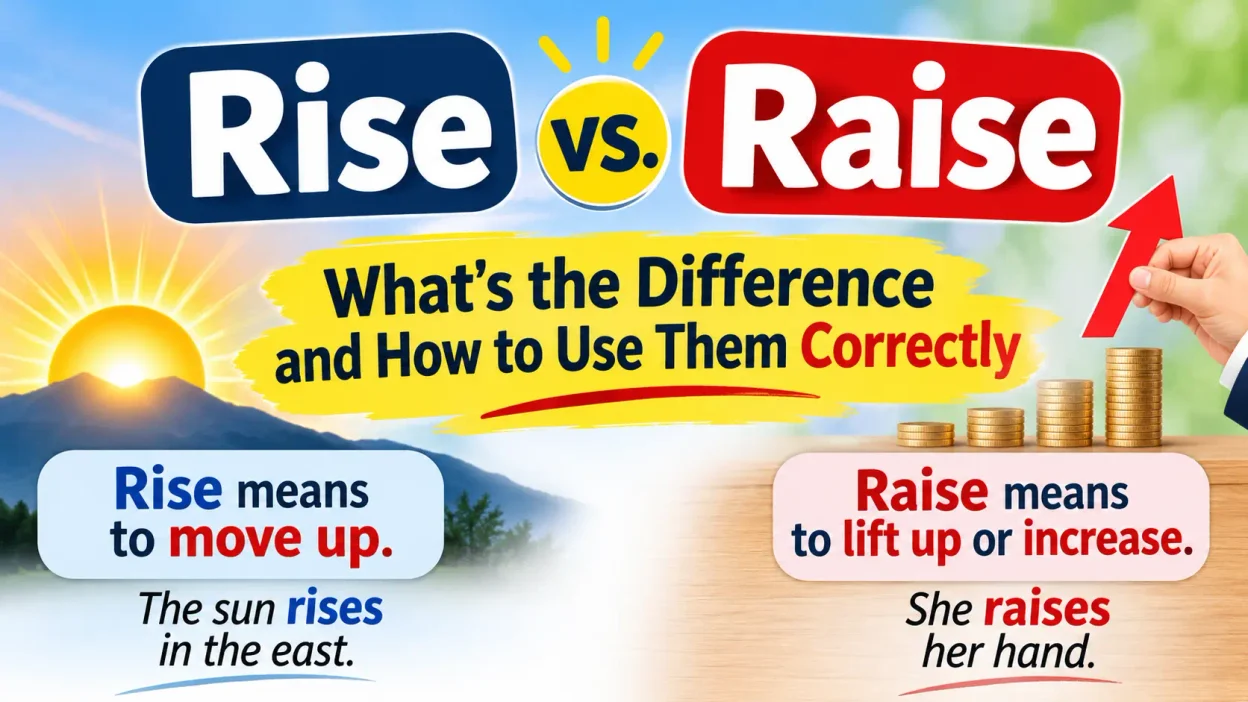
The main difference is that rise means to move upward or increase by itself, while raise means to lift or increase something else.
For example:
- The sun rises in the east.
- She raises her hand to ask a question.
- Prices rise every year.
- The company raises its prices.
The most important grammar difference is that rise is an intransitive verb, meaning it does not need a direct object, while raise is a transitive verb, meaning it normally needs a direct object.
In this guide, you will learn the meanings of rise and raise, their verb forms, grammar rules, common expressions, examples, and mistakes to avoid.
1. What Does Rise Mean?
The verb rise means to move upward, get up, increase, or become higher. It describes something moving or changing without directly acting on another object.
Rise is an intransitive verb, so it does not take a direct object.
Examples:
- The sun rises every morning.
- Hot air rises.
- The temperature rises during summer.
- Water levels rise after heavy rain.
- She rises early every day.
In these sentences, the subject itself moves upward or increases.
Common Uses of Rise
1. Moving upward
Use rise when something moves from a lower position to a higher one.
Examples:
- The balloon rose into the sky.
- Smoke rises from the chimney.
- The elevator rises to the tenth floor.
2. Increasing in amount or level
Rise can describe an increase in prices, temperatures, numbers, or other measurements.
Examples:
- Food prices continue to rise.
- The unemployment rate rose last year.
- The temperature is rising quickly.
3. Getting out of bed or standing up
Rise can also mean getting up from a bed, chair, or seated position.
Examples:
- I rise at six every morning.
- He rose from his chair.
- She rose early to prepare breakfast.
4. Becoming stronger or more powerful
Rise can describe someone or something gaining influence, status, or strength.
Examples:
- The young athlete rose to fame.
- The company rose to prominence.
- She rose above her difficulties.
2. What Does Raise Mean?
The verb raise means to lift, move, increase, or bring something to a higher level. Unlike rise, raise usually requires someone or something to perform the action on an object.
Raise is a transitive verb, so it normally takes a direct object.
Examples:
- Please raise your hand.
- They raised the flag.
- The company raised its prices.
- She raised three children.
- We need to raise enough money for the project.
In these sentences, the subject performs an action that affects another person or thing.
Common Uses of Raise
1. Lifting something
Use raise when someone or something lifts an object or body part.
Examples:
- He raised his arms.
- She raised the box above her head.
- The student raised his hand.
2. Increasing something
Raise is used when someone or an organization deliberately increases a price, amount, level, or salary.
Examples:
- The store raised its prices.
- The company raised employee salaries.
- The government raised taxes.
3. Bringing up children or animals
Raise can mean caring for and bringing up children or animals until they grow.
Examples:
- They raised four children.
- My grandparents raised chickens.
- She was raised in a small town.
4. Collecting money
Raise is commonly used when collecting money for a particular purpose.
Examples:
- The charity raised money for children.
- We raised $5,000 for the hospital.
- The organization is raising funds for education.
5. Introducing a question or concern
Raise can also mean bringing a topic, question, or issue to someone’s attention.
Examples:
- She raised an important question.
- He raised concerns about the project.
- The manager raised the issue during the meeting.
3. Rise vs. Raise: Key Differences
The main difference between rise and raise is whether the subject moves upward by itself or causes something else to move upward.
| Rise | Raise |
|---|---|
| Means to move upward or increase | Means to lift or increase something |
| Intransitive verb | Transitive verb |
| Does not take a direct object | Normally takes a direct object |
| The subject experiences the movement | The subject causes the movement |
| Example: Prices rise. | Example: Stores raise prices. |
| Example: The sun rises. | Example: She raises her hand. |
Compare These Examples
Example 1: Temperature
- The temperature rises during the afternoon.
- The heater raises the temperature of the room.
The first sentence describes an increase. The second explains what causes the temperature to increase.
Example 2: Hand
- The child rose from the floor.
- The child raised his hand.
The first sentence describes the child’s upward movement. The second describes the child lifting something: his hand.
Example 3: Prices
- Food prices rise during inflation.
- The store raises the prices of its products.
Prices increase in the first sentence. The store deliberately increases them in the second.
4. Rise vs. Raise: Verb Forms
One of the most important differences between these verbs is their past tense and past participle.
| Verb Form | Rise | Raise |
|---|---|---|
| Base form | Rise | Raise |
| Third-person singular | Rises | Raises |
| Past simple | Rose | Raised |
| Past participle | Risen | Raised |
| Present participle | Rising | Raising |
Important: Rise is an irregular verb, while raise is a regular verb.
Examples of Rise in Different Tenses
Present Simple
- The sun rises in the east.
- Prices rise every year.
Past Simple
- The sun rose at 6 a.m.
- The water level rose after the storm.
Present Perfect
- The temperature has risen significantly.
- Living costs have risen recently.
Present Continuous
- The balloon is rising.
- The number of visitors is rising.
Examples of Raise in Different Tenses
Present Simple
- She raises her hand in class.
- The company raises salaries annually.
Past Simple
- He raised his voice.
- They raised enough money for the project.
Present Perfect
- The organization has raised thousands of dollars.
- The school has raised its admission fees.
Present Continuous
- She is raising her hand.
- They are raising funds for charity.
5. Rise vs. Raise in Everyday English
Both verbs are common in daily conversations. Here are examples that show how to use them naturally.
At home:
- The sun rises early in summer.
- I usually rise before everyone else.
- Please raise the blinds.
- She raised the volume of the television.
At work:
- The company’s profits are rising.
- The manager raised an important concern.
- Employee satisfaction has risen.
- The company raised everyone’s salaries.
At school:
- The students rose from their seats.
- The teacher asked everyone to raise their hands.
- The number of students has risen.
- The school raised money for a charity.
In daily conversations:
- My blood pressure rises when I feel stressed.
- Can you raise the window?
- The cost of living has risen.
- They raised their children in the countryside.
6. Common Expressions with Rise
Rise appears in several common English expressions.
| Expression | Meaning | Example |
|---|---|---|
| Rise and shine | Wake up and get ready | Rise and shine! It’s morning. |
| Rise to fame | Become famous | The singer rose to fame quickly. |
| Rise above | Overcome a difficulty | She rose above the criticism. |
| Rise in price | Become more expensive | Fuel prices continue to rise. |
| Rise from the ashes | Recover or begin again | The business rose from the ashes. |
| Rise to power | Gain political authority | The leader rose to power. |
| Rise to the occasion | Respond successfully to a challenge | He rose to the occasion. |
| Give rise to | Cause something to happen | The decision gave rise to controversy. |
7. Common Expressions with Raise
Raise is also used in many fixed expressions.
| Expression | Meaning | Example |
|---|---|---|
| Raise a hand | Lift a hand | Raise your hand if you agree. |
| Raise money | Collect money | They raised money for charity. |
| Raise a family | Bring up children | She raised a family in London. |
| Raise awareness | Make people more informed | The campaign raises awareness about pollution. |
| Raise a question | Introduce a question | He raised an interesting question. |
| Raise concerns | Express worries | Residents raised concerns about safety. |
| Raise your voice | Speak more loudly | Please don’t raise your voice. |
| Raise the bar | Set a higher standard | The new policy raises the bar. |
| Raise funds | Collect financial support | The organization raised funds for research. |
| Raise an issue | Bring a matter to attention | She raised the issue during the meeting. |
8. Rise or Raise? Commonly Confused Sentences
Choosing between rise and raise becomes easier when you identify the subject and object.
| Correct Sentence | Explanation |
|---|---|
| The sun rises every morning. | The sun moves upward. |
| She raises her hand. | She lifts her hand. |
| Prices have risen. | Prices have increased. |
| The store raised its prices. | The store increased the prices. |
| The temperature rose. | The temperature increased. |
| The heater raised the temperature. | The heater caused an increase. |
| He rose from his chair. | He stood up. |
| He raised the box. | He lifted the box. |
| The river is rising. | The water level is increasing. |
| They raised the riverbank. | They made the riverbank higher. |
A Simple Test
Ask yourself:
Is something moving or increasing by itself?
Use rise.
- The balloon rises.
- Prices rise.
- The sun rises.
Is someone or something lifting or increasing another thing?
Use raise.
- She raises the balloon.
- The company raises prices.
- He raises his hand.
9. Common Mistakes to Avoid
English learners sometimes use rise and raise incorrectly because they have similar meanings.
Here are common mistakes with their corrections:
| Incorrect | Correct |
|---|---|
| She raised from her chair. | She rose from her chair. |
| The sun raises in the east. | The sun rises in the east. |
| Prices have raised. | Prices have risen. |
| He rose his hand. | He raised his hand. |
| The company rose its prices. | The company raised its prices. |
| The temperature has raised. | The temperature has risen. |
| They risen the flag. | They raised the flag. |
| The balloon is raising. | The balloon is rising. |
Tips to Remember
- Use rise when the subject moves upward or increases.
- Use raise when the subject lifts or increases something else.
- Remember that rise is irregular: rise, rose, risen.
- Remember that raise is regular: raise, raised, raised.
- Check whether the verb has a direct object.
- Learn common expressions such as rise to fame, raise money, and raise awareness.
10. Is Rise Transitive or Intransitive?
Rise is an intransitive verb, meaning it does not take a direct object.
Examples:
- The sun rises.
- The prices rose.
- The balloon is rising.
You cannot normally say, “She rose her hand,” because rise does not take the hand as a direct object.
Raise is a transitive verb, meaning it normally takes a direct object.
Examples:
- She raised her hand.
- They raised the flag.
- The company raised salaries.
The object receives the action of the verb.
This grammatical difference is one of the easiest ways to remember which verb to use.
11. Rise vs. Raise: Practice Exercises
Test your understanding by choosing the correct form of rise or raise.
Fill in the blanks:
- The sun _____ in the east.
- Please _____ your hand if you know the answer.
- Food prices have _____ recently.
- The company _____ employee salaries last year.
- The balloon is _____ into the sky.
- He _____ from his chair when the teacher entered.
- The charity has _____ thousands of dollars.
- The temperature _____ during the afternoon.
- Parents should _____ their children with care.
- The river level has _____ after the heavy rain.
Answers
- Rises
- Raise
- Risen
- Raised
- Rising
- Rose
- Raised
- Rises
- Raise
- Risen
12. Frequently Asked Questions About Rise vs. Raise
1. What is the main difference between rise and raise?
Rise means to move upward or increase without a direct object. Raise means to lift or increase something else and normally requires a direct object.
Examples:
- The temperature rises.
- The heater raises the temperature.
2. Is it rise your hand or raise your hand?
The correct expression is raise your hand because you are lifting your hand.
Example: Please raise your hand before speaking.
3. Is it prices rise or prices raise?
Use prices rise when describing prices increasing.
Example: Food prices rise during periods of inflation.
Use raise when someone deliberately increases prices.
Example: The company raised its prices.
4. What is the past tense of rise?
The past tense of rise is rose.
Example: The sun rose at 6:30 yesterday morning.
5. What is the past tense of raise?
The past tense of raise is raised.
Example: She raised her hand during the lesson.
6. What is the past participle of rise?
The past participle of rise is risen.
Example: The temperature has risen significantly.
7. What is the past participle of raise?
The past participle of raise is raised.
Example: They have raised enough money for the project.
8. Is rise a regular or irregular verb?
Rise is an irregular verb because its forms change from rise to rose to risen.
9. Is raise a regular or irregular verb?
Raise is a regular verb. Its past simple and past participle forms are both raised.
10. Do we say the sun rises or the sun raises?
The correct expression is the sun rises because the sun appears to move upward in the sky from our perspective.
11. Is it raise children or rise children?
The correct expression is raise children because parents bring up and care for their children.
Example: They raised three children.
12. Can rise and raise be used interchangeably?
No. Although both verbs can describe upward movement or an increase, their grammatical structures are different. Rise describes something moving or increasing, while raise describes someone or something causing another thing to move or increase.
Conclusion
Understanding the difference between rise vs. raise is essential for using English grammar correctly. Both verbs can describe upward movement or an increase, but they have different grammatical functions.
Use rise when something moves upward or increases by itself, as in “The sun rises,” “Prices rise,” and “The temperature has risen.”
Use raise when someone or something lifts or increases another thing, as in “Raise your hand,” “Raise money,” and “The company raised salaries.”
Remember the verb forms: rise, rose, risen and raise, raised, raised. With regular practice and attention to direct objects, you can use these verbs confidently in everyday English.