The words possibility and opportunity are closely related because both describe something that may happen or become available in the future. However, they have different meanings and are not always interchangeable.
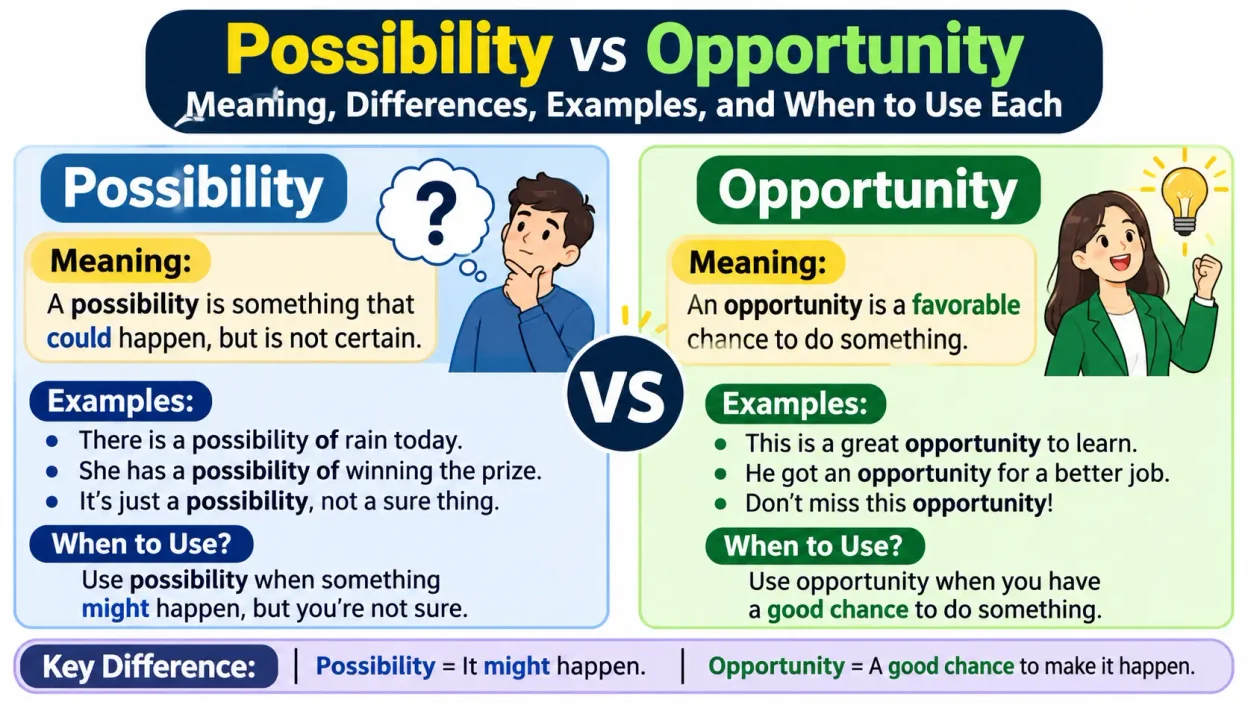
A possibility is something that may happen or be true. It refers to a potential outcome, situation, or event. An opportunity, on the other hand, is a favorable situation or set of circumstances that gives someone a chance to do something, achieve a goal, or make progress.
For example, getting a job abroad is a possibility if it could happen someday. Receiving a job offer from an international company is an opportunity because it gives you a concrete chance to work abroad.
Understanding the difference between possibility and opportunity can help you communicate more clearly in everyday conversations, professional writing, academic discussions, and decision-making.
What Does Possibility Mean?
Possibility is a noun that refers to something that can happen, exist, or be true. It describes potential rather than certainty.
A possibility may be positive, negative, or neutral. It does not necessarily mean that someone has a useful chance to take action. It simply means that something is conceivable or could occur.
Examples of Possibility
- There is a possibility of rain tomorrow.
- Moving to another country is a real possibility.
- We should consider every possibility before making a decision.
- There is a possibility that the project will be delayed.
- Learning a new language creates the possibility of working internationally.
In these examples, possibility describes something that may happen or exist.
Common Uses of Possibility
The word possibility is commonly used when discussing:
- Potential future events
- Uncertain outcomes
- Things that may be true
- Alternative explanations
- Available choices or scenarios
- Hypothetical situations
Example: There is a possibility that she will accept the invitation.
This sentence means that her acceptance may happen, but it is not certain.
What Does Opportunity Mean?
Opportunity is a noun that refers to a favorable situation, circumstance, or opening that allows someone to do something or achieve something.
Unlike possibility, opportunity usually suggests a chance for action, improvement, or progress. It often involves something valuable that a person can take advantage of.
Examples of Opportunity
- This internship is a great opportunity to gain experience.
- She received an opportunity to study abroad.
- Starting a business can be an exciting opportunity.
- The conference gave us an opportunity to meet industry experts.
- He took the opportunity to explain his ideas.
In these examples, opportunity refers to a favorable chance to do something.
Common Uses of Opportunity
The word opportunity is commonly used when discussing:
- Career and professional growth
- Education and learning
- Business and investment
- Personal development
- Social connections
- Favorable circumstances
- Chances to achieve specific goals
Example: The scholarship gave him an opportunity to attend university.
This sentence means that the scholarship created a practical chance for him to pursue higher education.
Possibility vs Opportunity: Key Differences
Although possibility and opportunity both refer to potential, they emphasize different aspects of a situation.
| Basis | Possibility | Opportunity |
|---|---|---|
| Meaning | Something that may happen or exist | A favorable chance to do something |
| Main focus | Potential or uncertainty | Action or advantage |
| Nature | Can be positive, negative, or neutral | Usually favorable |
| Certainty | Does not guarantee an outcome | Does not guarantee success |
| Action | May not require action | Often invites action |
| Context | Events, outcomes, and situations | Growth, achievement, and progress |
| Example | There is a possibility of promotion. | The company offered me an opportunity for promotion. |
The easiest way to remember the difference: A possibility is something that could happen, while an opportunity is a favorable chance to make something happen.
Possibility vs Opportunity in Example Sentences
Comparing the words in similar situations makes their differences easier to understand.
1. Career
- Possibility: There is a possibility that I will get a job in another country.
- Opportunity: I received an opportunity to work for an international company.
The first sentence describes a potential outcome. The second describes a real chance to pursue employment.
2. Education
- Possibility: Studying abroad is a possibility after graduation.
- Opportunity: The scholarship provides an opportunity to study abroad.
The first sentence discusses something that may happen. The second identifies a favorable chance.
3. Business
- Possibility: There is a possibility that the business will expand next year.
- Opportunity: The new market offers an opportunity to expand the business.
The possibility refers to a potential future event, while the opportunity refers to favorable circumstances for action.
4. Personal Development
- Possibility: Becoming a better public speaker is a possibility with regular practice.
- Opportunity: The speaking competition gives me an opportunity to improve my communication skills.
The first sentence describes potential improvement. The second identifies a practical way to achieve it.
5. Relationships
- Possibility: There is a possibility that they will become friends.
- Opportunity: The community event gives them an opportunity to get to know each other.
One describes what might happen, while the other describes a situation that makes it possible.
When to Use Possibility
Use possibility when you want to describe something that may happen, exist, or be true.
It is particularly useful when discussing uncertainty, predictions, hypothetical situations, and alternative outcomes.
Examples:
- There is a possibility of a power outage tonight.
- We cannot ignore the possibility of failure.
- Is there any possibility of changing the meeting date?
- The scientist discussed the possibility of discovering new planets.
- Moving to a different city remains a possibility.
Common Expressions with Possibility
- A strong possibility: Something that is quite likely to happen.
- A real possibility: Something that genuinely could happen.
- A slight possibility: Something that has a small chance of happening.
- A possibility of success: The potential to succeed.
- Consider the possibility: Think about something that might happen or be true.
When to Use Opportunity
Use opportunity when referring to a favorable situation that allows someone to take action, gain experience, or achieve something.
It is especially common in professional, educational, business, and personal-development contexts.
Examples:
- This position is an excellent opportunity for career growth.
- I appreciate the opportunity to work with your team.
- She took the opportunity to ask an important question.
- The training program offers an opportunity to develop new skills.
- We should take advantage of this opportunity.
Common Expressions with Opportunity
- A great opportunity: A particularly favorable chance.
- A golden opportunity: An unusually valuable chance.
- Career opportunity: A chance for professional advancement.
- Business opportunity: A favorable situation for commercial activity.
- Miss an opportunity: Fail to take advantage of a favorable chance.
- Seize an opportunity: Act quickly to benefit from a favorable situation.
Can Possibility and Opportunity Be Used Interchangeably?
No. Possibility and opportunity are not generally interchangeable because they communicate different ideas.
Consider these sentences:
- There is a possibility of getting a promotion.
- There is an opportunity to get a promotion.
The first sentence means that a promotion may happen. The second suggests that a favorable chance to earn or receive a promotion exists.
However, the two ideas can be connected. An opportunity can create a possibility, but not every possibility represents an opportunity.
For example, winning a lottery is a possibility, but buying a ticket does not necessarily represent a meaningful opportunity for career development. Receiving a paid internship, by contrast, may be an opportunity that creates the possibility of future employment.
The Relationship Between Possibility and Opportunity
Possibility and opportunity often work together, particularly when people make decisions or pursue goals.
A possibility represents what could happen. An opportunity provides favorable circumstances that may help someone turn that potential into reality.
For example, imagine someone wants to become a professional writer.
- Possibility: Becoming a published author is something that could happen.
- Opportunity: A publishing competition gives the person a chance to submit their work.
- Action: The person writes and submits a manuscript.
- Potential outcome: The manuscript may be selected for publication.
An opportunity does not guarantee success, just as a possibility does not guarantee that an event will occur. Both involve uncertainty, but opportunity emphasizes the chance to act.
Possibility vs Opportunity in Professional and Academic English
Both words are common in formal and professional communication, but they serve different purposes.
In Professional Communication
Use possibility when discussing potential outcomes, risks, or future plans.
Example: We should explore the possibility of expanding our services next year.
Use opportunity when discussing favorable circumstances, professional growth, or potential benefits.
Example: This partnership provides an opportunity to reach new customers.
In Academic Writing
Possibility is useful when discussing theories, explanations, hypotheses, and potential findings.
Example: The research examines the possibility of alternative explanations for the results.
Opportunity is useful when discussing access, development, learning, and practical benefits.
Example: The program creates an opportunity for students to gain practical research experience.
Choosing the correct word makes professional and academic writing more precise.
Common Mistakes to Avoid
Even though the difference is straightforward, these words are sometimes confused.
Mistake 1: Treating every possibility as an opportunity
Incorrect: There is a great possibility to improve my skills through this course.
Better: This course provides a great opportunity to improve my skills.
The second sentence is more natural because the course offers a favorable chance to develop skills.
Mistake 2: Using opportunity when discussing simple uncertainty
Less natural: There is an opportunity that it will rain tomorrow.
Better: There is a possibility that it will rain tomorrow.
Rain is a potential event, not a favorable chance to take action.
Mistake 3: Assuming an opportunity guarantees success
Incorrect idea: If you receive an opportunity, you will definitely succeed.
Correct understanding: An opportunity gives you a chance to pursue a goal, but the outcome depends on several factors.
Mistake 4: Confusing possibility with probability
Possibility means something can happen. Probability refers to how likely it is to happen.
For example, it is possible that a team will win a competition, but its probability of winning may be low.
Quick Tips to Remember the Difference
Use these simple guidelines when choosing between possibility and opportunity:
- Use possibility when something could happen.
- Use opportunity when someone has a favorable chance to do something.
- Use possibility for uncertainty, predictions, and potential outcomes.
- Use opportunity for career growth, education, business, and personal development.
- Remember that an opportunity can create a possibility, but the two words do not mean the same thing.
Conclusion
The main difference between possibility and opportunity is their focus. Possibility describes something that may happen, exist, or be true, while opportunity describes a favorable situation that gives someone a chance to take action or achieve a goal.
For example, getting a better job may be a possibility, while receiving an interview invitation is an opportunity to pursue that goal.
Both words are useful when discussing the future, making decisions, and considering personal or professional goals. By understanding their meanings and using them in the right contexts, you can make your English clearer, more natural, and more accurate.
Frequently Asked Questions (FAQs)
1. What is the main difference between possibility and opportunity?
Possibility refers to something that may happen or exist, while opportunity refers to a favorable chance to do something or achieve a goal.
2. Is possibility the same as opportunity?
No. Possibility describes potential, whereas opportunity describes a favorable situation that allows someone to take action. They are related but have different meanings.
3. Can an opportunity be a possibility?
Yes. An opportunity can create the possibility of achieving something. For example, a scholarship provides an opportunity to study abroad and makes earning an international degree more possible.
4. What is an example of possibility?
“There is a possibility that our team will win the competition.” This sentence describes an outcome that may happen but is not certain.
5. What is an example of opportunity?
“The internship provides an opportunity to gain professional experience.” This sentence describes a favorable chance to develop useful skills.
6. Is opportunity always positive?
Opportunity usually has a positive meaning because it refers to a favorable chance. However, an opportunity may involve challenges, risks, or responsibilities.
7. Is possibility positive or negative?
Possibility can be positive, negative, or neutral. For example, the possibility of success is positive, while the possibility of failure is negative.
8. What does it mean to seize an opportunity?
To seize an opportunity means to act quickly or confidently when a favorable chance becomes available.
9. What does a strong possibility mean?
A strong possibility means that something has a relatively high chance of happening, although it is not guaranteed.
10. Which word should I use for career growth: possibility or opportunity?
Use opportunity when referring to a favorable chance for career growth. Use possibility when discussing whether career growth may happen.
11. What is the difference between possibility and probability?
Possibility means that something can happen, while probability describes how likely it is to happen. Something may be possible even when its probability is very low.
12. Can I use possibility and opportunity in the same sentence?
Yes. For example: “This internship is an opportunity that creates the possibility of a permanent position.” The sentence correctly uses both words to express related but different ideas.