“Breath” and “breathe” are two English words that look almost identical, but they have different meanings, pronunciations, and grammatical functions. Because they differ by only one letter, many people confuse them in everyday writing, emails, conversations, and social media posts.
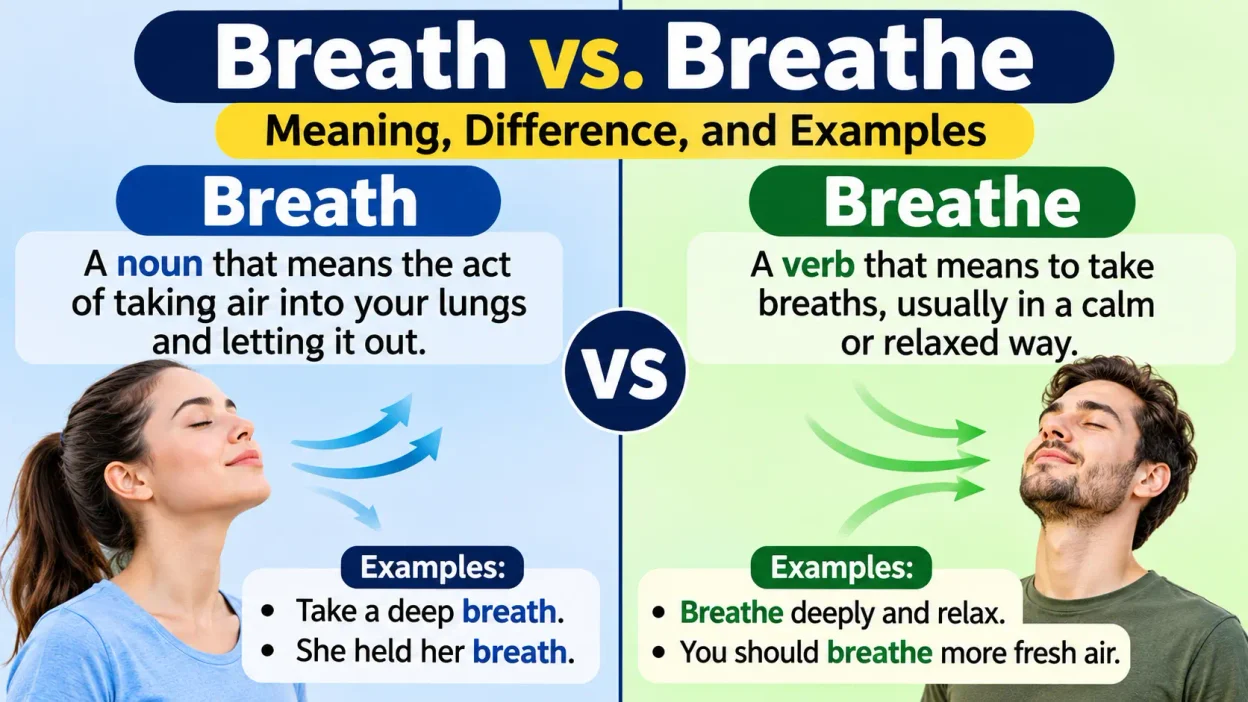
The easiest way to remember the difference is that breath is a noun referring to the air you take into or release from your lungs, while breathe is a verb describing the action of taking air in and letting it out.
For example:
- Take a deep breath before speaking.
- Remember to breathe slowly and calmly.
Although both words are related to respiration, using one instead of the other can make a sentence grammatically incorrect. This guide explains their meanings, pronunciation, differences, common expressions, and practical examples to help you use them correctly.
What Does Breath Mean?
Breath is a noun that refers to the air taken into or released from the lungs during breathing. It can also describe a single act of inhaling or exhaling.
The word is commonly used when talking about respiration, physical activity, emotions, freshness, and short periods of rest.
Examples of Breath in Sentences
- Take a deep breath before starting your presentation.
- She held her breath while waiting for the results.
- His breath smelled like peppermint.
- I could see my breath in the cold morning air.
- He was out of breath after running up the stairs.
- The singer took a quick breath between verses.
In each sentence, breath refers to air or a single instance of breathing.
Common Meanings of Breath
Breath can have several meanings depending on the context.
1. Air taken into or released from the lungs
Example: Take a slow breath and relax.
2. A single inhalation or exhalation
Example: She took one final breath before speaking.
3. The air coming from someone’s mouth or lungs
Example: His breath smelled of fresh mint.
4. A short pause or moment of rest
Example: Let’s take a breath before continuing the discussion.
5. A small amount of air or movement
Example: There wasn’t even a breath of wind outside.
What Does Breathe Mean?
Breathe is a verb that describes the action of taking air into the lungs and releasing it.
It refers to the process of respiration and can also be used figuratively to describe relaxation, relief, or having room to move and develop.
Examples of Breathe in Sentences
- Remember to breathe slowly during meditation.
- Fish breathe through their gills.
- It is difficult to breathe in a smoky room.
- She stopped running to breathe more comfortably.
- Take a moment to breathe and collect your thoughts.
- Plants also breathe through processes involving gas exchange.
Common Meanings of Breathe
1. To inhale and exhale
Example: Humans breathe continuously, even while sleeping.
2. To take air into the lungs
Example: Breathe deeply before beginning the exercise.
3. To release air from the lungs
Example: Breathe out slowly and relax your shoulders.
4. To rest or recover
Example: After finishing the project, the team finally had time to breathe.
5. To allow something room or freedom
Example: The new design gives the room space to breathe.
Breath vs. Breathe: Key Differences
The main difference between breath and breathe is their grammatical function. Breath is a noun, while breathe is a verb.
| Feature | Breath | Breathe |
|---|---|---|
| Part of speech | Noun | Verb |
| Meaning | Air taken in or released from the lungs | The action of inhaling and exhaling |
| Pronunciation | /breθ/ | /briːð/ |
| Final sound | Unvoiced TH, as in thin | Voiced TH, as in this |
| Example | Take a deep breath. | Breathe deeply. |
| Common phrase | Out of breath | Hard to breathe |
Quick rule: If you are talking about the air or a single inhalation or exhalation, use breath. If you are describing the action of inhaling and exhaling, use breathe.
Breath vs. Breathe Pronunciation
Another important difference between these words is their pronunciation.
Although they begin with the same letters, their vowel sounds and final consonant sounds are different.
- Breath sounds like “breth,” with a short E sound.
- Breathe sounds like “breeth,” with a long E sound.
The final TH sound also changes:
- Breath ends with an unvoiced TH sound, like the ending of thin.
- Breathe ends with a voiced TH sound, like the ending of this.
| Word | Pronunciation | Final Sound |
|---|---|---|
| Breath | BRETH | Unvoiced TH |
| Breathe | BREETH | Voiced TH |
Practicing these sounds can help you distinguish the words when speaking.
Breath vs. Breathe Examples in Everyday English
The following examples show how both words are used in common situations.
| Breath (Noun) | Breathe (Verb) |
|---|---|
| Take a deep breath. | Breathe deeply. |
| She held her breath. | She tried to breathe slowly. |
| I am out of breath. | I cannot breathe comfortably. |
| His breath smelled fresh. | He breathed in the fresh air. |
| Take a breath before speaking. | Remember to breathe while speaking. |
| The cold air took my breath away. | It is easier to breathe outside. |
Breath in Everyday Conversations
- I need a moment to catch my breath.
- Take a deep breath and relax.
- He was completely out of breath.
- She held her breath in excitement.
- The fresh air was a breath of fresh air.
Breathe in Everyday Conversations
- Just breathe and stay calm.
- You need to breathe more slowly.
- It is difficult to breathe in this room.
- Breathe in through your nose.
- I finally have room to breathe.
Common Expressions With Breath and Breathe
Both words appear in many familiar English expressions. Learning these phrases can help you understand their correct usage.
Common Expressions With Breath
| Expression | Meaning |
|---|---|
| Take a deep breath | Inhale deeply, often to relax |
| Out of breath | Having difficulty breathing after physical activity |
| Hold your breath | Stop breathing temporarily |
| Catch your breath | Recover normal breathing |
| A breath of fresh air | Something refreshing or new |
| Under your breath | Speaking quietly or softly |
| Waste your breath | Speak without achieving anything |
| With bated breath | Waiting anxiously or excitedly |
Examples:
- Take a deep breath before answering the question.
- I was out of breath after climbing the stairs.
- She whispered something under her breath.
- The new employee was a breath of fresh air.
Common Expressions With Breathe
| Expression | Meaning |
|---|---|
| Breathe deeply | Inhale and exhale slowly and fully |
| Breathe in | Inhale air |
| Breathe out | Exhale air |
| Breathe easily | Feel relaxed or free from worry |
| Breathe life into | Make something more active or interesting |
| Breathe a sigh of relief | Express relief through breathing |
| Live and breathe something | Be extremely interested or involved in something |
Examples:
- Breathe in slowly and breathe out gently.
- The new manager helped breathe life into the project.
- We could finally breathe easily after receiving the good news.
- She lives and breathes music.
Breath vs. Breathe: Common Mistakes to Avoid
Many people accidentally use breath when they mean breathe, or breathe when they mean breath. These errors often happen because the words have similar spelling and related meanings.
Here are some common mistakes and their corrections.
| Incorrect Sentence | Correct Sentence |
|---|---|
| Take a deep breathe. | Take a deep breath. |
| I cannot breath properly. | I cannot breathe properly. |
| She held her breathe. | She held her breath. |
| Remember to breath slowly. | Remember to breathe slowly. |
| He was out of breathe. | He was out of breath. |
| I need to catch my breathe. | I need to catch my breath. |
| Just take a moment to breath. | Just take a moment to breathe. |
| His breathe smelled fresh. | His breath smelled fresh. |
Why Do People Confuse Breath and Breathe?
There are several reasons these words are frequently mixed up:
- Similar spelling: Both words contain nearly the same letters, making them easy to confuse.
- Related meanings: Both are connected to the process of breathing.
- Different grammatical roles: Some writers forget that breath is a noun and breathe is a verb.
- Pronunciation differences: Their vowel sounds and final TH sounds are different, but these distinctions can be difficult for English learners.
The simplest way to avoid mistakes is to identify whether the sentence needs a noun or a verb.
Breath vs. Breathe: How to Remember the Difference
If you regularly confuse these words, try these simple memory tricks.
1. Remember that breath is a noun
Breath refers to the air itself or one instance of inhaling or exhaling.
Example: Take a deep breath.
2. Remember that breathe is an action
Breathe describes what a person or living organism does.
Example: Try to breathe slowly.
3. Look at the final letter
Breathe has an extra E at the end. You can associate this extra letter with the action of breathing.
4. Use the sentence test
Ask yourself:
- Am I talking about a thing or an amount of air? Use breath.
- Am I talking about an action? Use breathe.
For example:
- I need a breath. (Noun)
- I need to breathe. (Verb)
Breath vs. Breathe vs. Breathing: What Is the Difference?
Another related word is breathing. Although breath, breathe, and breathing are closely connected, they have different grammatical functions.
| Word | Part of Speech | Meaning | Example |
|---|---|---|---|
| Breath | Noun | Air taken into or released from the lungs | Take a deep breath. |
| Breathe | Verb | To inhale and exhale | Remember to breathe. |
| Breathing | Noun or verb form | The process or action of respiration | Her breathing became slower. |
Examples of Breathing
As a noun:
- Deep breathing can help some people relax.
- His breathing was slow and steady.
As a verb form:
- She is breathing normally.
- They were breathing heavily after the race.
Remember:
- Breath: The air or a single inhalation or exhalation.
- Breathe: The action of inhaling and exhaling.
- Breathing: The ongoing process or activity of respiration.
Breath vs. Breathe: Practice Quiz
Test your understanding by choosing the correct word in each sentence.
- Take a deep _____ before you begin.
- Remember to _____ slowly during meditation.
- He was out of _____ after running.
- It is difficult to _____ in a smoky room.
- She held her _____ while watching the performance.
- You should _____ through your nose.
- I need a moment to catch my _____.
- Plants and animals _____ in different ways.
Answers
- Breath
- Breathe
- Breath
- Breathe
- Breath
- Breathe
- Breath
- Breathe
If you answered all eight correctly, you understand the difference between breath and breathe.
Frequently Asked Questions (FAQs)
1. What is the main difference between breath and breathe?
Breath is a noun that refers to the air taken into or released from the lungs. Breathe is a verb that describes the action of inhaling and exhaling.
Example: Take a deep breath and breathe slowly.
2. Is it take a breath or take a breathe?
The correct expression is take a breath because breath is a noun.
Example: Take a deep breath before speaking.
3. Is it hard to breath or hard to breathe?
The correct expression is hard to breathe because the word after “to” is the base form of a verb.
Example: It is hard to breathe in a room filled with smoke.
4. Is it out of breath or out of breathe?
The correct phrase is out of breath. Breath is a noun referring to air or the act of breathing.
Example: I was out of breath after running.
5. Is breath a noun or a verb?
Breath is a noun. It refers to the air that enters or leaves the lungs or a single inhalation or exhalation.
Example: Her breath was visible in the cold air.
6. Is breathe a noun or a verb?
Breathe is a verb. It describes the action of inhaling and exhaling air.
Example: Humans breathe throughout the day and night.
7. What is the past tense of breathe?
The past tense of breathe is breathed.
Examples:
- She breathed deeply before speaking.
- He breathed a sigh of relief.
- The athlete breathed heavily after the race.
8. What is the adjective form of breath?
The adjective breathless describes someone who is out of breath, or something that creates intense excitement or suspense.
Example: She was breathless after climbing the hill.
9. What is the plural of breath?
The plural of breath is breaths.
Example: Take three slow breaths before beginning the exercise.
10. How can I remember breath and breathe?
Remember that breath is a noun and breathe is a verb. Breath refers to the air, while breathe describes the action of taking air in and letting it out.
Conclusion
Understanding the difference between breath vs. breathe becomes easy when you remember their grammatical roles. Breath is a noun that refers to the air you inhale or exhale, while breathe is a verb that describes the action of inhaling and exhaling.
Use breath in expressions such as “take a deep breath,” “hold your breath,” and “out of breath.” Use breathe in sentences such as “remember to breathe,” “breathe slowly,” and “learn to breathe properly.”
The simplest memory trick is to remember that breath is something you take, while breathe is something you do. With a little practice, you can use both words confidently and avoid one of the most common English spelling mistakes.