“Loose” and “lose” are two commonly confused English words. They look and sound similar, but they have different meanings, pronunciations, and grammatical uses. Using the wrong one can change the meaning of a sentence or make your writing look less polished.
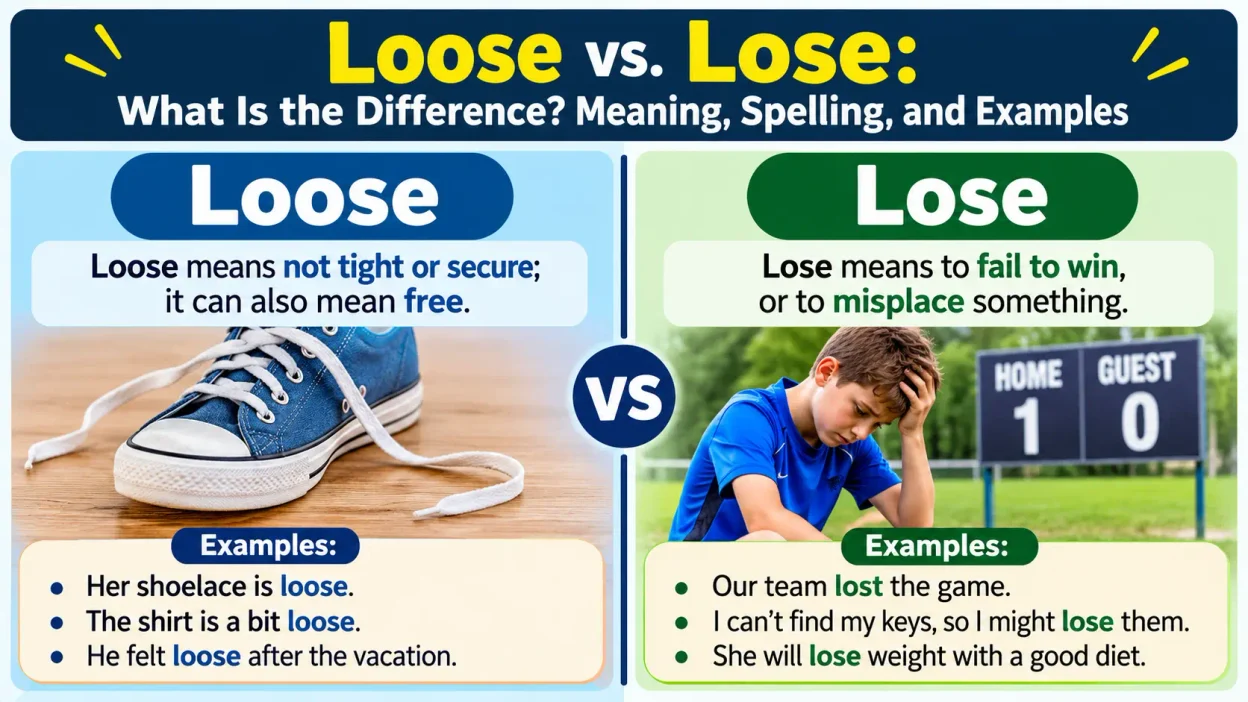
The easiest way to remember the difference is that loose usually describes something that is not tight, secure, or firmly attached, while lose means to misplace something, fail to keep it, or not win a competition.
For example:
- My shirt is too loose around the waist.
- Be careful not to lose your keys.
Although the words differ by only one letter, they serve completely different purposes. Let’s explore their meanings, pronunciation, grammar rules, and examples so you can use them correctly.
What Does Loose Mean?
Loose is primarily an adjective that describes something that is not tight, firmly fixed, securely attached, or closely controlled.
It can refer to clothing, objects, physical connections, rules, relationships, or situations.
Examples of Loose in Sentences
- These shoes are too loose for my feet.
- The dog escaped because its collar was loose.
- She prefers wearing loose clothing in summer.
- There is a loose button on my jacket.
- The company has loose rules about working hours.
- A loose connection caused the computer to stop working.
In each example, loose describes a condition in which something is not tight, firmly attached, or strictly controlled.
Common Meanings of Loose
Loose can have several related meanings depending on the context.
1. Not tight
Used for clothing, objects, or anything that does not fit closely.
Example: These trousers are too loose around the waist.
2. Not securely attached
Describes something that is moving, detached, or not firmly fixed.
Example: There is a loose wire behind the television.
3. Not strict or controlled
Refers to rules, arrangements, or restrictions that are flexible.
Example: The school has relatively loose regulations.
4. Not closely connected
Describes a weak or informal relationship between ideas, people, or events.
Example: The two stories have a loose connection.
5. Free or released
In expressions such as “let loose,” the word suggests allowing someone or something to move or behave freely.
Example: The children were finally let loose in the playground.
What Does Lose Mean?
Lose is a verb that means to misplace something, fail to keep something, experience a loss, or fail to win.
Unlike loose, which describes a condition, lose expresses an action or outcome.
Examples of Lose in Sentences
- Don’t lose your phone while traveling.
- Our team might lose the final match.
- I don’t want to lose this opportunity.
- You can lose weight through healthy habits and regular exercise.
- She was afraid of losing her best friend.
- If you don’t save your work, you may lose your progress.
In these examples, lose describes something that happens or could happen.
Common Meanings of Lose
1. To misplace something
Example: I always lose my sunglasses.
2. To fail to win
Example: Our team did not want to lose the championship.
3. To stop having something
Example: He did not want to lose his job.
4. To experience a reduction
Example: The company may lose money this year.
5. To become separated from someone or something
Example: We were careful not to lose sight of the children.
6. To fail to maintain something
Example: You should not lose confidence after making a mistake.
Loose vs. Lose: Key Differences
The main difference between loose and lose is their meaning and grammatical function. Loose is generally an adjective, whereas lose is a verb.
| Feature | Loose | Lose |
|---|---|---|
| Part of speech | Usually an adjective | Verb |
| Meaning | Not tight, secure, or firmly fixed | To misplace, fail to keep, or fail to win |
| Pronunciation | /luːs/ | /luːz/ |
| Final sound | S sound | Z sound |
| Example | My jacket is loose. | Don’t lose your jacket. |
| Related word | Loosen | Loss |
Quick rule: If you are describing something that is not tight, use loose. If you are talking about misplacing something or failing to win, use lose.
Loose vs. Lose Pronunciation
One reason people confuse these words is that their spelling is very similar. However, their final sounds are different.
- Loose rhymes with moose and ends with an S sound.
- Lose rhymes with choose and ends with a Z sound.
Listen to the difference:
- Loose: LOO-S
- Lose: LOO-Z
The vowel sound is similar, but the final consonant sound changes the pronunciation.
Remembering the final sound can help you distinguish the two words when speaking.
Loose vs. Lose Examples in Everyday English
The following examples show how these words are used in common situations.
| Sentence with Loose | Sentence with Lose |
|---|---|
| My shoes are too loose. | I don’t want to lose my shoes. |
| The screw is loose. | Don’t lose the screw. |
| She wears loose clothes. | She doesn’t want to lose her clothes. |
| The dog has a loose collar. | Be careful not to lose the dog’s collar. |
| The company has loose policies. | The company could lose its customers. |
| My hair is loose today. | I don’t want to lose my hairbrush. |
Loose in Everyday Conversations
- Your shoelaces are loose.
- I like wearing loose shirts.
- The handle feels loose.
- Keep an eye on that loose cable.
- The rules are too loose.
Lose in Everyday Conversations
- Don’t lose your wallet.
- I hope we don’t lose the game.
- You should never lose hope.
- I don’t want to lose contact with you.
- Try not to lose your patience.
Common Expressions With Loose and Lose
Both words appear in many common English expressions. Learning these phrases can make it easier to recognize the correct spelling.
Common Expressions With Loose
| Expression | Meaning |
|---|---|
| Let loose | To allow freedom or behave without restraint |
| Loose ends | Unfinished details or unresolved matters |
| Play fast and loose | To act carelessly or irresponsibly |
| On the loose | Free and not under control |
| Loose change | Small coins |
| Hang loose | Stay relaxed or calm |
Examples:
- The children were allowed to let loose at the party.
- We still have a few loose ends to address.
- The escaped animal is still on the loose.
Common Expressions With Lose
| Expression | Meaning |
|---|---|
| Lose weight | To become lighter in body weight |
| Lose hope | To stop believing that something good will happen |
| Lose control | To stop being able to manage something |
| Lose track | To stop knowing where something or someone is |
| Lose interest | To stop being interested |
| Lose your temper | To become angry |
Examples:
- She wants to lose weight gradually.
- Never lose hope during difficult times.
- I lost track of time while reading.
Loose vs. Lose: Common Mistakes to Avoid
Many English learners accidentally use loose when they mean lose, or lose when they mean loose. These mistakes are common in emails, social media posts, text messages, and everyday writing.
Here are some incorrect sentences and their corrections.
| Incorrect Sentence | Correct Sentence |
|---|---|
| Don’t loose your keys. | Don’t lose your keys. |
| My shoes are too lose. | My shoes are too loose. |
| I don’t want to loose the game. | I don’t want to lose the game. |
| This shirt is very lose. | This shirt is very loose. |
| Never loose hope. | Never lose hope. |
| The screw is lose. | The screw is loose. |
| I might loose my job. | I might lose my job. |
| Her dress is too lose. | Her dress is too loose. |
Why Do People Confuse Loose and Lose?
There are three main reasons:
- Similar spelling: Both words contain almost the same letters, making them easy to mix up.
- Similar pronunciation: Their vowel sounds are identical, although their final consonant sounds differ.
- Frequent typing mistakes: People sometimes add an extra O to lose because they associate the spelling with loose.
The best way to avoid these mistakes is to remember that loose describes something, while lose expresses an action or outcome.
Easy Tricks to Remember Loose vs. Lose
If you regularly confuse these words, try these simple memory tricks.
1. Remember the extra O in loose
Loose has two O’s. Think of the extra O as creating extra space, like loose clothing that does not fit tightly.
2. Associate lose with losing something
Lose has only one O. Remember the sentence: “Don’t lose your one opportunity.”
3. Focus on the final sound
- Loose ends with an S sound.
- Lose ends with a Z sound.
4. Check the sentence meaning
Ask yourself:
- Am I describing something that is not tight? Use loose.
- Am I talking about misplacing something or failing to win? Use lose.
These simple tricks can help you choose the correct word without hesitation.
Loose vs. Lose vs. Loss: What Is the Difference?
Another word that often causes confusion is loss. Although loose, lose, and loss are related in spelling and meaning, they have different grammatical functions.
| Word | Part of Speech | Meaning | Example |
|---|---|---|---|
| Loose | Adjective | Not tight or secure | The lid is loose. |
| Lose | Verb | To misplace or fail to win | Don’t lose the lid. |
| Loss | Noun | The act or result of losing | The team suffered a loss. |
Examples of Loss
- Losing the competition was a major loss for the team.
- The company reported a financial loss.
- She experienced the loss of a close friend.
- The loss of important documents caused problems.
Remember:
- Loose: Not tight.
- Lose: To misplace or fail to win.
- Loss: The result or experience of losing.
Loose vs. Lose: Practice Quiz
Test your understanding by choosing the correct word in each sentence.
- Don’t _____ your passport while traveling.
- These shoes are too _____ for me.
- I don’t want to _____ this opportunity.
- The handle on the door is _____.
- Never _____ confidence in yourself.
- The dog escaped because its collar was _____.
- Our team doesn’t want to _____ the final match.
- She prefers wearing _____ clothes.
Answers
- Lose
- Loose
- Lose
- Loose
- Lose
- Loose
- Lose
- Loose
If you answered all eight correctly, you understand the difference between loose and lose.
Frequently Asked Questions (FAQs)
1. What is the main difference between loose and lose?
Loose is an adjective that describes something that is not tight, secure, or firmly attached. Lose is a verb that means to misplace something, fail to keep it, or fail to win.
2. Is it lose weight or loose weight?
The correct expression is lose weight. Lose is a verb that describes a reduction in body weight. Loose weight is incorrect in this context.
Example: She wants to lose weight through regular exercise.
3. Is it loose or lose your keys?
The correct phrase is lose your keys because lose means to misplace something.
Example: Be careful not to lose your keys.
4. Is it loose or lose clothing?
The correct word is loose clothing because loose describes clothing that does not fit tightly.
Example: I prefer wearing loose clothing during hot weather.
5. Is loose an adjective or a verb?
Loose is primarily an adjective, but it can also be used as a verb meaning to release or set something free.
Example as an adjective: The screw is loose.
Example as a verb: They decided to loose the animals into the field.
6. Is lose a verb or an adjective?
Lose is a verb. It describes an action or situation involving misplacing something, failing to win, or no longer having something.
Example: I don’t want to lose my phone.
7. What is the past tense of lose?
The past tense of lose is lost.
Examples:
- I lost my wallet yesterday.
- Our team lost the match.
- She lost her favorite necklace.
8. What is the opposite of loose?
Depending on the context, the opposite of loose can be tight, firm, secure, or fastened.
Example: These shoes are loose, but those shoes are tight.
9. What is the noun form of lose?
The noun form associated with lose is loss.
Example: The unexpected loss affected the entire team.
10. How can I remember loose and lose?
Remember that loose has an extra O, which can remind you of extra space or something that is not tight. Lose has one O and means to misplace something or fail to win.
Conclusion
Understanding the difference between loose vs. lose is simple once you remember their meanings and grammatical roles. Loose describes something that is not tight, secure, or firmly attached, while lose is a verb meaning to misplace something, fail to keep it, or fail to win.
Use loose when describing loose clothing, a loose button, or a loose connection. Use lose when talking about losing your keys, losing a game, or losing confidence.
The easiest memory trick is to remember the extra O in loose as extra space. With regular practice and attention to sentence meaning, you can avoid this common spelling mistake and use both words confidently.