The words to and too look and sound almost identical, but they have different meanings and grammatical functions. Because they are pronounced the same way, it is easy to confuse them when writing emails, messages, essays, or everyday sentences.
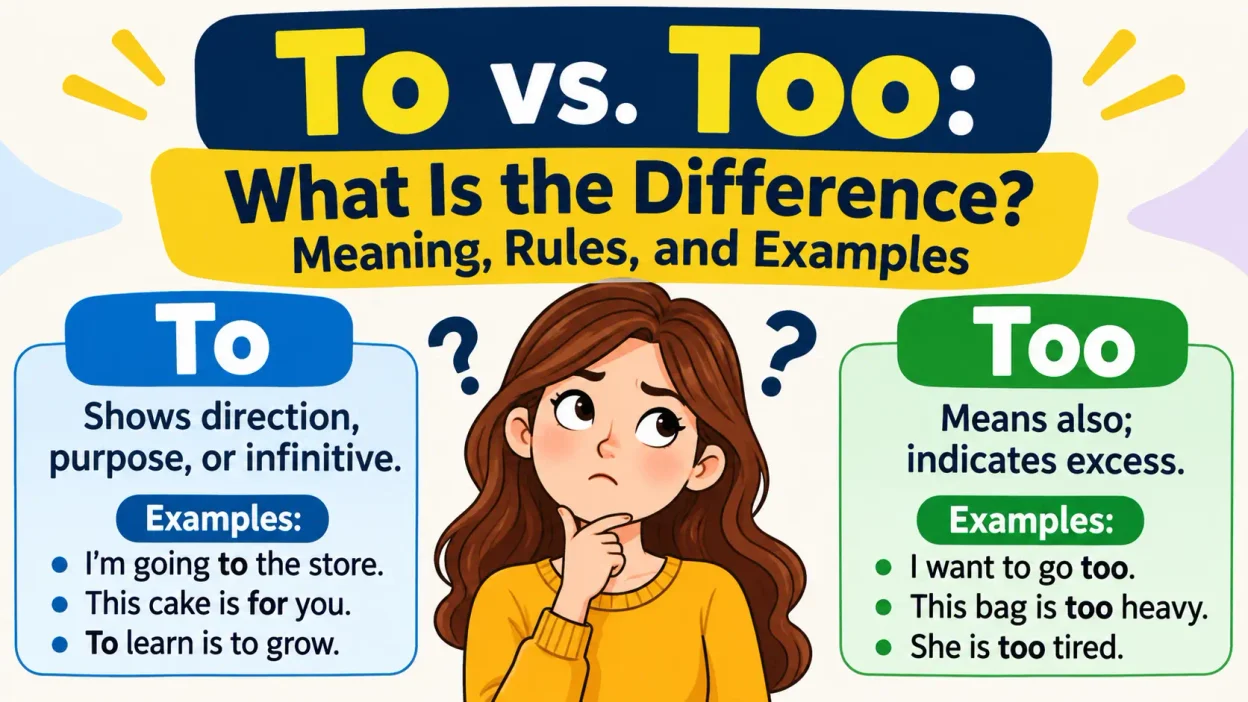
The main difference is simple: to is commonly used as a preposition or as part of an infinitive verb, while too is an adverb meaning “also” or “more than necessary.”
For example:
- I want to learn English.
- I want to go too.
- This coffee is too hot.
In the first sentence, “to” introduces the infinitive verb “learn.” In the second, the first “to” introduces “go,” while “too” means “also.” In the third, “too” indicates an excessive degree.
Understanding these differences will help you avoid common spelling mistakes and make your writing clearer. This guide explains the meanings, grammar rules, examples, and practical ways to remember when to use to and too.
What Is the Difference Between To and Too?
The primary difference between to and too is their meaning and grammatical role.
| Word | Part of Speech | Meaning | Example |
|---|---|---|---|
| To | Preposition or infinitive marker | Direction, destination, relationship, or purpose | She went to school. |
| Too | Adverb | Also, or more than necessary | I want to come too. |
To usually expresses movement toward a place, a connection between things, or an infinitive verb.
Too usually means “also,” “as well,” or “excessively.”
Remember that both words are pronounced the same in standard English, but they cannot be used interchangeably.
What Does To Mean?
To is a common English word used primarily as a preposition and as an infinitive marker. Its meaning depends on the sentence.
1. To as a Preposition of Direction or Movement
When used as a preposition, “to” can show movement toward a particular place or destination.
Examples:
- We are going to the market.
- She walked to the library.
- He drove to the airport.
- They traveled to London last summer.
- I sent my brother to the store.
In these sentences, “to” indicates where someone or something is going.
2. To as an Infinitive Marker
“To” is used before the base form of a verb to create an infinitive.
Examples:
- I want to sleep.
- She likes to read.
- They decided to leave early.
- He needs to study for the exam.
- We hope to visit Japan.
In these examples, “to” comes before verbs such as sleep, read, leave, study, and visit.
3. To Showing a Recipient
“To” can identify the person or thing receiving something.
Examples:
- I gave the book to my sister.
- She sent an email to her manager.
- He explained the problem to his teacher.
- Please pass the message to John.
4. To Showing Time or a Limit
“To” can also express a time range, a boundary, or a limit.
Examples:
- The shop is open from 9 a.m. to 6 p.m.
- We have five minutes to finish.
- The temperature dropped from 20 degrees to 10 degrees.
- The meeting runs from Monday to Wednesday.
5. To Showing Purpose or Intention
“To” can introduce an infinitive phrase that explains why someone does something.
Examples:
- I went outside to get some fresh air.
- She studies hard to pass her exams.
- He saved money to buy a car.
- They called us to share the news.
What Does Too Mean?
Too is an adverb with two main uses. It can mean “also” or “as well,” and it can describe something that exceeds a suitable, expected, or desirable amount.
1. Too Meaning Also or As Well
Use “too” when you want to say that something applies to another person or situation.
Examples:
- I love chocolate too.
- She wants to come too.
- He is a talented musician too.
- We enjoyed the movie too.
- You can join us too.
In these sentences, “too” means “also.”
It often appears at the end of a sentence, although it can appear in other positions for emphasis or a particular writing style.
2. Too Meaning Excessively
“Too” can also indicate that something is more than necessary, appropriate, or desirable.
Examples:
- This bag is too expensive.
- The soup is too hot.
- He speaks too quickly.
- The room is too small.
- She is too tired to work.
In these examples, “too” suggests an excessive degree.
3. Too Followed by an Adjective
“Too” commonly appears before adjectives to show that something exceeds a particular limit.
Examples:
- The box is too heavy.
- The weather is too cold.
- This question is too difficult.
- The music is too loud.
4. Too Followed by an Adverb
“Too” can also modify an adverb to describe an excessive degree.
Examples:
- You are driving too fast.
- She arrived too late.
- He talks too loudly.
- They worked too slowly.
5. The Structure Too…To
The structure too + adjective or adverb + to + base verb explains that something has an excessive quality that prevents an action.
Examples:
- I am too tired to study.
- The box is too heavy to lift.
- She was too nervous to speak.
- The coffee is too hot to drink.
Notice that both words can appear in the same sentence. “Too” expresses excess, while “to” introduces the verb.
To vs. Too: Comparison Table
The following table makes the difference between these two words easier to understand.
| Feature | To | Too |
|---|---|---|
| Part of speech | Preposition or infinitive marker | Adverb |
| Main meaning | Direction, relationship, or infinitive | Also or excessively |
| Common position | Before a noun, pronoun, or base verb | Often at the end or before an adjective/adverb |
| Indicates direction | Yes | No |
| Introduces an infinitive | Yes | No |
| Means also | No | Yes |
| Shows excess | No | Yes |
| Example | I need to leave. | I need to leave too. |
When to Use To vs. Too
Choosing the correct word becomes easier when you identify what you want the sentence to communicate.
Use To When Talking About Direction
If you are describing movement toward a person, place, or destination, use “to.”
Correct: She went to the hospital.
Incorrect: She went too the hospital.
Use To Before an Infinitive Verb
When “to” introduces the base form of a verb, use “to.”
Correct: I want to learn French.
Incorrect: I want too learn French.
Use Too When You Mean Also
If you can replace the word with “also” or “as well,” use “too.”
Correct: My brother is coming too.
Meaning: My brother is also coming.
Incorrect: My brother is coming to.
Use Too to Show Excess
If you mean “more than necessary” or “excessively,” use “too.”
Correct: The dress is too expensive.
Incorrect: The dress is to expensive.
Use Both Words When Necessary
Some sentences naturally require both words because they perform different grammatical functions.
Examples:
- I want to come too.
- She is too busy to talk.
- He decided to invite us too.
- The water is too cold to swim in.
Common Mistakes When Using To and Too
Because “to” and “too” sound alike, writers sometimes choose the wrong spelling. Here are common mistakes and their corrections.
| Incorrect Sentence | Correct Sentence |
|---|---|
| I want too go home. | I want to go home. |
| She is going too school. | She is going to school. |
| This coffee is to hot. | This coffee is too hot. |
| I like pizza to. | I like pizza too. |
| He is to tired to work. | He is too tired to work. |
| Can I come to? | Can I come too? |
| They went too the park. | They went to the park. |
| It is to late now. | It is too late now. |
Why Do People Confuse To and Too?
There are several reasons:
- Identical pronunciation: Both words are pronounced /tuː/ in standard English.
- Similar spelling: The words differ by only one letter.
- Fast typing: People may choose the wrong word when writing quickly.
- Autocorrect mistakes: Spell-checking tools may not recognize a grammatical error when the misspelled choice is itself a valid word.
The best way to avoid these mistakes is to understand the meaning of each word instead of relying only on how it sounds.
Easy Tricks to Remember To vs. Too
If you frequently confuse these words, a few simple memory tricks can help.
1. Remember That Too Has an Extra O
The word too has an extra “o.” Think of that extra letter as representing “extra” or “more than necessary.”
For example:
- The bag is too heavy.
- The room is too hot.
- The price is too high.
This trick is especially useful when “too” means excessively.
2. Replace Too With Also
When you are unsure whether to use “too,” try replacing it with “also.”
- I want to come too.
- I also want to come.
Both sentences communicate the same idea, so “too” is correct.
3. Look for a Verb After To
If the word introduces a base-form verb, it is usually the infinitive marker “to.”
Examples:
- To eat
- To sleep
- To learn
- To travel
- To write
For example: “She wants to travel.”
4. Check Whether the Sentence Shows Direction
If the sentence describes movement toward a destination or person, use “to.”
Example: “We walked to the beach.”
To vs. Too in Everyday English
Understanding these words is useful in daily conversations, professional writing, school assignments, and online communication.
| Situation | Correct Example |
|---|---|
| Everyday conversation | I want to go home. |
| Text messaging | I want to come too. |
| Workplace communication | Please send the report to your manager. |
| Academic writing | Students need to understand the instructions. |
| Shopping | This product is too expensive. |
| Travel | We are traveling to Canada. |
| Social invitations | You are welcome to join us too. |
Practice Exercise: To or Too?
Test your understanding by choosing the correct word in each sentence.
- I want ___ learn Spanish.
- This room is ___ small for our family.
- She is going ___ the supermarket.
- Can I come ___?
- He is ___ tired to continue.
- We need ___ finish the project.
- The movie was ___ long.
- I would like ___ order a coffee.
- My sister wants to travel ___.
- The weather is ___ cold today.
Answers and Explanations
- To – It introduces the infinitive verb “learn.”
- Too – It means excessively small.
- To – It indicates the destination.
- Too – It means “also.”
- Too – It indicates an excessive level of tiredness.
- To – It introduces the infinitive verb “finish.”
- Too – It means excessively long.
- To – It introduces the infinitive verb “order.”
- Too – It means “also.”
- Too – It means excessively cold.
Frequently Asked Questions About To vs. Too
Is it to or too?
Both spellings are correct, but they have different meanings. Use “to” for direction, relationships, and infinitive verbs. Use “too” when you mean “also” or “excessively.”
What is the easiest way to remember to vs. too?
Remember that “too” has an extra “o.” You can associate that extra letter with something extra or excessive. You can also replace “too” with “also” to check whether it is correct.
Is it I want to or I want too?
The correct expression is “I want to” when it is followed by a verb.
Example: I want to sleep.
However, “I want to come too” is also correct because the first “to” introduces the verb and the second “too” means “also.”
Is it me too or me to?
The correct expression is “me too” when you want to say that you share someone’s feeling, opinion, or experience.
Example:
Person A: I love summer.
Person B: Me too!
“Me to” is not correct for this meaning.
Is it too much or to much?
The correct phrase is “too much.” It means more than necessary or an excessive amount.
Example: There is too much sugar in this tea.
Is it too late or to late?
The correct phrase is “too late.” Here, “too” means excessively or beyond the appropriate time.
Example: It is too late to call him now.
Is it going to or going too?
Use “going to” when referring to a destination or a future action.
Examples:
- I am going to school.
- I am going to study tonight.
Use “going too” when you mean that someone is also going.
Example: I am going too.
Can to and too be used in the same sentence?
Yes. They often appear together because they have different grammatical functions.
Example: She is too busy to attend the meeting.
Here, “too” means excessively, while “to” introduces the verb “attend.”
Is too always negative?
No. “Too” can be neutral or positive when it means “also.”
Example: I would love to visit Paris too.
However, when it means excessively, it often suggests that something is beyond a desirable limit.
Conclusion
The difference between to and too becomes easy once you understand their meanings and grammatical roles. “To” is generally used to express direction, relationships, or infinitive verbs, while “too” means “also” or “more than necessary.”
Remember these simple rules:
- Use to for direction: She went to school.
- Use to before an infinitive: I want to learn.
- Use too to mean also: I want to come too.
- Use too to express excess: The coffee is too hot.
Although these words sound alike, their meanings are different. By practicing these rules and checking the meaning of each sentence, you can use to and too confidently in everyday writing.