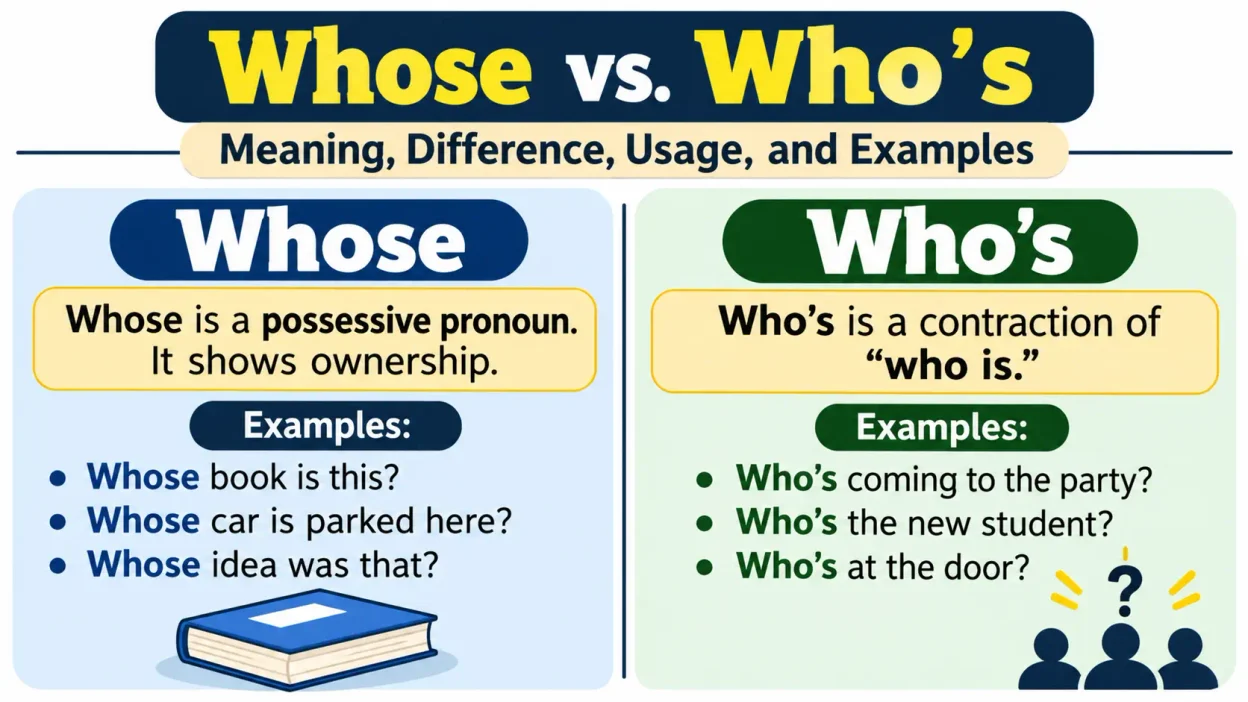
“Whose” and “who’s” are two commonly confused words in English. They sound exactly alike, but they have different meanings and grammatical functions. The main difference is that “whose” shows possession or ownership, while “who’s” is a contraction of “who is” or “who has.”
Understanding when to use each word can help you avoid common grammar mistakes and make your writing clearer. Whether you are writing an email, an academic assignment, or everyday messages, knowing the difference between whose and who’s is essential.
Whose vs. Who’s: Quick Difference
- Whose: A possessive pronoun or determiner used to ask who owns something or to show a relationship with someone.
- Who’s: A contraction of “who is” or “who has.”
Examples:
- Whose phone is ringing?
- Who’s calling me?
- Whose jacket is this?
- Who’s coming to the party?
A simple way to remember the difference is to replace “who’s” with “who is” or “who has.” If the sentence still makes sense, use “who’s.” Otherwise, you probably need “whose.”
What Does Whose Mean?
“Whose” is a possessive form of “who.” It is used to ask about ownership, possession, or the person associated with something.
It can appear in direct questions, indirect questions, and relative clauses.
Examples of Whose in Sentences
- Whose bag is lying on the floor?
- Do you know whose car is parked outside?
- The student whose notebook went missing reported it.
- Whose idea was it to organize the event?
- I met a writer whose books are popular worldwide.
In each example, “whose” connects something to the person who owns it or is associated with it.
What Does Who’s Mean?
“Who’s” is a contraction that combines the pronoun “who” with either “is” or “has.” The apostrophe represents the missing letters.
1. Who’s = Who Is
Use “who’s” when you mean “who is.”
Examples:
- Who’s your favorite singer?
- Who’s waiting outside?
- Who’s responsible for this project?
- Do you know who’s at the door?
- Who’s ready for dinner?
You can replace “who’s” with “who is” in all these sentences without changing their basic meaning.
2. Who’s = Who Has
“Who’s” can also mean “who has,” particularly when followed by a past participle.
Examples:
- Who’s finished the assignment?
- Who’s seen my keys?
- Who’s taken my notebook?
- Who’s been working here the longest?
- Who’s completed the project?
In these examples, “who’s” means “who has.”
Whose vs. Who’s: Key Differences
| Feature | Whose | Who’s |
|---|---|---|
| Meaning | Shows possession | Who is or who has |
| Grammar | Possessive form | Contraction |
| Apostrophe | No apostrophe | Contains an apostrophe |
| Purpose | Identifies ownership or association | Asks about a person or describes an action |
| Example | Whose book is this? | Who’s reading the book? |
When to Use Whose
Use “whose” when you want to identify the owner of something or connect a person with something that belongs to them.
Common situations include:
- Asking about ownership: Whose shoes are these?
- Identifying relationships: She is the artist whose paintings won the award.
- Asking about responsibility: Whose turn is it?
- Referring to someone in a relative clause: I know a teacher whose lessons are interesting.
Remember that “whose” does not always refer to physical ownership. It can also describe relationships, qualities, and associations.
When to Use Who’s
Use “who’s” whenever you can replace it with “who is” or “who has.”
Examples:
- Who’s your new manager? (Who is your new manager?)
- Who’s coming with us? (Who is coming with us?)
- Who’s eaten the last cookie? (Who has eaten the last cookie?)
- Who’s been to London? (Who has been to London?)
The contraction makes sentences sound more natural and conversational.
Common Mistakes to Avoid
Even experienced English speakers sometimes confuse “whose” and “who’s.” Here are some common mistakes and their corrections.
Incorrect: Who’s phone is this?
Correct: Whose phone is this?
Explanation: The sentence asks about ownership, so “whose” is correct.
Incorrect: Whose coming to dinner?
Correct: Who’s coming to dinner?
Explanation: “Who’s” means “who is” in this sentence.
Incorrect: I know who’s dog won the competition.
Correct: I know whose dog won the competition.
Explanation: The sentence identifies the owner of the dog.
Incorrect: Whose been using my computer?
Correct: Who’s been using my computer?
Explanation: “Who’s” means “who has” here.
Easy Tricks to Remember Whose vs. Who’s
If you struggle to remember which word to use, try these simple tricks:
- Check for ownership: If the sentence asks who owns something, use “whose.”
- Expand the contraction: Replace “who’s” with “who is” or “who has.”
- Look for the apostrophe: “Who’s” always contains an apostrophe, while “whose” does not.
- Read the sentence aloud: Expanding the contraction can help you identify the correct word.
For example:
- Whose keys are these? (Asks about ownership.)
- Who’s lost their keys? (Who has lost their keys?)
Whose vs. Who’s: Practice Exercises
Test your understanding by choosing the correct word in each sentence.
- ______ jacket is hanging by the door?
- ______ going to the concert tonight?
- Do you know ______ responsible for this decision?
- ______ finished the homework?
- The woman ______ son won the award is my neighbor.
- ______ idea was it to change the schedule?
- ______ been using my laptop?
- I wonder ______ coming to the meeting.
Answers
- Whose
- Who’s
- Who’s
- Who’s
- Whose
- Whose
- Who’s
- Who’s
Frequently Asked Questions
Is whose possessive or a contraction?
“Whose” is possessive. It identifies the person who owns something or has a particular relationship with something. It is not a contraction.
Is who’s short for who is or who has?
“Who’s” can represent both “who is” and “who has.” Its meaning depends on the sentence.
Can whose be used for animals and things?
Yes. “Whose” can refer to people, animals, and sometimes things.
Example: The dog whose owner lives next door is very friendly.
Why does who’s have an apostrophe?
The apostrophe indicates that letters have been omitted from “who is” or “who has.” It is a standard feature of contractions.
Is whose the same as who’s?
No. Although they sound alike, they have different meanings. “Whose” indicates possession, whereas “who’s” means “who is” or “who has.”
Conclusion
The difference between “whose” and “who’s” is simple once you understand their grammatical roles. Use “whose” when asking about ownership or showing a relationship, and use “who’s” when you mean “who is” or “who has.”
Remember the easiest rule: if you can replace the word with “who is” or “who has,” use “who’s.” If you are talking about possession, use “whose.” With a little practice, you can use both words confidently and avoid one of the most common English grammar mistakes.