
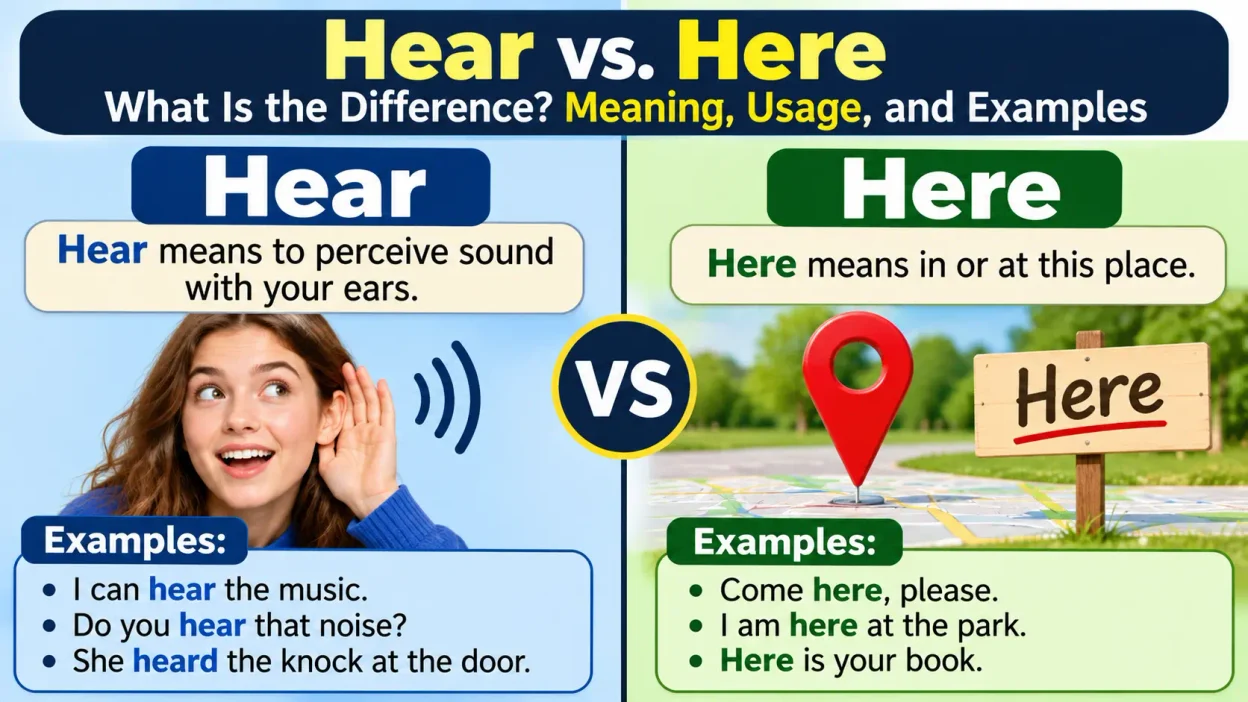
“Hear” and “here” are two commonly confused English words. They sound exactly alike, but they have completely different meanings and uses. This makes them homophones—words that share the same pronunciation but have different spellings and meanings.
The main difference is simple: hear relates to the sense of listening, while here refers to a place or location.
For example:
- I can hear the birds singing outside.
- Please come here and sit beside me.
Although both words sound like /hɪr/, choosing the correct one depends on what you want to communicate. Understanding their meanings, grammatical roles, and common expressions will help you avoid spelling mistakes in everyday writing.
What Does Hear Mean?
Hear is a verb that means to perceive sound through your ears. It describes the natural ability to receive sounds, whether you are paying attention to them or not.
You can hear music, voices, conversations, animals, traffic, or other noises.
Examples of Hear in Sentences
- I can hear someone knocking at the door.
- Did you hear the news this morning?
- She loves to hear her favorite songs.
- We could hear thunder during the storm.
- I didn’t hear what you said because the room was noisy.
- He wants to hear your opinion.
In each example, “hear” refers to receiving or perceiving sound.
Different Forms of Hear
“Hear” is an irregular verb, so its past forms do not follow the regular -ed pattern.
| Verb Form | Word | Example |
|---|---|---|
| Base form | Hear | I hear a strange noise. |
| Third-person singular | Hears | She hears everything. |
| Past tense | Heard | We heard a loud sound. |
| Past participle | Heard | I have heard that song. |
| Present participle | Hearing | He is hearing voices outside. |
Common Expressions with Hear
- Hear about: To receive information about something.
- I heard about your new job.
- Hear from: To receive communication from someone.
- I haven’t heard from my friend lately.
- Hear of: To know that someone or something exists.
- Have you ever heard of this author?
- Hear out: To listen to someone until they finish explaining.
- Please hear me out before making a decision.
- Hear someone loud and clear: To understand someone clearly.
- I can hear you loud and clear.
What Does Here Mean?
Here is an adverb that refers to a particular place or location. It means in, at, or toward the place where the speaker or writer is.
It helps identify where someone or something is located.
For example, if you tell someone, “Come here,” you are asking them to move toward your current location.
Examples of Here in Sentences
- Please come here for a moment.
- I live here with my family.
- Your keys are here on the table.
- We are waiting here for the bus.
- Put your bag here beside the chair.
- Is everyone here for the meeting?
In these sentences, “here” identifies a place or location.
Different Uses of Here
Although “here” is primarily an adverb, it can appear in several common sentence structures.
1. Referring to a location
- I am here to help you.
- She works here every day.
2. Directing someone toward a place
- Come here immediately.
- Bring the documents here.
3. Introducing or presenting something
- Here is your coffee.
- Here are the books you requested.
4. Referring to the present situation or point in a discussion
- Here is where we need to make a decision.
- Let’s stop here for today.
Common Expressions with Here
- Here and there: In different places.
- We traveled here and there during our vacation.
- Here you go: An expression used when giving something to someone.
- Here you go. This is your receipt.
- From here: Starting at this location.
- The station is five minutes from here.
- Here we go: An expression used when something is about to begin.
- Here we go! The show is starting.
- Right here: In this exact place.
- Your phone is right here.
Hear vs. Here: Key Differences
The easiest way to understand the difference is to remember that “hear” is connected to sound, while “here” is connected to location.
| Feature | Hear | Here |
|---|---|---|
| Meaning | To perceive sound | In or at this place |
| Part of speech | Verb | Adverb (primarily) |
| Refers to | Sound and listening | Place and location |
| Pronunciation | /hɪr/ | /hɪr/ |
| Example | I hear music. | Come here. |
| Related word | Heard | There |
Remember: If your sentence is about listening or sound, use “hear.” If it is about a place or location, use “here.”
Hear vs. Here in Everyday Sentences
Both words are frequently used in everyday English, but they cannot replace each other.
Compare these examples:
| Using Hear | Using Here |
|---|---|
| Can you hear me? | Can you come here? |
| I heard a noise. | I left my bag here. |
| Did you hear the announcement? | Is your brother here? |
| She hears the birds every morning. | She lives here. |
| I want to hear your story. | I want you here. |
The meaning changes completely when you switch one word for the other.
Common Mistakes When Using Hear and Here
Because “hear” and “here” are pronounced identically, people sometimes use the wrong spelling, especially when writing quickly.
Here are some common mistakes and their corrections.
| Incorrect Sentence | Correct Sentence |
|---|---|
| Come hear, please. | Come here, please. |
| I can here you. | I can hear you. |
| Your bag is hear. | Your bag is here. |
| Did you here that sound? | Did you hear that sound? |
| I want to be hear. | I want to be here. |
Why Do People Confuse Hear and Here?
There are several reasons:
- Same pronunciation: Both words sound alike, so listening alone cannot help you distinguish their spelling.
- Different meanings: Their meanings are unrelated, which can make choosing the correct spelling confusing.
- Fast typing: People may accidentally select the wrong word when writing messages or emails.
- Homophone confusion: English contains many words with identical pronunciations but different spellings, including “there,” “their,” and “they’re.”
Easy Tricks to Remember Hear vs. Here
If you frequently confuse these words, a few simple memory tricks can help.
1. Hear has “ear” in it
The word hear contains the word “ear.” Since your ears help you perceive sound, remember:
- HEAR = EAR = Sound.
Example: I can hear the birds.
2. Here refers to a place
Think of “here” as the opposite of “there.” Both words refer to locations.
- Here = This place.
- There = That place.
Example: Your book is here, not there.
3. Check the meaning of your sentence
Before choosing a word, ask yourself:
- Am I talking about sound? Use hear.
- Am I talking about a location? Use here.
This quick check can prevent most spelling mistakes.
Hear vs. Here: Practice Quiz
Test your understanding by choosing the correct word in each sentence.
- Can you ___ the music playing outside?
- Please come ___ and help me.
- I didn’t ___ the phone ringing.
- Your shoes are ___ near the door.
- Did you ___ what the teacher said?
- We are happy to be ___ today.
Answers:
- Hear
- Here
- Hear
- Here
- Hear
- Here
If you answered all six correctly, you understand the basic difference between these homophones.
Frequently Asked Questions (FAQs)
1. What is the main difference between hear and here?
“Hear” is a verb meaning to perceive sound through your ears. “Here” is an adverb that refers to a particular place or location.
2. Are hear and here pronounced the same?
Yes. In many English accents, “hear” and “here” are homophones. Both are pronounced /hɪr/ in common American English pronunciation.
3. Is hear a verb or an adjective?
“Hear” is a verb. It describes the action or ability of perceiving sound.
Example: I can hear the rain.
4. Is here a verb?
No. “Here” is primarily an adverb of place. It indicates where someone or something is located.
Example: Your package is here.
5. How can I remember the spelling of hear?
Remember that “hear” contains “ear.” Since you use your ears to hear sounds, this connection makes the spelling easier to remember.
6. Can hear and here be used in the same sentence?
Yes. Both words can appear naturally in one sentence because they have different meanings.
Example: I can hear you clearly from here.
7. What are the past tense and past participle of hear?
Both the past tense and past participle of “hear” are heard.
Examples:
- I heard a strange noise.
- I have heard that story before.
8. What is the opposite of here?
“There” is commonly used as the opposite of “here” when referring to location. “Here” indicates the speaker’s location, while “there” generally refers to another place.
Conclusion
Understanding the difference between hear and here is easy once you remember their meanings. “Hear” is a verb related to sound and the ability to perceive it through your ears. “Here” is an adverb that identifies a particular place or location.
Although these words have the same pronunciation, they are not interchangeable. Remember the simple trick: hear has “ear” for sound, while here means this place.
With regular practice and attention to context, you can use both words correctly in conversations, emails, academic writing, and everyday communication.