The English words look and see are closely related because both involve the sense of sight. However, they do not mean exactly the same thing. Understanding the difference between them can help you communicate more clearly and avoid common grammar mistakes.
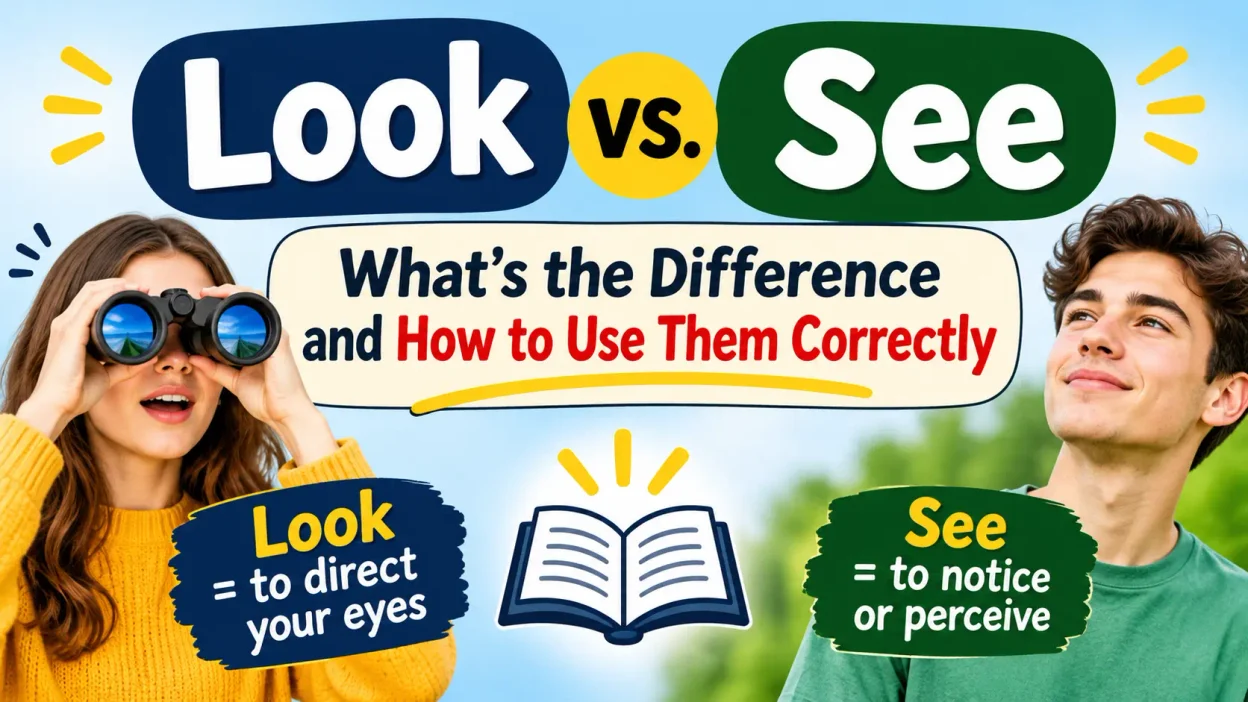
The main difference is that look usually describes the intentional action of directing your eyes toward something, while see describes the ability to notice or perceive something with your eyes.
For example:
- Look at the beautiful sunset! (You are directing someone’s attention toward it.)
- I can see the sunset from my window. (You are visually noticing it.)
Although these words are sometimes interchangeable in casual conversation, they follow different grammatical patterns and express different ideas.
In this article, we will explain the meanings of look and see, their grammatical differences, common expressions, and practical examples to help you use them correctly.
What Is the Difference Between Look and See?
The main difference between look and see is intention.
- Look means to direct your eyes toward something deliberately.
- See means to notice or become aware of something through your eyes.
Look generally describes an intentional action, while see often describes the result of visual perception.
| Feature | Look | See |
|---|---|---|
| Meaning | Direct your eyes toward something | Notice or perceive something visually |
| Intention | Usually intentional | Often unintentional |
| Grammar | Look at something | See something |
| Example | Look at that bird! | I see a bird. |
| Main idea | The action of looking | The experience of seeing |
Easy way to remember: You look intentionally, but you see when your eyes perceive something.
1. What Does Look Mean?
The verb look means to direct your eyes toward a person, object, or place to observe it.
It usually involves intention or conscious attention.
Examples of Look in Sentences
- Look at the stars in the sky.
- She looked at her phone during the meeting.
- He looked through the window.
- Look carefully before crossing the road.
- They looked at the painting for several minutes.
- I looked around the room for my keys.
In each example, someone deliberately directs their eyes toward something.
Look as a Linking Verb
Look can also describe someone’s appearance or the way something seems.
Examples:
- You look tired today.
- This room looks beautiful.
- The food looks delicious.
- He looks happy with his new job.
- That sounds difficult, but it looks manageable.
In these sentences, look does not mean physically directing your eyes. It describes an appearance or impression.
Common Expressions With Look
| Expression | Meaning | Example |
|---|---|---|
| Look at | Direct your eyes toward something | Look at this picture. |
| Look for | Search for something | I am looking for my keys. |
| Look after | Take care of someone or something | She looks after her younger brother. |
| Look into | Investigate something | The manager will look into the problem. |
| Look up | Search for information | Look up the word in a dictionary. |
| Look out | Be careful or watch for danger | Look out! A car is coming. |
| Look forward to | Feel excited about something in the future | I look forward to meeting you. |
2. What Does See Mean?
The verb see means to notice, recognize, or perceive something with your eyes.
Unlike look, seeing does not always require deliberate effort. You may see something simply because it is within your field of vision.
Examples of See in Sentences
- I can see the mountains from my house.
- Did you see that shooting star?
- She saw her friend at the shopping mall.
- We can see the moon tonight.
- He saw a strange object in the garden.
- I cannot see anything in the dark.
These examples describe visual perception rather than the deliberate action of directing the eyes.
See as a Verb of Understanding
See can also mean to understand, realize, or recognize an idea.
Examples:
- I see what you mean.
- Now I see why you were upset.
- Do you see the difference between these words?
- I see your point.
- She finally saw the importance of education.
In these sentences, see refers to understanding rather than physical vision.
Common Expressions With See
| Expression | Meaning | Example |
|---|---|---|
| See off | Say goodbye to someone leaving | We went to the airport to see him off. |
| See through | Recognize the truth behind something | I can see through his excuses. |
| See to | Take care of or deal with something | Please see to the arrangements. |
| See eye to eye | Agree with someone | They do not always see eye to eye. |
| See for yourself | Check or discover something personally | Go and see for yourself. |
| See someone | Meet or visit someone | I will see you tomorrow. |
| See a doctor | Visit a medical professional | You should see a doctor. |
3. Look vs. See: Grammar Rules
Understanding the grammar patterns of these verbs makes it easier to use them correctly.
Rule 1: Use Look At When Directing Your Eyes
When look refers to intentionally observing something, it is generally followed by at.
Correct:
- Look at the board.
- She looked at me.
- He is looking at the photograph.
Incorrect:
- Look the board.
- She looked me.
- He is looking the photograph.
Rule 2: Use See Directly With an Object
See normally takes a direct object without the preposition at.
Correct:
- I see a bird.
- She saw her teacher.
- We can see the ocean.
Incorrect in standard usage:
- I see at a bird.
- She saw at her teacher.
- We can see at the ocean.
Rule 3: Look Can Describe Appearance
When look means seem or appear, it is followed by an adjective.
Examples:
- You look wonderful.
- The sky looks cloudy.
- This cake looks delicious.
Do not use an adverb to describe the subject’s appearance in these examples.
Rule 4: See Can Describe Understanding
See can express mental understanding without referring to eyesight.
Examples:
- I see your problem.
- Do you see what I am saying?
- Now I see the reason.
Rule 5: Use the Correct Verb Forms
Both verbs are irregular or have different forms worth remembering.
| Base Form | Past Simple | Past Participle | -ing Form |
|---|---|---|---|
| Look | Looked | Looked | Looking |
| See | Saw | Seen | Seeing |
Examples:
- I looked at the photograph yesterday.
- I have looked everywhere.
- I saw a beautiful bird.
- I have seen that movie before.
- She is looking at the map.
- He is seeing a specialist tomorrow.
4. Look vs. See in Everyday Conversations
Both words appear frequently in everyday English, but the choice depends on what you want to express.
Situation 1: Drawing Someone’s Attention
Look: Look at that beautiful flower!
This asks someone to direct their eyes toward the flower.
See: Can you see that beautiful flower?
This asks whether the person can visually notice it.
Situation 2: Watching Something
Look: Look at the children playing in the park.
This directs someone’s attention toward the children.
See: I can see the children playing in the park.
This describes your ability to observe them.
Situation 3: Finding Something
Look: I am looking for my wallet.
This means you are searching for your wallet.
See: I cannot see my wallet.
This means you cannot visually find or notice it.
Situation 4: Understanding Something
Look: Look at the problem carefully.
This asks someone to examine the problem.
See: I see the problem now.
This means you understand the problem.
5. Look at vs. See: What Is the Difference?
One of the most common questions English learners ask is whether they should use look at or see.
The answer depends on the intended meaning.
| Look At | See |
|---|---|
| Focuses on directing your eyes | Focuses on visual perception |
| Usually intentional | Often unintentional |
| Requires the preposition at in this pattern | Takes a direct object |
| Look at the sky. | I see the sky. |
| Look at that man. | I see that man. |
Examples:
- Please look at this document before signing it.
- I can see the document on your desk.
- Look at the traffic lights.
- I can see the traffic lights from here.
Remember that looking does not always guarantee seeing. You can look at something but fail to notice it.
6. Can Look and See Be Used Interchangeably?
Sometimes look and see can appear in similar situations, but they are not generally interchangeable because they describe different actions.
For example:
- Look at the bird. This is an instruction to direct your eyes toward the bird.
- See the bird. This can be an instruction in certain contexts, but it is less natural than “Look at the bird” when drawing attention to something.
Similarly:
- I looked at the picture. You deliberately observed it.
- I saw the picture. You noticed or viewed it.
The difference may seem small, but it changes the focus of the sentence.
7. Common Mistakes When Using Look and See
English learners sometimes confuse these verbs because both relate to eyesight.
Here are common mistakes and their corrections:
| Incorrect Sentence | Correct Sentence | Explanation |
|---|---|---|
| Look the picture. | Look at the picture. | Use at after look in this pattern. |
| I saw at him. | I saw him. | See takes a direct object. |
| I am seeing the mountains from here. | I can see the mountains from here. | Can see is more natural for visual ability. |
| She looks happily. | She looks happy. | Use an adjective when describing appearance. |
| I have saw that movie. | I have seen that movie. | Use the past participle seen. |
| Look for the board. | Look at the board. | Use at when directing your eyes toward something. |
8. Look vs. See vs. Watch
Another useful distinction is between look, see, and watch. All three relate to vision, but their meanings are different.
- Look: Direct your eyes toward something.
- See: Notice or perceive something visually.
- Watch: Observe something for a period of time, usually while it moves or changes.
| Word | Main Meaning | Example |
|---|---|---|
| Look | Direct your eyes | Look at the bird. |
| See | Notice visually | I see a bird. |
| Watch | Observe over time | Watch the bird fly. |
Examples in Context
- Look at the television.
- I can see the television.
- I watch television every evening.
Another example:
- Look at the football players.
- I can see the football players.
- We watched the football match.
Understanding these three verbs can make your English more natural and precise.
Frequently Asked Questions About Look vs. See
1. What is the main difference between look and see?
Look means to direct your eyes toward something intentionally, while see means to notice or perceive something with your eyes. Look describes the action, whereas see describes visual perception.
2. Is look an action verb?
Yes. Look is an action verb when it means directing your eyes toward something. It can also function as a linking verb when describing appearance, as in “You look tired.”
3. Do you say look at or see at?
You generally say look at when directing your eyes toward something. See normally takes a direct object without at.
Examples:
- Look at the moon.
- I see the moon.
4. Can I say “I am seeing it”?
Yes. “I am seeing it” can be correct in certain contexts, such as describing a temporary experience or a meeting. However, when describing ordinary visual ability, “I can see it” is usually more natural.
5. What is the difference between look and watch?
Look means to direct your eyes toward something, while watch means to observe something carefully over a period of time, often because it is moving or changing.
Example:
- Look at the baby.
- Watch the baby crawl.
6. Is “look” always intentional?
When look means directing your eyes toward something, it is generally intentional. However, when it means appear or seem, as in “You look happy,” it does not describe an intentional visual action.
7. Can see mean understand?
Yes. See can mean understand, realize, or recognize an idea.
Example: “I see what you mean” means “I understand what you mean.”
8. What is the past tense of look and see?
The past tense of look is looked, while the past tense of see is saw.
Examples:
- I looked at the picture.
- I saw the picture.
9. What is the past participle of see?
The past participle of see is seen.
Example: “I have seen that movie before.”
Do not say “I have saw that movie.”
10. Which is correct: “Look at me” or “See me”?
Both can be correct, but they have different meanings. “Look at me” asks someone to direct their eyes toward you. “See me” can mean notice me, meet me, or understand me, depending on the context.
Conclusion
Look and see are closely related English verbs, but they express different ideas. Look generally means to direct your eyes toward something deliberately, while see means to notice or perceive something visually.
Remember the basic patterns: use look at when directing your attention toward something, and use see directly with an object. Also, remember that see can describe understanding, while look can describe someone’s appearance.
Once you understand these differences, you can use both words more confidently in everyday conversations and writing.