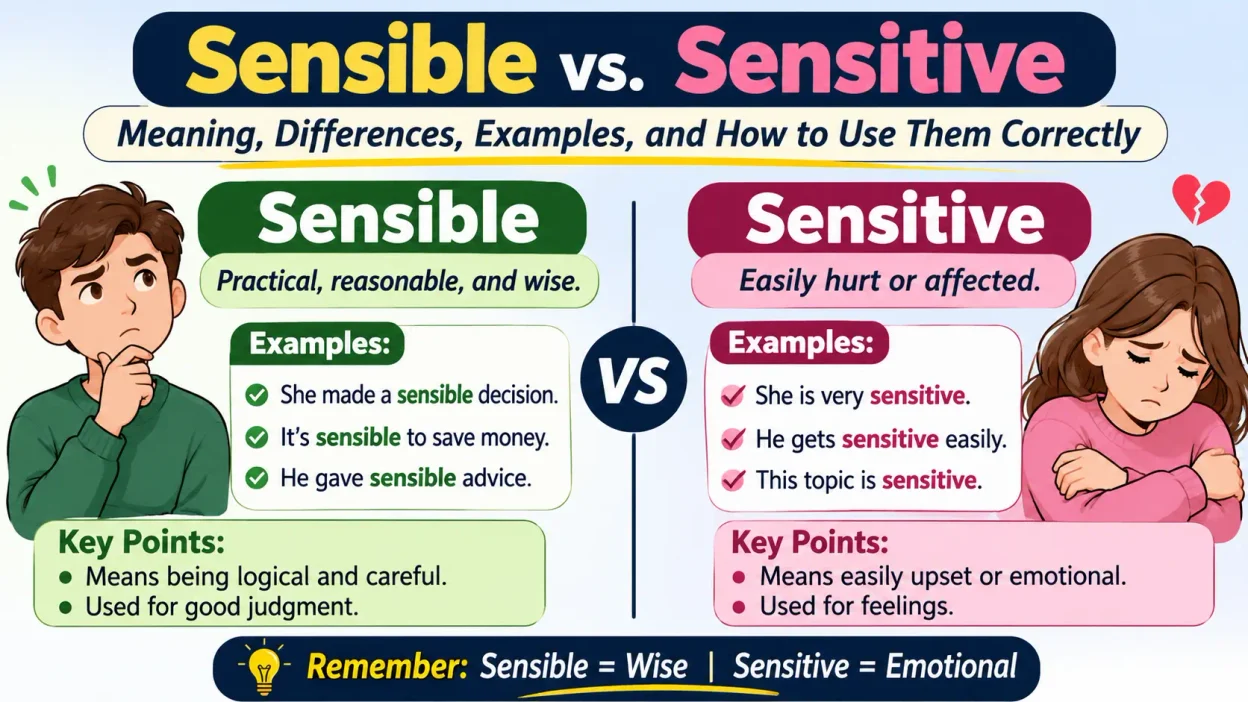
The words sensible and sensitive look and sound similar, but they have very different meanings. Both are adjectives used to describe people, decisions, and reactions, which makes them easy to confuse.
Sensible describes someone who makes practical, reasonable, and intelligent decisions. Sensitive describes someone who is easily affected by emotions, criticism, physical sensations, or changes in their surroundings.
For example, a sensible person thinks carefully before making a decision, while a sensitive person may react strongly to emotional situations or other people’s words.
Understanding the difference between sensible and sensitive will help you choose the correct word in conversations, emails, academic writing, and everyday English.
What Does Sensible Mean?
Sensible is an adjective that describes someone or something that shows good judgment, practical thinking, and common sense.
A sensible person considers the facts, thinks about possible consequences, and makes reasonable decisions instead of acting carelessly or impulsively.
Examples:
- It was sensible to save money for emergencies.
- She made a sensible decision to study before the examination.
- Wearing a warm coat in winter is sensible.
- He is a sensible person who thinks before speaking.
- Taking an umbrella when rain is expected is a sensible choice.
In these examples, sensible describes practical thinking and reasonable behavior.
Common Uses of Sensible
1. Sensible Decisions
Use sensible when describing choices based on good judgment.
Examples:
- Buying a reliable car was a sensible decision.
- It would be sensible to check the information before sharing it.
- She made a sensible choice by accepting the job offer.
2. Sensible People
Use sensible to describe people who behave responsibly and think practically.
Examples:
- My brother is very sensible.
- We need someone sensible to manage the project.
- A sensible person considers the consequences of their actions.
3. Sensible Advice
Use sensible when describing advice that is practical and reasonable.
Examples:
- My teacher gave me sensible advice.
- It is sensible to plan your budget before shopping.
- She offered a sensible solution to the problem.
What Does Sensitive Mean?
Sensitive is an adjective that describes someone or something that reacts easily or strongly to emotions, criticism, physical sensations, or external influences.
A sensitive person may feel emotions deeply, notice subtle changes in other people’s moods, or become upset by criticism. However, sensitivity is not necessarily a weakness. It can also be associated with empathy, compassion, and emotional awareness.
Examples:
- She is sensitive to criticism.
- My skin is sensitive to certain products.
- He is a sensitive person who understands other people’s feelings.
- This information is sensitive and should remain private.
- Her eyes are sensitive to bright light.
In these examples, sensitive describes the ability or tendency to respond strongly to something.
Common Uses of Sensitive
1. Sensitive People
Use sensitive to describe someone who experiences emotions deeply or reacts strongly to other people’s words and actions.
Examples:
- My sister is sensitive and easily gets emotional.
- He is sensitive to other people’s feelings.
- She is a sensitive person who cares deeply about others.
2. Sensitive Topics
Use sensitive when describing subjects that require care because they may cause emotional discomfort, disagreement, or concern.
Examples:
- Politics can be a sensitive topic.
- We should discuss this sensitive issue respectfully.
- The manager handled the sensitive situation carefully.
3. Sensitive Skin or Physical Reactions
Sensitive is commonly used in health, beauty, and everyday contexts to describe physical reactions.
Examples:
- I have sensitive skin.
- Her eyes are sensitive to sunlight.
- Some people have sensitive teeth.
4. Sensitive Information
Use sensitive to describe private or confidential information that requires protection.
Examples:
- The company stores sensitive customer information.
- Do not share sensitive personal details online.
- Employees must protect sensitive documents.
Sensible vs. Sensitive: Key Differences
Although the two words look similar, their meanings are quite different.
| Feature | Sensible | Sensitive |
|---|---|---|
| Part of speech | Adjective | Adjective |
| Main meaning | Practical and reasonable | Easily affected or responsive |
| Focus | Judgment and decision-making | Emotions, sensations, or reactions |
| Describes people | People with good judgment | People who feel or react deeply |
| Common expressions | Sensible decision, sensible advice | Sensitive person, sensitive skin |
| Example | He made a sensible choice. | He is sensitive to criticism. |
The easiest way to remember the difference: Sensible means using common sense, while sensitive means reacting or feeling strongly.
Sensible vs. Sensitive in Sentences
Compare these sentences to understand how the meaning changes.
| Sensible | Sensitive |
|---|---|
| She is a sensible person. | She is a sensitive person. |
| He made a sensible decision. | He has sensitive feelings. |
| That is sensible advice. | That is a sensitive subject. |
| Wearing comfortable shoes is sensible. | My skin is sensitive to chemicals. |
| We need a sensible solution. | We need to handle this sensitive issue carefully. |
Notice that sensible usually relates to practical judgment, while sensitive relates to emotional or physical responses.
Can Someone Be Both Sensible and Sensitive?
Yes. A person can be both sensible and sensitive because the words describe different qualities.
Someone may have excellent judgment while also being emotionally aware and understanding of other people’s feelings.
Examples:
- She is sensible enough to make practical decisions and sensitive enough to understand others.
- He is a sensible manager who handles sensitive situations with care.
- My mother is both sensible and sensitive; she gives practical advice while understanding my emotions.
Being sensible does not mean being unemotional, and being sensitive does not mean lacking common sense.
Sensible vs. Sensitive vs. Sensitivity
Another related word is sensitivity. Understanding these three words will help you use them correctly.
| Word | Part of Speech | Meaning | Example |
|---|---|---|---|
| Sensible | Adjective | Showing good judgment | That was a sensible decision. |
| Sensitive | Adjective | Easily affected or responsive | She is sensitive to criticism. |
| Sensitivity | Noun | The quality or condition of being sensitive | He showed sensitivity toward others. |
More Examples
- Sensible: It is sensible to prepare before an interview.
- Sensitive: She is sensitive about her appearance.
- Sensitivity: His sensitivity toward other people’s feelings makes him a caring friend.
Common Expressions with Sensible and Sensitive
Learning common expressions can help you use both words naturally.
| Expressions with Sensible | Expressions with Sensitive |
|---|---|
| Sensible decision | Sensitive person |
| Sensible choice | Sensitive skin |
| Sensible advice | Sensitive issue |
| Sensible solution | Sensitive information |
| Sensible approach | Sensitive subject |
| Sensible behavior | Sensitive to criticism |
| Sensible investment | Emotionally sensitive |
| Sensible option | Highly sensitive equipment |
Common Mistakes to Avoid
Here are some frequent mistakes English learners make when using sensible and sensitive.
Mistake 1: Using sensitive instead of sensible
Incorrect: It was a sensitive decision to save money.
Correct: It was a sensible decision to save money.
Why? Saving money is a practical decision, so sensible is the correct word.
Mistake 2: Using sensible to describe emotional reactions
Incorrect: She is very sensible about criticism and gets upset easily.
Correct: She is very sensitive to criticism and gets upset easily.
Why? Sensitive describes someone who reacts emotionally to criticism.
Mistake 3: Confusing sensitive skin with sensible skin
Incorrect: I have sensible skin.
Correct: I have sensitive skin.
Why? Sensitive is the correct adjective for skin that reacts easily to certain products or environmental factors.
Mistake 4: Confusing sensible advice with sensitive advice
Incorrect: My teacher gave me sensitive advice about managing my time.
Correct: My teacher gave me sensible advice about managing my time.
Why? Advice that is practical and reasonable is described as sensible.
Mistake 5: Assuming sensitive always means weak
Incorrect: Sensitive people cannot make good decisions.
Correct: Sensitive people can be thoughtful, emotionally aware, and excellent decision-makers.
Why? Sensitivity describes how someone responds to emotions or external influences. It does not determine their intelligence or judgment.
Quick Practice: Sensible or Sensitive?
Choose the correct word to complete each sentence.
- It is _____ to wear a helmet while riding a motorcycle.
- She is very _____ to negative comments.
- My doctor recommended a product for _____ skin.
- He made a _____ decision after considering all the options.
- We should be careful when discussing this _____ subject.
- It is _____ to save some money for emergencies.
- My brother is _____ and understands how others feel.
- The company protects _____ customer information.
Answers:
- Sensible
- Sensitive
- Sensitive
- Sensible
- Sensitive
- Sensible
- Sensitive
- Sensitive
Conclusion
The main difference between sensible and sensitive is that sensible describes practical thinking and good judgment, while sensitive describes someone or something that reacts easily to emotions, physical sensations, or external influences.
Use sensible when discussing reasonable decisions, practical advice, and responsible behavior. Use sensitive when talking about emotions, physical reactions, private information, or delicate subjects.
Remember this simple rule: A sensible person uses common sense, while a sensitive person feels or reacts deeply. Knowing this distinction will make your English clearer and more accurate.
Frequently Asked Questions (FAQs)
1. What is the main difference between sensible and sensitive?
Sensible means practical, reasonable, and showing good judgment. Sensitive means easily affected by emotions, criticism, physical sensations, or other influences.
2. Is sensible a positive word?
Yes. Sensible is generally positive because it describes practical thinking, responsible behavior, and good decision-making.
3. Is sensitive a positive or negative word?
Sensitive can be positive or negative depending on the context. It can describe empathy and emotional awareness, but it can also describe someone who is easily upset or physically affected.
4. Can a person be sensible and sensitive at the same time?
Yes. Someone can make practical decisions while also being emotionally aware and understanding of other people’s feelings.
5. What does a sensible person mean?
A sensible person is someone who uses common sense, considers consequences, and makes practical and reasonable decisions.
6. What does a sensitive person mean?
A sensitive person is someone who experiences emotions deeply or reacts strongly to criticism, other people’s behavior, or certain situations.
7. Should I say sensible skin or sensitive skin?
You should say sensitive skin. Sensitive describes skin that reacts easily to products, chemicals, sunlight, or other environmental factors.
8. What is the noun form of sensitive?
The noun form is sensitivity. For example: “She showed great sensitivity toward her friend’s feelings.”
9. What is the opposite of sensible?
Depending on the context, opposites of sensible include foolish, unreasonable, impractical, and irrational.
10. What is the opposite of sensitive?
Depending on the context, opposites of sensitive include insensitive, unresponsive, and unaffected. For emotional awareness, insensitive is often the most direct opposite.
11. Is being sensitive a weakness?
No. Sensitivity is not automatically a weakness. It can help people understand emotions, recognize others’ needs, and build meaningful relationships.
12. How can I remember the difference between sensible and sensitive?
Remember that sensible is connected to sense and common sense, while sensitive is connected to feelings and reactions. A sensible decision is reasonable, whereas a sensitive person may feel emotions deeply.