
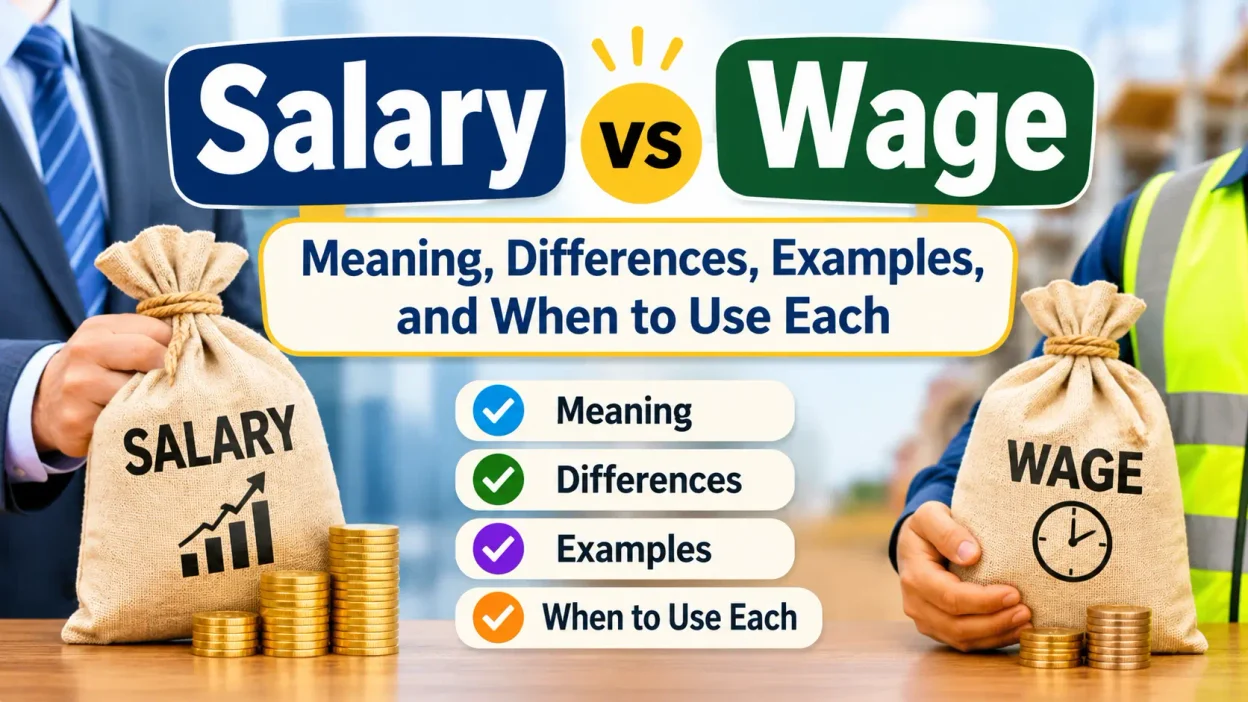
Understanding the difference between salary and wage is important when discussing jobs, employment, and payment. Both words refer to money people receive for their work, but they describe different payment arrangements. A salary is generally a fixed amount paid regularly, while wages are usually calculated according to the hours worked, days worked, or amount of work completed.
Although these terms are sometimes used interchangeably in everyday conversations, they have distinct meanings. Knowing when to use salary and wage can help you communicate more accurately, understand employment agreements, and discuss compensation with confidence.
What Does Salary Mean?
Salary is a fixed amount of money an employee receives for performing a job over a specific period, usually expressed as an annual amount. Employers commonly divide this amount into regular payments, such as monthly, twice-monthly, or biweekly payments.
A salaried employee generally receives the agreed amount regardless of small changes in the number of hours worked, subject to the terms of their employment agreement and applicable labor laws.
Examples:
- She earns an annual salary of $60,000 as a marketing manager.
- His monthly salary is enough to cover his living expenses.
- The company offered her a higher salary for the new position.
- Employees receive their salaries at the end of each month.
In these examples, salary refers to a predetermined amount of compensation paid regularly.
What Does Wage Mean?
Wage refers to money paid to a worker based on the number of hours, days, or units of work completed. Wages are commonly calculated using an hourly rate, daily rate, or piece rate.
Unlike a fixed salary, the total amount a worker earns may change depending on how much they work during a particular pay period.
Examples:
- The factory worker earns an hourly wage of $18.
- Her weekly wages depend on the number of hours she works.
- The company increased the minimum wage for its employees.
- Construction workers receive daily wages for their labor.
In these examples, wage describes compensation calculated according to work performed or time spent working.
Salary vs Wage: Key Differences
The main difference between salary and wage is how compensation is calculated.
| Feature | Salary | Wage |
|---|---|---|
| Meaning | Fixed regular compensation | Payment based on work or time |
| Calculation | Usually annual or monthly | Usually hourly, daily, or per unit |
| Payment | Often monthly or biweekly | Often weekly or biweekly |
| Amount | Generally predictable | Can vary |
| Common jobs | Managers, teachers, administrators | Retail workers, laborers, hourly staff |
| Extra hours | Depends on employment terms and law | May qualify for overtime pay |
| Income stability | Usually more predictable | Depends on hours or work completed |
These are general distinctions. Actual payment arrangements and overtime entitlements depend on the employment contract and applicable labor laws.
10 Examples of Salary vs Wage in Sentences
Here are ten examples to help you understand how salary and wage are used in everyday English.
- Salary: My brother receives a monthly salary from his employer.
- Wage: The restaurant pays its workers an hourly wage.
- Salary: She negotiated a higher salary before accepting the position.
- Wage: The government announced an increase in the minimum wage.
- Salary: His annual salary includes several employment benefits.
- Wage: Workers receive additional wages for approved overtime.
- Salary: The company offers a competitive salary to experienced employees.
- Wage: Her weekly wage depends on the number of hours she works.
- Salary: A stable salary makes it easier to plan monthly expenses.
- Wage: The workers demanded fair wages for their hard work.
When to Use Salary
Use salary when referring to a fixed amount of compensation that an employee receives regularly, usually as part of a professional or long-term employment arrangement.
Common situations include:
- Discussing annual compensation.
- Comparing job offers.
- Negotiating employment contracts.
- Talking about monthly earnings.
- Describing fixed employee compensation.
Examples:
- What is your expected salary?
- The position offers an attractive starting salary.
- He receives a salary increase every year.
- Her salary is paid directly into her bank account.
When to Use Wage
Use wage when discussing compensation calculated according to hours worked, days worked, or the amount of work completed.
Common situations include:
- Discussing hourly pay.
- Talking about minimum wage.
- Calculating overtime compensation.
- Describing payment for manual or temporary work.
- Discussing labor costs.
Examples:
- The minimum wage varies by location.
- Employees deserve a fair hourly wage.
- His wage increased after his promotion.
- Workers receive higher wages for night shifts.
Are Salary and Wage Interchangeable?
Salary and wage are related, but they are not always interchangeable.
Both words describe compensation for work, but they emphasize different payment arrangements.
For example:
- “She earns a salary of $50,000 per year” describes a fixed annual compensation arrangement.
- “She earns a wage of $25 per hour” describes compensation based on hours worked.
Using wage when discussing a fixed annual salary may make the sentence less precise. Similarly, using salary to describe an hourly payment arrangement may create confusion.
However, in informal conversations, people sometimes use these terms more loosely to refer to earnings or compensation in general.
Salary vs Wage: Which Is Better?
Neither salary nor wage is automatically better. The right payment arrangement depends on the job, working conditions, financial needs, and employment agreement.
Advantages of a salary:
- More predictable income.
- Easier monthly budgeting.
- Often associated with regular employment benefits.
- Greater financial consistency.
Advantages of wages:
- Payment can increase with additional working hours.
- Hourly compensation is easier to track.
- Some positions offer overtime opportunities.
- Flexible working arrangements may be available.
A salaried position may provide greater income predictability, while an hourly wage arrangement may offer more direct compensation for additional hours. However, benefits and overtime eligibility depend on the employer’s policies and local laws.
Common Mistakes to Avoid
Here are some common mistakes people make when using salary and wage.
Mistake 1: Using salary for hourly compensation
Incorrect: He earns a salary of $15 per hour.
Better: He earns a wage of $15 per hour.
Mistake 2: Using wage for annual fixed compensation
Incorrect: Her wage is $70,000 per year.
Better: Her salary is $70,000 per year.
Mistake 3: Assuming every salaried employee earns more
Salary does not automatically mean higher earnings. An hourly worker may earn more depending on their rate, working hours, and overtime.
Mistake 4: Assuming wages are always paid daily
Wages can be paid weekly, biweekly, or according to another agreed payment schedule. The payment frequency does not determine whether compensation is a salary or wage.
Frequently Asked Questions (FAQs)
1. What is the main difference between salary and wage?
The main difference is how payment is calculated. Salary generally refers to a fixed amount paid regularly, while wage usually refers to compensation based on hours, days, or work completed.
2. Is salary paid monthly or weekly?
Salary is commonly paid monthly, twice monthly, or biweekly. The payment schedule depends on the employer and employment agreement.
3. Is wage always hourly?
No. Wages can be calculated hourly, daily, or according to the amount of work completed. Hourly wages are simply one of the most common arrangements.
4. Which is higher, salary or wage?
Neither is always higher. Total earnings depend on the agreed salary, hourly rate, working hours, overtime, and other compensation.
5. Can salaried employees receive overtime pay?
Yes, some salaried employees qualify for overtime pay, depending on their job classification and applicable labor laws. Receiving a salary does not automatically mean someone is exempt from overtime.
6. What is the plural of wage?
The plural of wage is wages. For example, “Workers deserve fair wages for their efforts.”
7. Is minimum salary the same as minimum wage?
No. Minimum wage generally refers to the legally required minimum rate of pay for covered workers. Minimum salary may refer to the lowest fixed salary offered for a particular position or employment arrangement.
Conclusion
The difference between salary vs wage comes down to how employees receive compensation. A salary is generally a fixed amount paid regularly, while a wage is usually calculated according to hours worked, days worked, or tasks completed.
Use salary when discussing fixed annual or monthly compensation, and use wage when referring to hourly, daily, or work-based payment. Understanding this distinction will help you use both words correctly in professional conversations, workplace discussions, and everyday English.