The words principal and principle are commonly confused because they sound exactly alike but have different meanings and grammatical uses. Although their pronunciation is identical, their spelling and definitions are not interchangeable.
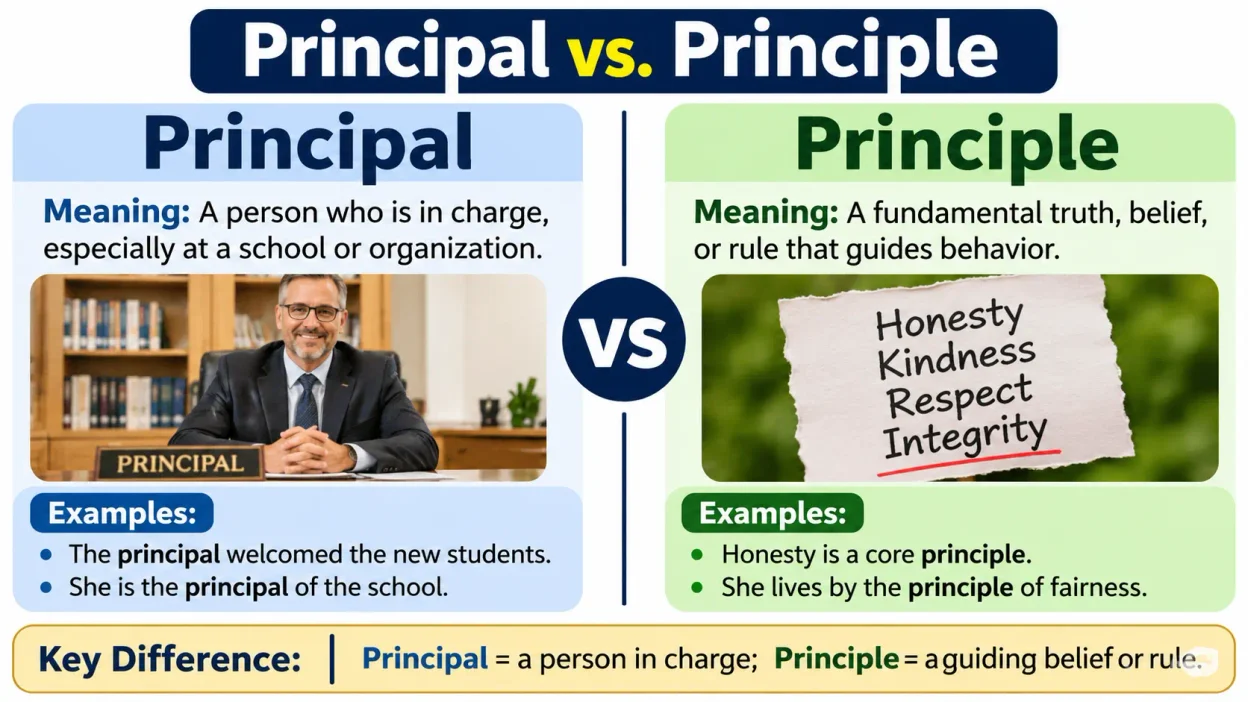
The easiest way to remember the difference is that principal usually refers to a person in an important position, something that is most important, or a financial amount. In contrast, principle refers to a fundamental rule, belief, value, or general truth.
For example, a school principal manages a school, while a teacher may follow the principle of treating every student fairly.
Understanding principal vs. principle is important for clear writing, especially in academic assignments, professional communication, business documents, and everyday conversations. This guide explains their meanings, grammatical roles, examples, common mistakes, and simple memory tricks to help you use both words correctly.
Principal vs. Principle: Quick Difference
The main difference between principal and principle is their meaning.
| Word | Part of Speech | Meaning | Example |
|---|---|---|---|
| Principal | Noun | A person who manages a school or organization | The principal welcomed the students. |
| Principal | Adjective | Main, primary, or most important | Safety is our principal concern. |
| Principal | Noun | The original amount of money borrowed or invested | She paid back the loan principal. |
| Principle | Noun | A fundamental rule, belief, or truth | Honesty is an important principle. |
Principal can function as both a noun and an adjective. Principle is a noun.
What Does Principal Mean?
The word principal has several meanings, depending on the context. It can describe a person who holds a leadership position, something that is most important, or the original amount of money involved in a financial transaction.
1. Principal as a Noun: A School Leader
One of the most familiar meanings of principal is the person responsible for managing a school.
A school principal supervises teachers, supports students, manages school operations, and helps maintain educational standards.
Examples:
- The principal announced the new school rules.
- Our principal organized a meeting for parents.
- The students congratulated their principal on the award.
- The principal spoke about the importance of education.
In American English, principal is the usual term for a school’s head administrator. In other English-speaking regions, titles such as headteacher or headmaster may be more common.
2. Principal as an Adjective: Main or Most Important
Principal can also function as an adjective meaning primary, leading, or most important.
It identifies the most significant person, factor, reason, or objective in a situation.
Examples:
- Our principal goal is to improve customer satisfaction.
- The principal reason for the delay was bad weather.
- Education is one of the principal priorities of the organization.
- Her principal responsibility is managing the department.
In these sentences, principal means main or most important.
3. Principal in Finance: The Original Amount of Money
In banking and finance, principal refers to the original amount of money borrowed, invested, or owed, excluding interest.
For example, if someone borrows $10,000, that amount is the loan principal. Interest is calculated separately according to the loan’s terms.
Examples:
- He paid an additional amount toward the loan principal.
- The investment earned interest on its original principal.
- Your monthly payment includes both principal and interest.
- The borrower reduced the principal balance.
This financial meaning is especially important when discussing loans, mortgages, investments, and savings.
What Does Principle Mean?
The word principle is a noun that refers to a fundamental belief, rule, value, or general truth that guides behavior, decisions, or the way something works.
A principle can be personal, moral, scientific, legal, or professional. It often describes an idea that people accept as a foundation for their actions or understanding.
1. Principle as a Moral Belief
A principle can represent a personal value or standard that guides someone’s behavior.
Examples include honesty, fairness, responsibility, respect, and integrity.
Examples:
- Honesty is an important principle in every relationship.
- She refused to compromise her principles.
- He believes in the principle of treating everyone equally.
- Their decisions are guided by strong moral principles.
In these examples, principle refers to values that influence how people behave.
2. Principle as a Fundamental Rule
Principle can also describe a basic rule or idea that explains how something should work.
Examples:
- The principle of fairness should guide every decision.
- The company follows the principle of transparency.
- The teacher explained the basic principles of mathematics.
- This method is based on a simple scientific principle.
Here, the word describes a foundational rule or concept.
3. Principle in Science and Technology
In scientific and technical contexts, a principle is a basic law, concept, or rule that helps explain how something operates.
For example, the principle of gravity explains the attraction between objects with mass. The principle of conservation of energy states that energy cannot be created or destroyed in an isolated system, although it can change forms.
Examples:
- Students learned the principles of physics.
- The machine operates on a simple mechanical principle.
- The experiment demonstrates an important scientific principle.
- Engineers apply mathematical principles when designing structures.
Principal vs. Principle: Key Differences
Although these words sound identical, their meanings and grammatical functions are different.
| Feature | Principal | Principle |
|---|---|---|
| Part of speech | Noun and adjective | Noun |
| Main meaning | Main, leading, or most important; a school leader; financial amount | Fundamental rule, belief, or truth |
| Refers to a person? | Yes | No |
| Refers to an idea or value? | Not usually | Yes |
| Financial meaning | Original amount borrowed or invested | No standard financial meaning |
| Example | The principal addressed the students. | Honesty is a guiding principle. |
The most important distinction is that principal describes a person, priority, or financial amount, while principle describes a belief, rule, or fundamental idea.
Principal vs. Principle Examples in Sentences
Seeing both words in context makes their difference easier to understand.
Examples Using Principal
- The school principal welcomed the new students.
- Our principal objective is to complete the project on time.
- The principal reason for the meeting was to discuss safety.
- She works closely with the principal of the school.
- The bank explained how much of the payment would reduce the loan principal.
- His principal responsibility is leading the research team.
- The principal investigator presented the study’s findings.
- Improving customer service is the company’s principal concern.
Examples Using Principle
- Honesty is an important principle of good leadership.
- She believes in the principle of equal opportunity.
- The scientist explained the principle behind the experiment.
- We should follow the principles of fairness and respect.
- He refused to change his decision because of his principles.
- The machine works according to a basic engineering principle.
- The principle of supply and demand influences market prices.
- Respect for others is a fundamental principle of friendship.
Common Mistakes When Using Principal and Principle
Because principal and principle are homophones, writers sometimes choose the wrong spelling. These mistakes can change the meaning of a sentence.
Here are some common examples:
| Incorrect Sentence | Correct Sentence |
|---|---|
| The school principle called a meeting. | The school principal called a meeting. |
| Honesty is an important principal. | Honesty is an important principle. |
| Our principle goal is to succeed. | Our principal goal is to succeed. |
| She paid the loan principle. | She paid the loan principal. |
| The company follows ethical principals. | The company follows ethical principles. |
Why Do People Confuse These Words?
There are several reasons:
- Identical pronunciation: Both words are pronounced the same way in standard English.
- Similar spelling: They differ by only a few letters.
- Different grammatical roles: Principal can be a noun or adjective, while principle is a noun.
- Overlapping contexts: Both words may appear in academic, professional, and educational writing.
The best way to avoid mistakes is to understand the meaning of the sentence before choosing the spelling.
Easy Tricks to Remember Principal vs. Principle
A few simple memory tricks can help you remember which word to use.
1. Principal Has “Pal” in It
The word principal contains the letters “pal.”
Think of a school principal as your school pal or a person who works with students.
Principal = Person or main thing.
This is a useful reminder when referring to a school leader.
2. Principle Ends in “Le”
Think of the final letters of principle as connected to a simple phrase such as “rule.”
Principle = Rule or belief.
A principle is something that guides your decisions or explains how something works.
3. Use the Meaning Test
Ask yourself what you are trying to describe.
- If you mean a school leader, use principal.
- If you mean the main or most important thing, use principal.
- If you mean an original loan or investment amount, use principal.
- If you mean a moral belief, rule, or fundamental truth, use principle.
4. Remember the Three Main Uses of Principal
You can remember principal through three common meanings:
- Person: The school principal.
- Priority: The principal reason.
- Payment: The loan principal.
Anything referring to a guiding belief or basic rule generally requires principle.
Principal vs. Principle in Different Contexts
Understanding how these words work in everyday situations makes them easier to use correctly.
In Education
Use principal when referring to a school leader or the most important educational objective.
Examples:
- The principal introduced a new attendance policy.
- Student development is the principal goal of the school.
Use principle when discussing educational values or teaching philosophies.
Example:
- The principle of equal access to education is important.
In Business
Principal can describe the main business objective or a person with a leading role in certain professional or legal contexts.
Examples:
- Customer satisfaction is our principal concern.
- The principal signed the agreement.
Principle refers to a business rule or ethical standard.
Example:
- The company follows the principle of transparency.
In Finance
Principal refers to the original amount of a loan or investment.
Example:
- The borrower paid down the principal balance.
Principle is used when discussing financial guidelines or fundamental economic ideas.
Example:
- The principle of supply and demand affects prices.
In Everyday Life
Principal describes something most important.
Example:
- My principal concern is my family’s safety.
Principle describes a personal belief.
Example:
- I would never lie because honesty is one of my strongest principles.
Principal vs. Principle: Practice Quiz
Test your understanding by choosing the correct word in each sentence.
1. The school ______ welcomed the new students.
- A. Principal
- B. Principle
2. Honesty is an important ______ in every relationship.
- A. Principal
- B. Principle
3. Our ______ objective is to finish the project today.
- A. Principal
- B. Principle
4. The bank explained how to reduce the loan ______.
- A. Principal
- B. Principle
5. The organization follows the ______ of equal opportunity.
- A. Principal
- B. Principle
6. Safety is our ______ concern.
- A. Principal
- B. Principle
Answers and Explanations
- Principal — It refers to the person who manages the school.
- Principle — It refers to a moral belief or value.
- Principal — It means the main or most important objective.
- Principal — It refers to the original amount of money borrowed.
- Principle — It refers to a fundamental rule or belief.
- Principal — It means the primary or most important concern.
Frequently Asked Questions
1. What is the main difference between principal and principle?
Principal refers to a school leader, something most important, or the original amount of money borrowed or invested. Principle refers to a fundamental belief, rule, value, or truth.
2. Is a school principal or principle?
The correct word is principal. A school principal is the person responsible for managing a school and overseeing its operations.
3. Is it the principal reason or principle reason?
The correct expression is principal reason because principal means main or most important.
Example: The principal reason for the cancellation was heavy rain.
4. Is it moral principal or moral principle?
The correct expression is moral principle because a principle is a belief or value that guides behavior.
Example: Honesty is a strong moral principle.
5. Do principal and principle sound the same?
Yes. Principal and principle are homophones, meaning they have the same pronunciation but different spellings and meanings.
6. Can principal be used as an adjective?
Yes. Principal can function as an adjective meaning main, primary, or most important.
Example: Our principal objective is to improve performance.
7. Can principle be plural?
Yes. The plural form is principles.
Example: The organization operates according to ethical principles.
8. What does principal mean in banking?
In banking, principal refers to the original amount of money borrowed or invested, excluding interest.
9. What is the plural of principal?
The plural is principals.
Example: Several school principals attended the conference.
10. What is an easy way to remember principal vs. principle?
Remember that principal contains “pal,” which can remind you of a school principal. Principle ends in “le,” which you can associate with a rule. Principal means a person or something primary, while principle means a belief or rule.
Conclusion
The difference between principal and principle becomes simple once you understand what each word represents. Principal refers to a school leader, a main or primary concern, or the original amount of money in a financial transaction. Principle refers to a fundamental belief, rule, value, or truth.
Although these words sound exactly alike, they cannot be used interchangeably. Remember the simple trick: principal has “pal” for a person, while principle refers to a rule or belief.
With regular practice and attention to context, you can confidently use principal and principle in academic writing, professional communication, and everyday English.