
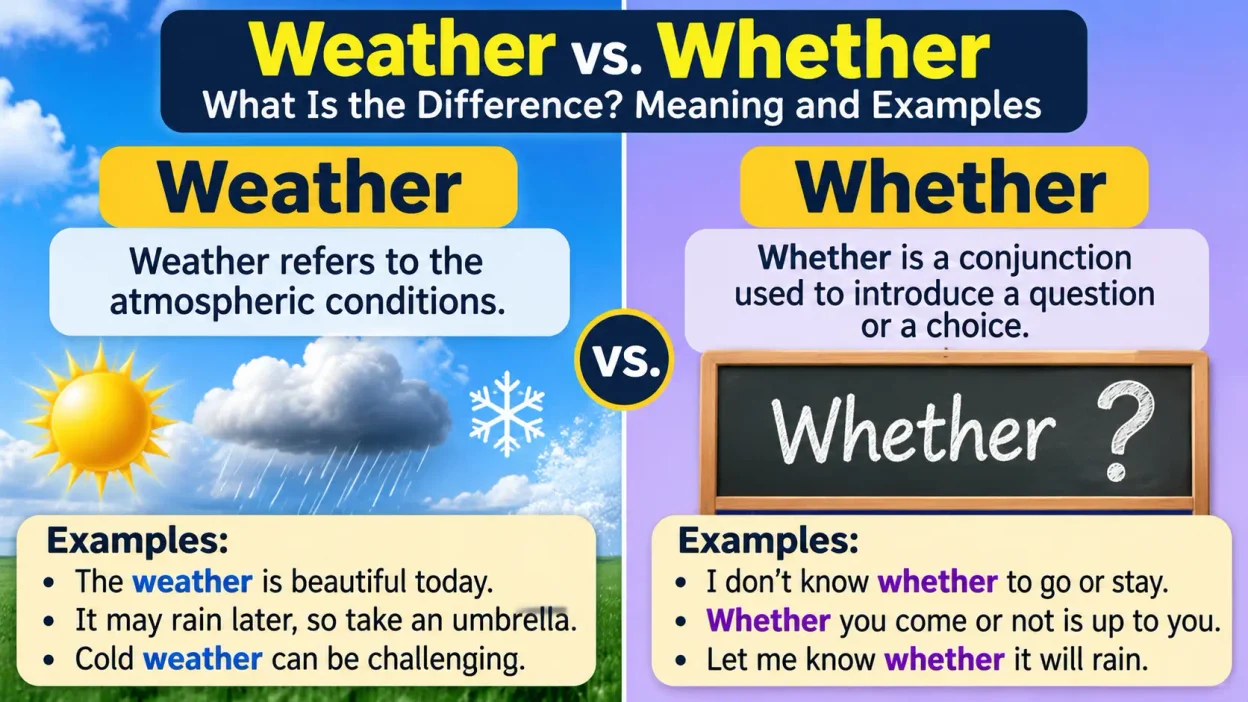
The words weather and whether are commonly confused in English because they sound exactly alike but have completely different meanings. Although their pronunciation is identical, their spelling, grammatical functions, and uses are different.
The easiest way to remember the difference is that weather refers to atmospheric conditions such as rain, sunshine, wind, temperature, and snow. In contrast, whether is a conjunction used to introduce alternatives, express uncertainty, or indicate that something depends on a particular choice or possibility.
For example, you might check the weather before going outside, but you may wonder whether it will rain tomorrow.
Understanding weather vs. whether is important for writing clearly and avoiding common spelling mistakes. In this guide, you will learn their meanings, grammatical uses, sentence examples, common errors, and simple tricks to remember which word to use.
Weather vs. Whether: Quick Difference
The main difference between weather and whether is their meaning and grammatical function.
| Word | Part of Speech | Meaning | Example |
|---|---|---|---|
| Weather | Noun | Atmospheric conditions, such as rain, sunshine, and temperature | The weather is beautiful today. |
| Weather | Verb | To survive or endure a difficult situation | They managed to weather the storm. |
| Whether | Conjunction | Used to introduce alternatives or express uncertainty | I don’t know whether she will come. |
Weather usually refers to atmospheric conditions, while whether introduces a choice, possibility, or uncertainty.
What Does Weather Mean?
The word weather is most commonly used as a noun referring to the condition of the atmosphere at a particular place and time.
It includes temperature, humidity, wind, rainfall, snowfall, cloud cover, and other atmospheric conditions.
1. Weather as a Noun: Atmospheric Conditions
Weather describes what the atmosphere is like outside. It can change throughout the day and vary from one location to another.
Examples:
- The weather is sunny today.
- We stayed home because the weather was terrible.
- The weather forecast predicts heavy rain tomorrow.
- Cold weather makes it difficult to work outside.
- The weather in the mountains changes quickly.
In these sentences, weather refers to atmospheric conditions.
2. Different Types of Weather
Weather can describe many atmospheric conditions, including:
- Sunny: Bright conditions with plenty of sunshine.
- Rainy: Conditions involving rainfall.
- Cloudy: A sky covered partly or completely by clouds.
- Windy: Conditions with noticeable moving air.
- Snowy: Weather involving snowfall.
- Stormy: Conditions involving storms, strong winds, or heavy rain.
- Foggy: Conditions in which suspended water droplets reduce visibility.
- Humid: Air containing a relatively high amount of moisture.
Examples:
- The sunny weather made the picnic enjoyable.
- Windy weather can make cycling difficult.
- The rainy weather caused traffic delays.
- We enjoyed the snowy weather during our winter vacation.
3. Weather as a Verb: To Endure or Survive
Weather can also function as a verb. It means to survive, endure, or successfully withstand a difficult experience or situation.
This meaning is often used figuratively, although it can also refer to physical exposure to the elements.
Examples:
- The company managed to weather the financial crisis.
- Their friendship weathered many difficult challenges.
- The old building has weathered several storms.
- She hopes her family will weather this difficult period.
In these sentences, weather means to withstand or survive something challenging.
4. Weather in Science and Geography
Weather is an important concept in meteorology, the scientific study of the atmosphere and atmospheric processes.
Meteorologists observe and measure conditions such as temperature, air pressure, humidity, wind speed, and precipitation to understand current weather and prepare forecasts.
Examples:
- Scientists study weather patterns to understand atmospheric changes.
- The meteorologist explained the expected weather conditions.
- Weather forecasts help people prepare for storms.
- Satellites provide valuable information about weather systems.
What Does Whether Mean?
The word whether is a conjunction used to express uncertainty, introduce alternatives, or indicate that something depends on a particular possibility.
It commonly appears when someone is considering two or more choices or is unsure about something.
1. Whether to Express Uncertainty
Whether is frequently used when someone does not know if something is true, possible, or likely to happen.
Examples:
- I don’t know whether he will attend the meeting.
- She is unsure whether the shop is open.
- We need to decide whether the plan is practical.
- He asked whether I had finished the assignment.
In these examples, whether introduces uncertainty about a situation.
2. Whether to Introduce Alternatives
Whether can also introduce two or more possible choices.
It is often used with the structure “whether…or.”
Examples:
- I cannot decide whether to travel by car or train.
- She must choose whether to study medicine or engineering.
- We need to determine whether the event will be indoors or outdoors.
- Whether you agree or disagree, we should discuss the issue.
Here, whether introduces alternatives or contrasting possibilities.
3. Whether in Indirect Questions
Whether is commonly used in indirect questions. These are questions included within a larger statement or question.
Examples:
- She asked whether I was available.
- I wonder whether they received my message.
- He wanted to know whether the documents were ready.
- Can you tell me whether the office is open?
Notice that indirect questions generally use statement word order rather than direct-question word order.
For example:
- Direct question: Is she coming?
- Indirect question: I wonder whether she is coming.
4. Whether or Not
The expression whether or not is used to emphasize that a situation applies regardless of the outcome.
Examples:
- I will attend the meeting whether or not it rains.
- She will complete the project whether or not she receives help.
- We must continue whether or not the results are immediate.
- Whether or not you agree, the decision has been made.
This expression makes it clear that the result does not change the main statement.
Weather vs. Whether: Key Differences
Although these words sound identical, their meanings and grammatical roles are different.
| Feature | Weather | Whether |
|---|---|---|
| Part of speech | Noun and verb | Conjunction |
| Main meaning | Atmospheric conditions; to endure something | Expresses uncertainty or alternatives |
| Refers to climate conditions? | Yes | No |
| Introduces choices? | No | Yes |
| Example | The weather is cold. | I don’t know whether it is cold. |
The most important distinction is that weather describes atmospheric conditions or the act of enduring something, while whether connects ideas involving uncertainty or alternatives.
Weather vs. Whether Examples in Sentences
The following examples show how both words are used correctly in everyday English.
Examples Using Weather
- The weather is perfect for a picnic.
- We canceled the trip because of bad weather.
- The weather forecast predicts heavy rainfall.
- Cold weather can affect people’s daily routines.
- The weather in this region is usually warm.
- The farmers are waiting for better weather.
- The old house has weathered many storms.
- The business managed to weather the economic crisis.
Examples Using Whether
- I don’t know whether she will attend the party.
- He asked whether I needed any help.
- We must decide whether to stay or leave.
- She is uncertain whether the information is correct.
- I wonder whether they have arrived.
- Tell me whether you agree with this decision.
- We will continue whether or not the situation improves.
- He could not decide whether to buy a new phone or repair his old one.
Common Mistakes When Using Weather and Whether
Because weather and whether are homophones, people sometimes choose the wrong spelling when writing.
Here are some common mistakes and their corrections.
| Incorrect Sentence | Correct Sentence |
|---|---|
| I don’t know weather she is coming. | I don’t know whether she is coming. |
| The whether is beautiful today. | The weather is beautiful today. |
| We will go outside whether permitting. | We will go outside if the weather permits. |
| She asked weather I was ready. | She asked whether I was ready. |
| The whether forecast predicts rain. | The weather forecast predicts rain. |
| I cannot decide weather to stay or leave. | I cannot decide whether to stay or leave. |
| Bad whether canceled the event. | Bad weather canceled the event. |
Why Do People Confuse These Words?
There are several reasons why weather and whether are frequently mixed up:
- Identical pronunciation: Both words sound the same in standard English.
- Similar spelling: They contain almost the same letters.
- Different grammatical functions: Weather is generally a noun or verb, while whether is a conjunction.
- Fast writing: People sometimes choose the wrong spelling without considering the sentence’s meaning.
The easiest way to avoid these mistakes is to identify whether the sentence refers to atmospheric conditions or expresses uncertainty.
Easy Tricks to Remember Weather vs. Whether
You can remember the difference between these words using a few simple spelling tricks.
1. Weather Has “A” for Atmosphere
The word weather contains the letter “a.”
Think of the word atmosphere.
Weather describes atmospheric conditions such as rain, sunshine, temperature, and wind.
Weather = Atmosphere and conditions outside.
Example: The weather is sunny today.
2. Whether Has “H” for a Choice
Think of whether as a word that helps you consider which possibility is correct.
For example:
- I don’t know whether to stay or leave.
- She asked whether I was ready.
Whether = A choice, possibility, or uncertainty.
3. Use the Replacement Test
Try replacing the word with a simpler expression.
If you can replace it with “atmospheric conditions,” use weather.
Example:
- The weather is cold.
- The atmospheric conditions are cold.
If you can replace it with “if” in a sentence expressing uncertainty, use whether.
Example:
- I don’t know whether he is coming.
- I don’t know if he is coming.
This test is useful in many everyday sentences, although whether is sometimes preferred when clearly presenting alternatives.
4. Remember a Simple Memory Sentence
Remember this sentence:
“I don’t know whether the weather will be sunny tomorrow.”
Here:
- Whether introduces uncertainty.
- Weather refers to atmospheric conditions.
This sentence uses both words together and makes their difference easy to remember.
Weather vs. Whether in Different Contexts
Understanding how these words are used in different situations can make them easier to recognize.
In Everyday Conversations
Use weather when discussing conditions outside.
Examples:
- How is the weather today?
- The weather is too hot for a walk.
Use whether when expressing uncertainty or discussing choices.
Examples:
- I don’t know whether he is available.
- She asked whether we wanted tea or coffee.
In Education and Academic Writing
Weather is used in geography, environmental science, and meteorology.
Example:
- Students studied how weather affects agriculture.
Whether is used to introduce alternatives or uncertain situations in academic discussions.
Example:
- The researchers investigated whether the treatment was effective.
In Business and Professional Communication
Weather can be used when discussing outdoor operations, travel conditions, or challenges.
Example:
- The company managed to weather the financial downturn.
Whether is used when discussing decisions and possibilities.
Example:
- The manager asked whether the team could complete the project on time.
In Travel and Planning
Weather is especially important when planning outdoor activities and journeys.
Example:
- We checked the weather before booking the hiking trip.
Whether is useful when considering travel options.
Example:
- We haven’t decided whether to travel by plane or train.
Whether vs. If: Are They the Same?
Whether and if are sometimes interchangeable, especially when introducing indirect yes-or-no questions.
Examples:
- I don’t know whether she is coming.
- I don’t know if she is coming.
Both sentences are grammatically correct.
However, whether is generally preferred when explicitly presenting alternatives, especially before “or.”
Example:
- I cannot decide whether to stay or leave.
Whether is also necessary in some grammatical constructions, such as before an infinitive.
Example:
- She hasn’t decided whether to apply.
In formal writing, whether can sometimes provide greater clarity when discussing alternatives or uncertainty.
Frequently Asked Questions
1. What is the main difference between weather and whether?
Weather refers to atmospheric conditions such as rain, sunshine, wind, and temperature. Whether is a conjunction used to introduce alternatives or express uncertainty.
2. Is it weather or whether in a question?
It depends on the meaning. Use weather when asking about atmospheric conditions and whether when asking about a possibility or choice.
Examples:
- How is the weather today?
- Do you know whether she is coming?
3. Are weather and whether homophones?
Yes. Weather and whether are homophones because they have the same pronunciation but different spellings and meanings.
4. Can weather be used as a verb?
Yes. Weather can mean to endure, survive, or withstand a difficult situation.
Example: The company managed to weather the financial crisis.
5. Can whether be used instead of if?
Sometimes. Whether and if can both introduce indirect yes-or-no questions.
Example:
- I don’t know whether he is ready.
- I don’t know if he is ready.
However, whether is preferred when presenting explicit alternatives, such as “whether to stay or leave.”
6. What does whether or not mean?
Whether or not means that something will happen or remain true regardless of a particular condition or choice.
Example: I will finish the work whether or not I receive help.
7. What is an easy way to remember weather vs. whether?
Remember that weather contains “a” for atmosphere, while whether introduces uncertainty or choices.
8. Is it bad weather or bad whether?
The correct expression is bad weather because weather describes atmospheric conditions.
Example: The outdoor event was canceled because of bad weather.
9. Is it whether it rains or weather it rains?
The correct expression is whether it rains when introducing a possibility.
Example: We will go hiking whether it rains or not.
10. Can weather and whether appear in the same sentence?
Yes. They can easily appear together in one sentence.
Example: I don’t know whether the weather will improve tomorrow.
Conclusion
The difference between weather and whether becomes simple once you understand their meanings and grammatical roles. Weather refers to atmospheric conditions such as sunshine, rain, wind, and temperature. It can also function as a verb meaning to endure or survive a difficult situation. Whether, on the other hand, is a conjunction used to express uncertainty or introduce alternatives.
Although both words sound exactly alike, they cannot be used interchangeably. Remember the simple trick: weather relates to the atmosphere, while whether introduces a choice or possibility.
With regular practice and attention to context, you can confidently use weather and whether in everyday conversations, academic assignments, professional emails, and other forms of English writing.