Sympathy and empathy are two important words associated with understanding other people’s feelings. They are often used interchangeably because both involve responding to someone’s emotions, especially during difficult experiences. However, they have different meanings and describe different ways of connecting with others.
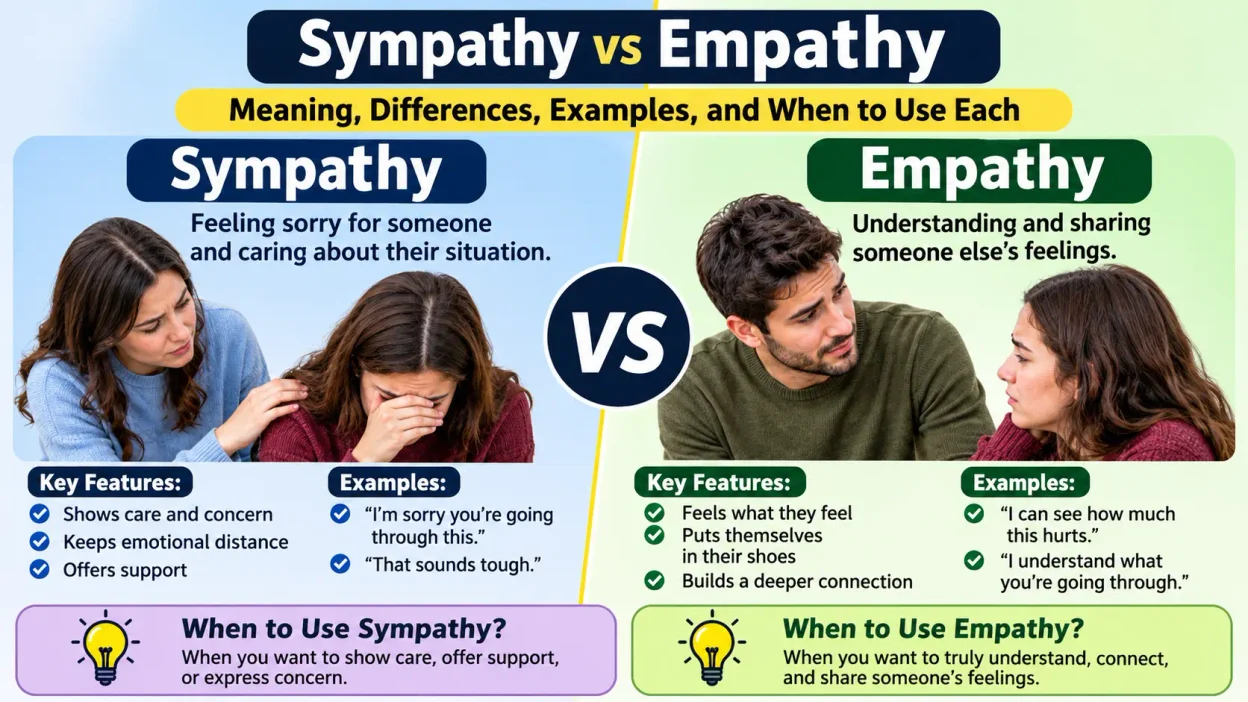
Sympathy generally means feeling concern, sorrow, or compassion for someone who is experiencing hardship. Empathy means understanding or sharing another person’s feelings by trying to see a situation from their perspective.
For example, if your friend loses a loved one, you may feel sympathy by expressing sadness and concern for their loss. You demonstrate empathy when you try to understand the depth of their grief and imagine what the experience might feel like for them.
Understanding sympathy vs empathy can improve communication, strengthen relationships, and help you respond more thoughtfully when someone needs emotional support.
What Is the Difference Between Sympathy and Empathy?
The main difference between sympathy and empathy is how you connect with another person’s emotions.
- Sympathy means feeling concern, sorrow, or compassion for someone else’s difficult situation.
- Empathy means understanding or sharing another person’s emotional experience by considering their perspective.
Sympathy often involves recognizing that someone is suffering and caring about their situation. Empathy involves making an emotional or perspective-based connection with what that person is experiencing.
| Sympathy | Empathy |
|---|---|
| Feeling concern for someone | Understanding someone’s feelings |
| Recognizes another person’s hardship | Tries to understand their experience |
| Often involves compassion from an outside perspective | Involves connecting with another person’s perspective |
| May involve expressing sorrow or support | May involve listening and validating emotions |
| Example: “I’m sorry you’re going through this.” | Example: “I can understand why this situation feels overwhelming.” |
Both are valuable emotional responses. Neither is automatically better in every situation.
What Does Sympathy Mean?
Sympathy is the feeling of care, concern, or sorrow for another person who is experiencing pain, difficulty, or misfortune.
When you sympathize with someone, you recognize that they are going through something challenging and feel compassion for them. You may not have experienced the same situation, but you still care about their well-being.
For example:
- Your coworker loses their job, and you feel sorry for their situation.
- Your neighbor becomes ill, and you express concern for their recovery.
- A friend experiences a breakup, and you offer comfort and encouragement.
- You hear about a family affected by a natural disaster and feel compassion for them.
Examples of Sympathy in Sentences
- I expressed my sympathy to her after the loss of her grandmother.
- The community showed sympathy for the families affected by the accident.
- He felt sympathy for his friend, who was struggling financially.
- We sent a sympathy card to the grieving family.
- Her kind words showed genuine sympathy during a difficult time.
Common Expressions of Sympathy
People often express sympathy through supportive words, gestures, or actions.
Examples include:
- “I’m sorry you’re going through this.”
- “You have my deepest sympathy.”
- “I’m sorry for your loss.”
- “That sounds like a difficult situation.”
- “Please let me know if there’s anything I can do.”
Sympathy can help people feel cared for and supported when they are facing difficult circumstances.
What Does Empathy Mean?
Empathy is the ability to understand, recognize, or share another person’s feelings and perspective.
When you show empathy, you try to understand what someone is experiencing emotionally rather than simply recognizing that they are having a difficult time.
Empathy does not require you to have experienced exactly the same situation. It involves listening carefully, considering another person’s perspective, and acknowledging their emotions without immediately judging or dismissing them.
For example, imagine that your friend is anxious about an important examination. Instead of simply saying that you feel sorry for them, you listen to their concerns and try to understand why the examination feels so stressful.
Examples of Empathy in Sentences
- Her empathy helped the new employee feel understood and welcomed.
- A good counselor needs empathy to understand clients’ experiences.
- He showed empathy by listening without judging his friend’s feelings.
- Teachers can use empathy to understand the challenges students face.
- She responded with empathy when her colleague explained her personal struggles.
Common Expressions of Empathy
Empathy is often demonstrated through active listening and thoughtful responses.
Examples include:
- “I can understand why that would hurt.”
- “It sounds like you’ve been dealing with a lot.”
- “That must have been difficult for you.”
- “I can see why you feel disappointed.”
- “Would you like to tell me more about what happened?”
These expressions communicate that you are trying to understand the person’s experience rather than simply offering a general expression of concern.
Sympathy vs Empathy: Key Differences Explained
Although sympathy and empathy are closely related, understanding their individual characteristics makes it easier to use them correctly.
1. Emotional Connection
Sympathy involves feeling concern or compassion for another person. Empathy involves understanding or sharing their emotional perspective.
For example, if someone fails an important examination, you may sympathize with their disappointment. If you try to understand how much the result affects their confidence and future plans, you are demonstrating empathy.
2. Perspective
Sympathy generally recognizes another person’s hardship from your own perspective.
Empathy requires you to consider the situation from the other person’s point of view.
This does not mean you must agree with their decisions. You can understand someone’s feelings without sharing their opinions.
3. Emotional Response
Sympathy often involves feelings such as sorrow, concern, or compassion.
Empathy can involve understanding a wide range of emotions, including happiness, excitement, anger, fear, disappointment, and grief.
4. Communication Style
Sympathy is commonly expressed through comforting statements, thoughtful gestures, and offers of help.
Empathy often involves listening carefully, asking thoughtful questions, acknowledging feelings, and avoiding assumptions.
5. Personal Experience
You can feel sympathy for someone without having experienced their situation.
Empathy also does not require an identical personal experience. However, having experienced something similar may sometimes help you understand another person’s feelings.
Types of Empathy
Psychologists and researchers commonly distinguish between several forms of empathy. Two widely discussed categories are emotional empathy and cognitive empathy. Compassionate empathy is also frequently used to describe understanding combined with a desire to help.
1. Cognitive Empathy
Cognitive empathy means understanding another person’s thoughts, feelings, or perspective.
It involves recognizing how someone might interpret a situation without necessarily experiencing the same emotion yourself.
Example: A manager understands why an employee feels frustrated about an unexpected change in their work schedule.
2. Emotional Empathy
Emotional empathy involves feeling an emotional response that reflects or resonates with another person’s feelings.
Example: You become tearful when watching a close friend cry because their sadness affects you emotionally.
3. Compassionate Empathy
Compassionate empathy combines understanding another person’s emotions with a willingness to offer support or take helpful action.
Example: You recognize that your colleague is overwhelmed, listen to their concerns, and offer to help with a difficult task.
These categories help explain how people understand and respond to the emotions of others.
Types of Sympathy
Sympathy is commonly expressed in different ways depending on the situation and the relationship between people.
1. Emotional Sympathy
Emotional sympathy involves feeling sorrow or concern because someone else is experiencing hardship.
Example: You feel sad when you learn that a friend is dealing with a serious family problem.
2. Compassionate Sympathy
Compassionate sympathy involves caring about another person’s suffering and wanting to support them.
Example: You donate food or clothing to families affected by a natural disaster because you feel compassion for their circumstances.
3. Expressed Sympathy
Expressed sympathy involves communicating your concern through words, messages, cards, or gestures.
Example: You send a condolence message to someone whose family member has passed away.
These categories are practical ways of describing sympathetic responses rather than a single universally accepted psychological classification.
Sympathy vs Empathy Examples in Everyday Situations
The easiest way to understand the difference between sympathy and empathy is to examine how each word applies to everyday experiences.
Example 1: Losing a Job
Situation: Your friend has recently lost their job.
- Sympathy: “I’m really sorry that happened. I hope you find another opportunity soon.”
- Empathy: “I imagine this must be stressful, especially when you weren’t expecting it. I can understand why you’re worried about what comes next.”
Sympathy expresses concern, while empathy focuses on understanding the friend’s emotional experience.
Example 2: Experiencing Grief
Situation: Your coworker’s father has passed away.
- Sympathy: “Please accept my deepest sympathy for your loss.”
- Empathy: “I know this must be an incredibly painful time. If you want to talk or need some space, I’m here for you.”
Both responses are appropriate. Sympathy communicates condolences, while empathy acknowledges the person’s emotional experience.
Example 3: Failing an Examination
Situation: Your younger sibling fails an important examination.
- Sympathy: “I’m sorry you didn’t get the result you wanted.”
- Empathy: “You worked hard for this, so I can understand why you’re disappointed.”
Example 4: Going Through a Breakup
Situation: Your friend has ended a long-term relationship.
- Sympathy: “I’m sorry you’re going through this.”
- Empathy: “Ending a relationship after investing so much time and emotion must be difficult. I can understand why you’re hurting.”
Example 5: Experiencing Financial Difficulties
Situation: Someone you know is struggling to pay their bills.
- Sympathy: “I’m sorry things have been so difficult financially.”
- Empathy: “It must be exhausting to worry about expenses every day. I can understand how much pressure you’re under.”
Example 6: Celebrating Success
Sympathy and empathy are not limited to negative emotions.
Situation: Your friend receives a promotion.
- Sympathy: This word is generally not appropriate because the situation does not involve suffering or hardship.
- Empathy: “I can imagine how excited and proud you must feel after working so hard for this promotion.”
Empathy can help you connect with positive emotions as well as difficult ones.
When to Use Sympathy
Use sympathy when you want to express concern, compassion, or sorrow for someone experiencing a difficult situation.
It is especially appropriate when:
- Someone has experienced a death in the family.
- A friend is dealing with illness or injury.
- A colleague has experienced a personal setback.
- Someone has lost their job or experienced financial difficulties.
- You want to send a condolence message.
- You want to acknowledge another person’s hardship.
Example: “We would like to express our sympathy to everyone affected by the tragedy.”
The word sympathy is particularly common in formal condolences and expressions of compassion.
When to Use Empathy
Use empathy when you want to demonstrate that you understand or are trying to understand another person’s feelings and perspective.
It is particularly useful when:
- A friend needs someone to listen.
- A family member is experiencing emotional difficulties.
- A colleague feels overwhelmed at work.
- A student is struggling with academic pressure.
- You want to understand a disagreement.
- You want to build stronger personal or professional relationships.
Example: “A good leader demonstrates empathy by listening to employees and understanding their concerns.”
Empathy is especially valuable in situations where people want to feel heard, respected, and understood.
Can You Have Sympathy and Empathy at the Same Time?
Yes. Sympathy and empathy can exist together, and many supportive responses involve both.
Imagine that your friend has recently experienced a painful breakup. You may feel sympathy because you are concerned about their sadness. At the same time, you may demonstrate empathy by listening to their feelings and trying to understand why the relationship mattered so much.
A response that combines both could be:
“I’m really sorry you’re going through this. I can understand why it hurts so much, especially after everything you shared. I’m here if you need someone to talk to.”
The first sentence expresses sympathy, while the second demonstrates empathy.
Using both can make emotional support feel more genuine and meaningful.
Why Are Sympathy and Empathy Important?
Sympathy and empathy help people build stronger relationships, communicate more effectively, and respond thoughtfully to difficult experiences.
Benefits of Sympathy
- Shows people that their struggles matter.
- Communicates concern and compassion.
- Helps people feel supported during difficult times.
- Encourages kindness and generosity.
- Provides an appropriate way to express condolences.
Benefits of Empathy
- Helps people feel understood and respected.
- Encourages active listening.
- Improves communication and conflict resolution.
- Supports healthier personal relationships.
- Helps build trust in workplaces and communities.
- Encourages consideration of different perspectives.
Both qualities contribute to compassionate communication, although they serve slightly different purposes.
Common Mistakes When Using Sympathy and Empathy
Because these words are related, people sometimes confuse their meanings or use them in situations where another expression would be more appropriate.
Mistake 1: Thinking Sympathy and Empathy Mean Exactly the Same Thing
Although both involve responding to other people’s emotions, sympathy emphasizes concern or compassion, while empathy emphasizes understanding or sharing their perspective.
Mistake 2: Assuming Empathy Requires the Same Experience
You do not need to experience exactly what another person has experienced to show empathy. You can listen, ask questions, and try to understand their perspective.
Mistake 3: Using Sympathy When You Mean Understanding
If you want to describe someone’s ability to understand another person’s feelings, empathy is usually the more accurate word.
Less accurate: “She has great sympathy for understanding different perspectives.”
Better: “She has great empathy for understanding different perspectives.”
Mistake 4: Assuming Sympathy Is Insincere
Sympathy is not automatically shallow or less meaningful than empathy. A sincere expression of sympathy can provide comfort, especially during grief or hardship.
Mistake 5: Trying to Fix Every Emotional Situation
Sometimes people need someone to listen rather than someone who immediately offers advice. Empathy involves understanding what the person needs before responding.
Sympathy vs Empathy vs Compassion
Sympathy and empathy are also closely related to compassion, but the three words have different meanings.
| Word | Meaning | Example |
|---|---|---|
| Sympathy | Feeling concern or sorrow for someone | “I’m sorry you’re having a difficult time.” |
| Empathy | Understanding or sharing someone’s feelings | “I can understand why this is painful for you.” |
| Compassion | Caring about someone’s suffering and wanting to help | “How can I support you through this?” |
In simple terms, sympathy recognizes suffering, empathy seeks to understand the experience, and compassion involves caring about the person’s well-being and often motivates helpful action.
Conclusion
Sympathy and empathy are closely connected, but they describe different ways of responding to another person’s emotions. Sympathy means feeling concern, sorrow, or compassion for someone who is experiencing hardship. Empathy means understanding or sharing that person’s emotional experience by considering their perspective.
Both are important in everyday communication. Sympathy helps people feel cared for, while empathy helps them feel understood. Neither is always more valuable than the other, and the most appropriate response depends on the situation.
By understanding sympathy vs empathy, you can communicate more thoughtfully, build stronger relationships, and offer meaningful support when other people need it most.
Frequently Asked Questions (FAQs)
1. What is the main difference between sympathy and empathy?
Sympathy means feeling concern or sorrow for another person’s hardship, while empathy means understanding or sharing their feelings and perspective.
2. Is sympathy better than empathy?
Neither is universally better. Sympathy is useful when expressing concern or condolences, while empathy is valuable when trying to understand someone’s emotional experience. Both can provide meaningful support.
3. Can you have empathy without sympathy?
Yes. You may understand another person’s emotions or perspective without necessarily feeling sorrow or compassion. Cognitive empathy, for example, involves understanding another person’s feelings without experiencing the same emotions.
4. Can you have sympathy without empathy?
Yes. You can feel sorry for someone and genuinely care about their situation without fully understanding what they are experiencing emotionally.
5. What is an example of sympathy?
If your friend loses their job and you say, “I’m sorry this happened to you. I hope things improve soon,” you are expressing sympathy.
6. What is an example of empathy?
If your friend loses their job and you say, “I can understand why you’re worried about your future, especially after working there for so long,” you are demonstrating empathy.
7. Is empathy the same as compassion?
No. Empathy involves understanding or sharing another person’s feelings, while compassion involves caring about their suffering and wanting to help. They often work together.
8. Which is more important in relationships, sympathy or empathy?
Both are valuable. Sympathy communicates care, while empathy helps people feel understood. Healthy relationships benefit from both qualities.
9. What is the opposite of empathy?
There is no single perfect opposite of empathy. Depending on the context, words such as indifference, insensitivity, or lack of understanding may describe the opposite behavior.
10. What is the opposite of sympathy?
Indifference or lack of compassion can be considered opposites of sympathy because they describe an absence of concern for another person’s suffering.
11. Is saying “I’m sorry for your loss” sympathy or empathy?
It is generally an expression of sympathy because it communicates sorrow and concern for someone who has experienced a loss. It may also be part of a broader empathetic response.
12. Why is empathy important in communication?
Empathy helps people understand different perspectives, listen without immediately judging, resolve misunderstandings, and build stronger relationships.