
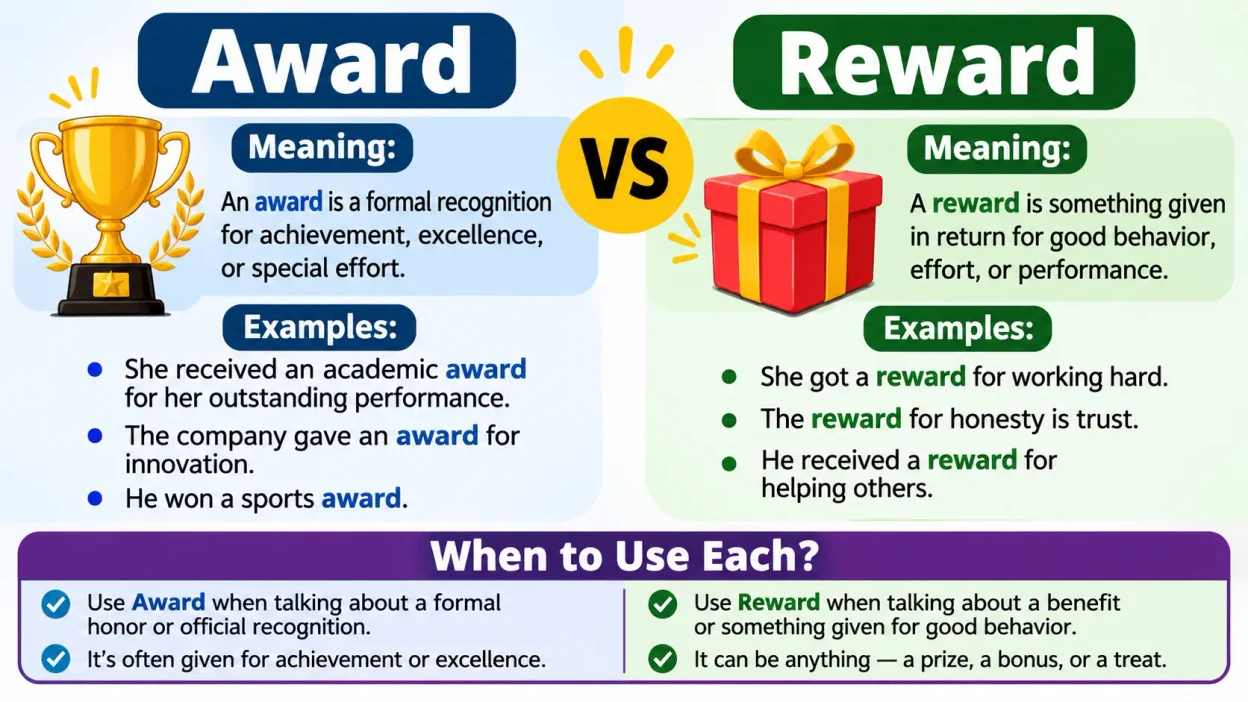
The words award and reward are closely related because both describe something given to a person in recognition of an action, achievement, or contribution. However, they are not interchangeable in every situation. Understanding the difference between award vs reward can help you communicate more clearly and choose the correct word in writing and everyday conversations.
An award is usually an honor, prize, or formal recognition given for an achievement, while a reward is something given in return for an action, effort, good behavior, or accomplishment. For example, a student may receive an award for academic excellence, while a child may receive a reward for completing household chores.
In this guide, you will learn what award and reward mean, how they differ, and how to use each word correctly with practical examples.
What Does Award Mean?
An award is a prize, honor, or official recognition given to someone because of an achievement, outstanding performance, contribution, or service.
Awards are commonly presented by schools, organizations, governments, professional associations, and other institutions. They recognize someone for doing something particularly well or making a meaningful contribution.
The word can function as both a noun and a verb.
Award as a noun:
- She received an award for her excellent academic performance.
- The film won several international awards.
- He was proud of receiving the employee of the year award.
Award as a verb:
- The committee awarded her a scholarship.
- The university awarded him a degree.
- The organization awarded the team first place.
Common Types of Awards
Awards can recognize achievements in many different fields.
| Type of Award | Meaning | Example |
|---|---|---|
| Academic award | Recognition for educational achievement | She received an academic award. |
| Sports award | Recognition for athletic performance | He won the best player award. |
| Professional award | Recognition for workplace excellence | The company gave her an employee award. |
| Artistic award | Recognition for creative work | The director received a film award. |
| Humanitarian award | Recognition for helping others | She earned an award for community service. |
| Lifetime achievement award | Recognition for long-term contributions | The actor received a lifetime achievement award. |
An award often has symbolic or public value. It may come with a certificate, trophy, medal, title, or monetary prize.
What Does Reward Mean?
A reward is something given to someone in return for an action, effort, achievement, good behavior, or service. It can be money, a gift, a benefit, recognition, or another form of compensation.
Rewards are often intended to encourage certain behavior, show appreciation, or provide something in return for a particular action.
Like award, reward can function as both a noun and a verb.
Reward as a noun:
- The company offered a reward for finding the missing documents.
- The children received rewards for completing their tasks.
- Hard work often brings its own rewards.
Reward as a verb:
- The teacher rewarded the students for their efforts.
- The company rewarded its employees with bonuses.
- The organization rewarded him for helping the community.
Common Types of Rewards
| Type of Reward | Meaning | Example |
|---|---|---|
| Financial reward | Money given for an action or achievement | She received a financial reward. |
| Performance reward | A benefit given for good performance | Employees received performance rewards. |
| Behavior reward | Something given for positive behavior | The child earned a reward for being helpful. |
| Loyalty reward | A benefit for continued support | Customers receive loyalty rewards. |
| Recognition reward | Appreciation for someone’s contribution | The volunteer received a reward for her service. |
| Intrinsic reward | Personal satisfaction from an action | Helping others can be its own reward. |
A reward does not always need to be an official prize. It can be something small, such as praise, a gift, a bonus, or personal satisfaction.
Award vs Reward: Key Differences
The main difference between award and reward is the reason something is given.
An award generally recognizes achievement or distinction, often through a formal decision. A reward is usually given in return for an action, effort, behavior, or result.
| Feature | Award | Reward |
|---|---|---|
| Meaning | A prize or honor recognizing achievement | Something given in return for an action or effort |
| Main purpose | To recognize excellence or distinction | To appreciate, encourage, or compensate |
| Common use | Competitions, ceremonies, schools, and professional achievements | Good behavior, completed tasks, helpful actions, and performance |
| Form | Trophy, medal, certificate, title, or prize | Money, gift, bonus, benefit, or praise |
| Formality | Often formal or official | Can be formal or informal |
| Example | She won an award for her research. | She received a reward for finding the lost wallet. |
The Simplest Way to Remember
- Award: Something you receive to recognize an achievement.
- Reward: Something you receive in return for an action or effort.
For example, a student may receive an award for being the best student in a school. The same student may receive a reward from their parents for completing homework on time.
Award vs Reward Examples in Sentences
The following examples show how to use both words correctly.
Examples of Award in Sentences
- The scientist received an award for her groundbreaking research.
- Our school gives an award to the best-performing student.
- The actor won an international award for his performance.
- The committee awarded the scholarship to a deserving candidate.
- She was honored with an award for her community service.
- The company received an award for its excellent customer service.
- He hopes to win an award for his latest book.
- The university awarded her a degree in business administration.
- The athlete received an award after winning the championship.
- Several awards were presented during the ceremony.
Examples of Reward in Sentences
- The company offered a reward for information about the missing equipment.
- Parents rewarded their children for good behavior.
- The employee received a financial reward for completing the project early.
- She believes that honesty brings its own reward.
- The teacher rewarded the students with extra break time.
- The police announced a reward for information leading to the suspect’s arrest.
- Hard work and dedication can bring great rewards.
- The organization rewarded volunteers for their contributions.
- He received a gift as a reward for helping his neighbor.
- The company introduced a reward program for loyal customers.
When to Use Award
Use award when you are talking about formal recognition, an honor, or a prize given because someone has achieved something special.
Common situations include:
- Academic achievements: A student receives an award for excellent grades.
- Professional accomplishments: An employee receives an award for outstanding performance.
- Competitions: A winner receives an award for finishing first.
- Creative achievements: A writer receives an award for an exceptional book.
- Public service: A person receives an award for making a valuable contribution to society.
Example: The organization gave her an award for her outstanding contribution to education.
In this sentence, award is appropriate because the organization is formally recognizing her achievement.
When to Use Reward
Use reward when something is given in return for an action, effort, helpful behavior, or successful result.
Common situations include:
- Good behavior: Parents reward children for behaving responsibly.
- Completed tasks: A manager rewards an employee for finishing a difficult assignment.
- Helpful actions: Someone receives a reward for returning a lost item.
- Business performance: A company offers bonuses as rewards for meeting targets.
- Customer loyalty: Businesses provide reward points to encourage repeat purchases.
Example: The company rewarded its employees for meeting their annual targets.
Here, reward is correct because the employees receive something in return for their performance.
Can Award and Reward Be Used Interchangeably?
Sometimes the words overlap, but they are not always interchangeable.
Both can refer to something given because of an achievement. However, they emphasize different ideas.
Consider these examples:
- She received an award for her excellent performance.
- She received a reward for her excellent performance.
Both sentences are grammatically correct, but their meanings are slightly different.
The first sentence suggests that her performance was formally recognized through a prize or honor. The second suggests that she received something in return for her performance, such as money, a bonus, or a gift.
Another example:
- The school awarded him a medal for winning the competition.
- The school rewarded him with a gift for winning the competition.
The first focuses on recognition, while the second focuses on what he received in return.
Award vs Reward in Different Contexts
In Education
An award is commonly given to students for academic excellence, leadership, or outstanding performance.
A reward may be given for completing homework, participating in class, or demonstrating good behavior.
Award: The student received an award for achieving the highest marks.
Reward: The teacher rewarded the class for completing the assignment.
In the Workplace
Employers use awards to recognize exceptional contributions and professional achievements. Rewards are often used to encourage productivity or compensate employees for meeting specific goals.
Award: Maria received an employee of the year award.
Reward: Maria received a bonus as a reward for exceeding her sales target.
In Sports
An award recognizes an athlete’s performance, achievement, or position in a competition. A reward may be given as an incentive for winning or reaching a particular goal.
Award: The player won an award for being the tournament’s best performer.
Reward: The team received a financial reward for winning the championship.
In Everyday Life
An award may be a formal certificate or trophy, while a reward can be something as simple as a favorite meal, a gift, or praise.
Award: He received an award for volunteering in his community.
Reward: His parents rewarded him with a new bicycle for his hard work.
Common Mistakes to Avoid
Although award and reward are related, confusing them can make a sentence less precise.
Mistake 1: Using award when you mean something given in return for an action
Incorrect: The teacher gave the child an award for cleaning the classroom.
Better: The teacher gave the child a reward for cleaning the classroom.
An award could still be appropriate if the teacher is formally recognizing an exceptional achievement, but reward is more natural for an ordinary incentive.
Mistake 2: Using reward when you mean a formal honor
Less natural: She received a reward for winning the Nobel Prize.
Better: She received an award for her groundbreaking work.
The Nobel Prize is a formal award, so award is the more appropriate word.
Mistake 3: Assuming every award includes money
An award can be a certificate, medal, trophy, title, or public recognition. It does not necessarily include financial compensation.
Mistake 4: Assuming every reward is a prize
A reward can also be a benefit, bonus, gift, or personal satisfaction. It does not have to be a trophy or competition prize.
Related Words: Award, Reward, Prize, and Recognition
These words have similar meanings, but each has a slightly different use.
| Word | Meaning | Example |
|---|---|---|
| Award | Formal recognition or a prize for achievement | She won an award for her research. |
| Reward | Something given in return for an action or effort | He received a reward for finding the wallet. |
| Prize | Something won in a competition or contest | She won first prize in the competition. |
| Recognition | Appreciation or acknowledgment of someone’s work | His contribution received public recognition. |
A prize is often something won through a competition, while an award can recognize achievements beyond competitions. A reward focuses on what someone receives in return for an action. Recognition refers more broadly to acknowledging someone’s contribution or success.
Frequently Asked Questions (FAQs)
1. What is the main difference between award and reward?
An award is generally given to recognize an achievement or outstanding contribution, while a reward is given in return for an action, effort, good behavior, or result.
2. Is an award a type of reward?
An award can sometimes be considered a type of reward because it is something given for achievement. However, an award specifically emphasizes recognition, while a reward emphasizes something received in return.
3. Is money an award or a reward?
Money can be either an award or a reward, depending on the context. Money given as a prize for winning a competition may be an award. Money given for completing a task or meeting a target is usually a reward.
4. Can a person receive both an award and a reward?
Yes. Someone might receive a trophy as an award for outstanding performance and a financial bonus as a reward for achieving a business target.
5. Is a trophy an award or a reward?
A trophy is usually an award because it formally recognizes an achievement, victory, or outstanding performance.
6. What is the difference between an award and a prize?
An award often recognizes achievement, service, or excellence, while a prize is commonly something won in a competition, contest, or game. Their meanings can overlap.
7. Can reward be used as a verb?
Yes. Reward can be used as a verb to describe giving someone something in return for an action or achievement.
Example: The company rewarded its employees for their hard work.
8. Can award be used as a verb?
Yes. Award can be used as a verb when an organization or authority officially gives someone a prize, honor, scholarship, or recognition.
Example: The committee awarded her first place.
9. Which word should I use for good behavior: award or reward?
Reward is generally the better choice when someone receives something for good behavior.
Example: Parents reward their children for being helpful.
10. Is a scholarship an award or a reward?
A scholarship can be described as an award when it recognizes academic achievement or is granted through a formal selection process. It can also function as a reward for academic excellence.
11. What is the opposite of reward?
There is no single opposite that fits every context. Depending on the meaning, punishment, penalty, or consequence may serve as an opposite.
12. What is the plural of award and reward?
The plural forms are awards and rewards.
Examples:
- The school presented several awards.
- The company offers rewards to loyal customers.
Conclusion
Understanding the difference between award vs reward is easier when you focus on why something is given. An award recognizes achievement, excellence, or an important contribution, while a reward is something received in return for an action, effort, or behavior.
Use award when referring to honors, trophies, medals, certificates, and formal recognition. Use reward when referring to bonuses, gifts, incentives, benefits, or something given in return for a particular action.
Although the two words sometimes overlap, choosing the right one makes your writing more accurate and natural.

[…] main difference between price and prize is that price means the cost of something, while prize means a reward or award given to someone for winning or achieving […]