The words its and it’s look almost identical, but they have completely different grammatical functions. The only visible difference is an apostrophe, yet using the wrong form can change the meaning of a sentence and create a common writing mistake.
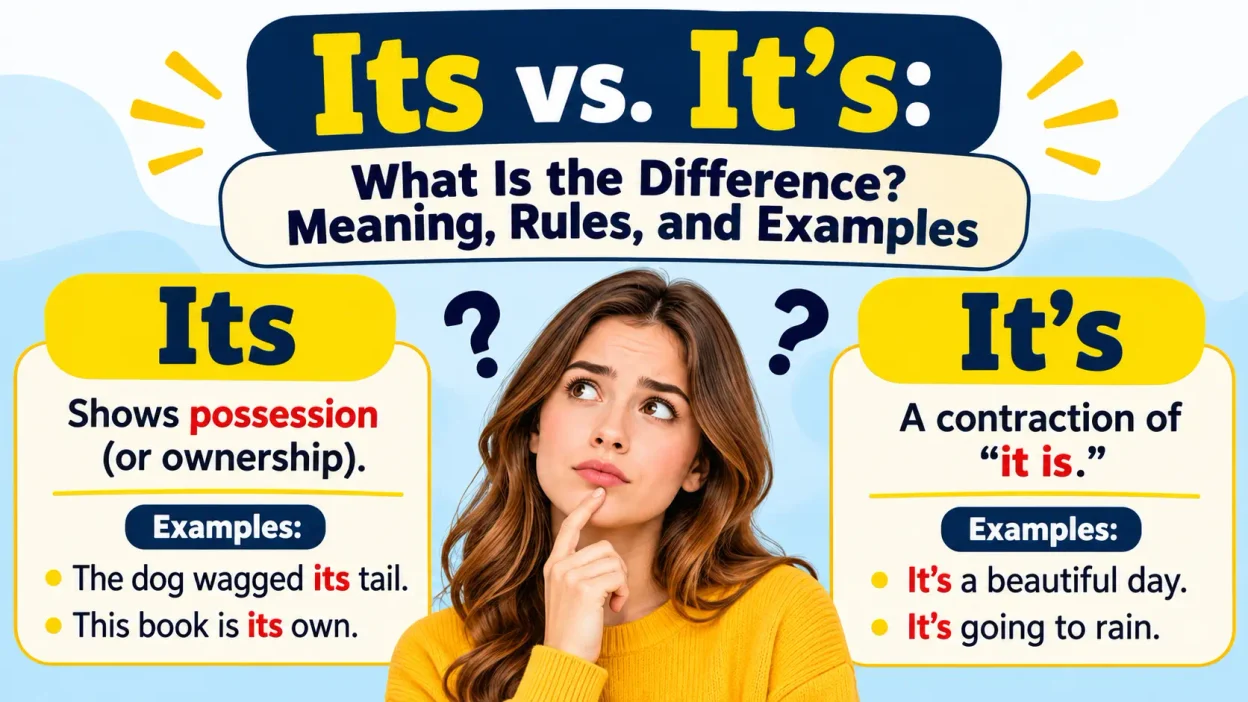
The easiest way to understand the difference is this: its is a possessive pronoun that shows ownership, while it’s is a contraction of “it is” or “it has.”
For example:
- The dog wagged its tail.
- It’s a beautiful day.
- It’s been a long week.
In the first sentence, “its” shows that the tail belongs to the dog. In the second, “it’s” means “it is.” In the third, “it’s” means “it has.”
Although the distinction seems simple, many English writers confuse these words because possessive nouns usually use apostrophes. This guide explains the meanings, grammar rules, examples, common mistakes, and easy tricks to help you use its and it’s correctly.
What Is the Difference Between Its and It’s?
The main difference between its and it’s is their grammatical purpose.
| Word | Meaning | Grammatical Function | Example |
|---|---|---|---|
| Its | Belonging to it | Possessive determiner | The cat licked its paw. |
| It’s | It is or it has | Contraction | It’s raining outside. |
Its indicates possession or ownership. It tells readers that something belongs to an animal, object, organization, or other thing represented by “it.”
It’s combines the pronoun “it” with either “is” or “has.”
A simple way to check your writing is to replace “it’s” with “it is” or “it has.” If the sentence still makes sense, the apostrophe is probably correct. If not, you may need “its.”
What Does Its Mean?
Its is a possessive form of the pronoun “it.” It shows that something belongs to or is associated with an animal, object, place, organization, or other nonhuman subject.
Unlike “it’s,” the word “its” does not contain an apostrophe.
1. Its Showing Ownership
Use “its” when you want to indicate that something belongs to an animal, object, or organization.
Examples:
- The dog wagged its tail.
- The company changed its logo.
- The bird built its nest.
- The tree lost its leaves.
- The phone has its own charger.
In each example, “its” shows a relationship of ownership or association.
2. Its Describing Parts of Something
“Its” is also used to identify a part, feature, or characteristic of something.
Examples:
- The house is known for its beautiful garden.
- The car is famous for its excellent performance.
- The flower is admired for its fragrance.
- The book is interesting because of its detailed characters.
- The restaurant is popular for its delicious food.
3. Its Referring to Animals
When an animal’s sex is unknown, irrelevant, or not specified, “its” can be used to show possession.
Examples:
- The rabbit cleaned its ears.
- The horse moved its head.
- The kitten opened its eyes.
- The snake shed its skin.
When an animal is known and referred to as he or she, writers may also use “his” or “her.”
4. Its Referring to Organizations and Institutions
“Its” can describe something belonging to an organization, business, school, or institution when the organization is treated as a single unit.
Examples:
- The university updated its website.
- The business expanded its services.
- The government announced its decision.
- The school changed its schedule.
What Does It’s Mean?
It’s is a contraction formed by combining “it” with either “is” or “has.”
The apostrophe indicates that letters have been omitted. Unlike “its,” which shows possession, “it’s” always represents one of these two grammatical combinations.
1. It’s Meaning It Is
The most common use of “it’s” is as a shortened form of “it is.”
Examples:
- It’s a beautiful morning.
- It’s getting cold outside.
- It’s important to practice English.
- It’s a difficult question.
- It’s time to go home.
In these examples, you can replace “it’s” with “it is” without changing the basic meaning.
For instance:
“It’s a beautiful morning.”
“It is a beautiful morning.”
Both sentences are grammatically correct.
2. It’s Meaning It Has
“It’s” can also be a contraction of “it has,” particularly when “has” functions as an auxiliary verb in the present perfect tense.
Examples:
- It’s been a wonderful experience.
- It’s already started.
- It’s taken several hours to finish.
- It’s been raining all morning.
- It’s happened before.
You can expand each contraction:
- It has been a wonderful experience.
- It has already started.
- It has taken several hours to finish.
3. It’s in Everyday Conversations
“It’s” is especially common in informal communication because contractions make sentences shorter and more natural.
Examples:
- It’s okay.
- It’s fine with me.
- It’s not my fault.
- It’s really nice to meet you.
- It’s going to be a great day.
These expressions are widely used in conversations, emails, messages, and everyday writing.
Its vs. It’s: Comparison Table
The following table summarizes the most important differences between the two words.
| Feature | Its | It’s |
|---|---|---|
| Meaning | Belonging to it | It is or it has |
| Grammar | Possessive determiner | Contraction |
| Apostrophe | No | Yes |
| Shows ownership | Yes | No |
| Can mean “it is” | No | Yes |
| Can mean “it has” | No | Yes |
| Example | The dog ate its food. | It’s hungry. |
When to Use Its vs. It’s
Choosing the correct word becomes much easier when you understand what the sentence is trying to communicate.
Use Its When Showing Possession
If something belongs to or is associated with an object, animal, or organization, use “its.”
Correct: The company changed its name.
Incorrect: The company changed it’s name.
The name belongs to the company, so the possessive form is necessary.
Use It’s When You Mean It Is
If you can replace the word with “it is,” use “it’s.”
Correct: It’s getting dark.
Expanded: It is getting dark.
Incorrect: Its getting dark.
Use It’s When You Mean It Has
When “it’s” represents “it has” as an auxiliary verb, the apostrophe is required.
Correct: It’s been a difficult year.
Expanded: It has been a difficult year.
Incorrect: Its been a difficult year.
Remember That Its Does Not Need an Apostrophe
This is the rule that confuses many writers. Most possessive nouns use an apostrophe, such as:
- The girl’s book.
- The dog’s collar.
- The teacher’s desk.
However, possessive pronouns generally do not use apostrophes.
Examples include:
- Mine
- Yours
- Hers
- Ours
- Theirs
- Its
Therefore, “its” follows the same general pattern as other possessive pronouns.
Common Mistakes When Using Its and It’s
Because these words differ by only one punctuation mark, they are frequently confused in writing.
Here are some common mistakes and their corrections.
| Incorrect Sentence | Correct Sentence |
|---|---|
| The cat licked it’s paw. | The cat licked its paw. |
| Its raining outside. | It’s raining outside. |
| The company changed it’s policy. | The company changed its policy. |
| Its a beautiful day. | It’s a beautiful day. |
| The bird spread it’s wings. | The bird spread its wings. |
| Its been a long time. | It’s been a long time. |
| The phone lost it’s signal. | The phone lost its signal. |
| I think its going to rain. | I think it’s going to rain. |
Why Do People Confuse Its and It’s?
There are several reasons these words are often mixed up:
- Possessive apostrophe confusion: Many English possessive nouns use apostrophes, so writers assume “it’s” must also show ownership.
- Similar appearance: The words differ by only one apostrophe.
- Identical pronunciation: Both words are generally pronounced the same way.
- Fast typing: Writers may overlook the punctuation mark when writing quickly.
- Autocorrect errors: Spell-checking tools may accept both forms without recognizing that the wrong one has been used in context.
Understanding the grammatical role of each word is the most reliable way to avoid these errors.
Easy Tricks to Remember Its vs. It’s
If you regularly confuse these words, try the following memory techniques.
1. Replace It’s With It Is
Whenever you are unsure whether to use “it’s,” replace it with “it is.”
Example:
- It’s raining.
- It is raining.
The sentence makes sense, so “it’s” is correct.
Now consider:
- The dog wagged it’s tail.
- The dog wagged it is tail.
The expanded sentence does not make sense. Therefore, the correct form is “its.”
2. Replace It’s With It Has
If the sentence contains a past participle and describes an action or experience, try replacing “it’s” with “it has.”
Example:
- It’s been a long day.
- It has been a long day.
The sentence makes sense, so “it’s” is correct.
3. Remember That Its Shows Ownership
Think of “its” as the word that answers the question, “What belongs to it?”
Examples:
- The bird spread its wings.
- The computer lost its connection.
- The flower opened its petals.
In each sentence, the word identifies something belonging to the subject.
4. Remember the Possessive Pronoun Rule
Possessive pronouns do not normally use apostrophes.
For example:
- This book is mine.
- That jacket is hers.
- The house is theirs.
- The dog wagged its tail.
This helps explain why “its” does not need an apostrophe.
Its vs. It’s in Different Types of Writing
Both words appear frequently in everyday English, academic writing, professional communication, and digital content.
| Writing Situation | Correct Example |
|---|---|
| Everyday conversation | It’s getting late. |
| Academic writing | The study explains its findings. |
| Business communication | The company updated its policy. |
| Emails | It’s great to hear from you. |
| Creative writing | The tree stretched its branches. |
| Website content | It’s important to understand the rules. |
| News writing | The organization announced its decision. |
In formal writing, both forms are acceptable when used correctly. However, some academic styles prefer avoiding contractions, so writers may choose “it is” or “it has” instead of “it’s.”
Practice Exercise: Its or It’s?
Test your understanding by choosing the correct word in each sentence.
- The dog wagged ___ tail.
- ___ going to rain tomorrow.
- The company changed ___ logo.
- ___ been a long day.
- The bird returned to ___ nest.
- I think ___ time to leave.
- The computer lost ___ internet connection.
- ___ important to study regularly.
- The flower opened ___ petals.
- ___ already started.
Answers and Explanations
- Its – The tail belongs to the dog.
- It’s – It means “it is going to rain.”
- Its – The logo belongs to the company.
- It’s – It means “it has been a long day.”
- Its – The nest belongs to the bird.
- It’s – It means “it is time to leave.”
- Its – The internet connection belongs to the computer.
- It’s – It means “it is important.”
- Its – The petals belong to the flower.
- It’s – It means “it has already started.”
Frequently Asked Questions About Its vs. It’s
What is the main difference between its and it’s?
“Its” is a possessive form that shows ownership or association, while “it’s” is a contraction of “it is” or “it has.”
Example:
- The cat cleaned its fur.
- It’s a beautiful cat.
Is its or it’s possessive?
Its is possessive. It shows that something belongs to or is associated with an animal, object, or organization.
Example: The company changed its name.
“It’s” is not possessive. It represents “it is” or “it has.”
Why does its not have an apostrophe?
“Its” is a possessive pronoun, and possessive pronouns generally do not use apostrophes. Words such as “mine,” “yours,” “hers,” and “theirs” follow the same rule.
Is it’s short for it is or it has?
“It’s” can mean either “it is” or “it has.” The intended meaning depends on the sentence.
Examples:
- It’s cold outside. (It is cold outside.)
- It’s been a busy week. (It has been a busy week.)
Is its always used for animals and objects?
No. “Its” can also refer to organizations, institutions, places, and other things represented by the pronoun “it.”
Example: The school updated its website.
Which is correct: The company changed its policy or it’s policy?
The correct sentence is “The company changed its policy.”
The policy belongs to the company, so the possessive form “its” is required.
Is it its own or it’s own?
The correct phrase is “its own.”
Example: Every country has its own traditions.
Here, “its” shows possession. “It’s own” would incorrectly mean “it is own.”
Is it in its place or in it’s place?
The correct phrase is “in its place.”
Example: The book is back in its place.
The word “its” indicates that the place is associated with the object.
Can I use it’s in formal writing?
Yes, contractions such as “it’s” are grammatically correct in many types of formal writing. However, some academic or professional style guides prefer expanded forms such as “it is” and “it has.”
How can I quickly check whether to use its or it’s?
Replace “it’s” with “it is” or “it has.” If the sentence still makes sense, use “it’s.” If the sentence expresses ownership, use “its.”
Conclusion
The difference between its and it’s is small but important. “Its” is a possessive form used to show ownership or association, while “it’s” is a contraction meaning “it is” or “it has.”
Remember these simple rules:
- Use its to show possession: The dog wagged its tail.
- Use it’s to mean “it is”: It’s a beautiful day.
- Use it’s to mean “it has”: It’s been a long journey.
The easiest way to avoid mistakes is to expand “it’s” into “it is” or “it has” whenever you are uncertain. If neither expansion makes sense, you probably need “its.”
With a little practice, you can use both forms confidently and make your English writing clearer, more accurate, and more professional.