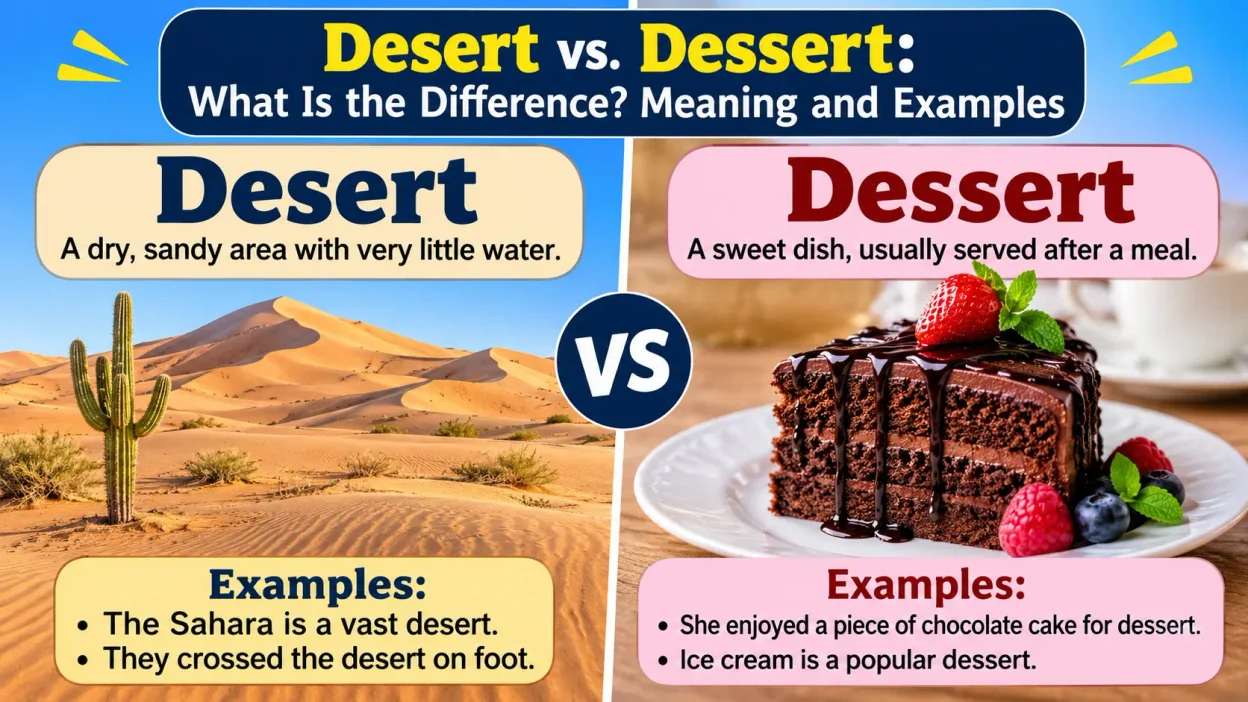
The words desert and dessert are often confused in English because they look almost identical. They differ by only one letter, but their meanings are completely different. Both words are also pronounced differently when referring to a dry landscape and a sweet course served after a meal.
The easiest way to remember the difference is that desert usually refers to a dry, often sandy region with very little rainfall, while dessert refers to a sweet food eaten after a meal.
For example, the Sahara is a famous desert, while chocolate cake is a popular dessert.
Understanding desert vs. dessert is important for improving spelling, vocabulary, and everyday communication. In this guide, you will learn their meanings, pronunciation, grammatical uses, examples, common mistakes, and simple tricks to remember which word to use.
Desert vs. Dessert: Quick Difference
The main difference between desert and dessert is their meaning, pronunciation, and spelling.
| Word | Part of Speech | Meaning | Example |
|---|---|---|---|
| Desert | Noun | A dry region that receives very little rainfall | The Sahara is a large desert. |
| Desert | Verb | To abandon someone or something | He refused to desert his family. |
| Dessert | Noun | A sweet dish eaten after a meal | We had ice cream for dessert. |
Desert has one “s” and can refer to a dry landscape or the act of abandoning someone. Dessert has two “s” letters and refers to sweet food served after a meal.
What Does Desert Mean?
The word desert has two main meanings. As a noun, it refers to a dry geographical region that receives very little precipitation. As a verb, it means to abandon someone, leave a place, or stop supporting something.
1. Desert as a Noun: A Dry Region
A desert is a geographical area characterized by very low precipitation. Deserts can be extremely hot or very cold, and they may contain sand, rocks, gravel, or snow.
Although many people imagine deserts as hot places covered in sand, not all deserts are sandy or hot. Antarctica, for example, is classified as a polar desert because it receives very little precipitation.
Examples:
- The Sahara is one of the largest hot deserts in the world.
- Camels are well adapted to life in the desert.
- Some deserts experience extremely cold temperatures at night.
- The travelers crossed the desert in search of water.
- The Atacama Desert is known for its exceptionally dry conditions.
In these examples, desert refers to a natural environment with very limited rainfall.
2. Desert as a Verb: To Abandon
Desert can also function as a verb meaning to leave someone, abandon a responsibility, or withdraw support.
It is commonly used when someone leaves a person or place in a difficult situation.
Examples:
- He promised never to desert his family.
- The soldiers were ordered not to desert their posts.
- She felt that her friends had deserted her during a difficult time.
- The residents were forced to desert their homes because of the danger.
- He would never desert his responsibilities.
The verb desert is often associated with abandonment, disloyalty, or leaving something behind.
3. Desert in the Expression “Just Deserts”
The expression just deserts means the reward or punishment someone deserves because of their actions.
Although it looks as if it should be spelled “desserts,” the correct expression uses deserts, with one “s” after the “e.”
Examples:
- After years of dishonest behavior, he finally received his just deserts.
- The hardworking employee received her just deserts through a well-earned promotion.
- Some people believe that everyone eventually gets their just deserts.
The word deserts in this expression is related to the verb deserve, not to dry landscapes or sweet food.
What Does Dessert Mean?
The word dessert is a noun that refers to a sweet dish or course usually served at the end of a meal.
Desserts can include cakes, ice cream, pastries, puddings, fruit-based dishes, chocolates, and many other sweet treats.
1. Dessert as a Sweet Dish
The most common meaning of dessert is a sweet food enjoyed after lunch, dinner, or another meal.
Examples:
- We had chocolate cake for dessert.
- My favorite dessert is vanilla ice cream.
- She prepared a delicious dessert for the guests.
- Would you like some fruit for dessert?
- The restaurant offers several homemade desserts.
In these sentences, dessert refers to something sweet served after a meal.
2. Different Types of Desserts
Desserts come in many forms and vary across cultures and cuisines.
Some popular examples include:
- Cakes: Chocolate cake, cheesecake, and sponge cake.
- Ice cream: Vanilla, chocolate, strawberry, and other flavors.
- Pastries: Tarts, éclairs, croissants, and sweet pies.
- Puddings: Rice pudding, chocolate pudding, and custard.
- Cookies: Chocolate chip cookies, shortbread, and biscuits.
- Traditional sweets: Gulab jamun, kheer, ras malai, baklava, and halwa.
- Fruit desserts: Fruit salad, baked apples, and fruit tarts.
Examples:
- Gulab jamun is a popular dessert in South Asia.
- She ordered cheesecake for dessert.
- The children enjoyed homemade chocolate cookies as dessert.
3. Dessert in Restaurants and Everyday Conversations
Dessert is frequently used when discussing restaurant menus, meal courses, celebrations, and special occasions.
Examples:
- The restaurant serves dessert after the main course.
- We ordered two desserts to share.
- Would you prefer coffee or dessert?
- The birthday celebration ended with a beautiful dessert.
Desert vs. Dessert: Key Differences
Although the two words look similar, they have different meanings and grammatical uses.
| Feature | Desert | Dessert |
|---|---|---|
| Part of speech | Noun and verb | Noun |
| Main meaning | Dry geographical region; to abandon | Sweet food served after a meal |
| Spelling | One “s” | Two “s” letters |
| Pronunciation as a noun | DEZ-ert | dih-ZURT |
| Pronunciation as a verb | dih-ZURT | Not applicable |
| Example | The desert is very dry. | We ate cake for dessert. |
One important detail is that the pronunciation of desert changes according to its meaning. As a noun referring to a dry region, it is pronounced DEZ-ert. As a verb meaning to abandon, it is pronounced dih-ZURT, like dessert.
Desert vs. Dessert: Pronunciation Differences
Pronunciation is another useful way to distinguish these words.
How to Pronounce Desert
When desert refers to a dry region, it is pronounced:
DEZ-ert (/ˈdez.ɚt/ in American English).
The stress is on the first syllable.
Example: The desert is home to many specially adapted plants and animals.
When desert is used as a verb meaning to abandon, it is pronounced:
dih-ZURT (/dɪˈzɝːt/ in American English).
The stress is on the second syllable.
Example: A loyal friend would never desert you.
How to Pronounce Dessert
Dessert is pronounced:
dih-ZURT (/dɪˈzɝːt/ in American English).
The stress is on the second syllable.
Example: We ordered chocolate dessert after dinner.
Therefore, the noun desert and dessert have different pronunciations, even though the verb desert and the word dessert sound alike.
Desert vs. Dessert Examples in Sentences
Understanding both words in context makes their differences easier to remember.
Examples Using Desert
- The Sahara Desert is located in North Africa.
- Many animals have special adaptations for surviving in the desert.
- The travelers carried extra water across the desert.
- The desert receives very little rainfall.
- He refused to desert his friends during difficult times.
- The soldiers were instructed not to desert their positions.
- She felt abandoned when her colleagues deserted her.
- The abandoned village appeared in the middle of the desert.
Examples Using Dessert
- Chocolate cake is my favorite dessert.
- We enjoyed ice cream for dessert.
- She prepared a delicious dessert for the family.
- The restaurant has a separate dessert menu.
- My mother makes traditional desserts for special occasions.
- Would you like some fruit for dessert?
- The children were excited about the birthday dessert.
- We shared two desserts after dinner.
Common Mistakes When Using Desert and Dessert
Because desert and dessert have similar spellings, people sometimes use them incorrectly.
Here are some common mistakes and their corrections.
| Incorrect Sentence | Correct Sentence |
|---|---|
| I ate chocolate desert after dinner. | I ate chocolate dessert after dinner. |
| The Sahara Dessert is very large. | The Sahara Desert is very large. |
| She made a delicious desert. | She made a delicious dessert. |
| The soldiers refused to dessert their posts. | The soldiers refused to desert their posts. |
| We ordered ice cream for desert. | We ordered ice cream for dessert. |
| They traveled through the hot dessert. | They traveled through the hot desert. |
Why Do People Confuse These Words?
There are several reasons:
- Similar spelling: Both words contain almost the same letters.
- Different pronunciation: Their noun pronunciations are different, but their verb and food pronunciations are identical.
- One-letter difference: Dessert contains an extra “s,” which can easily be forgotten.
- Unfamiliar expressions: Phrases such as “just deserts” can make the distinction more confusing.
The best way to avoid these mistakes is to understand the context and remember the extra “s” in dessert.
Easy Tricks to Remember Desert vs. Dessert
You can use a few simple memory tricks to remember the correct spelling.
1. Dessert Has Two “S” Letters Because You Want More
Think of dessert as something delicious that you might want a second serving of.
The word dessert has two “s” letters because you may want seconds.
Dessert = Sweet food after a meal.
Example: I always want a second serving of chocolate dessert.
2. Desert Has One “S” for Sand
Think of the word sand when remembering desert.
A desert is a dry region that may contain sand, rocks, or gravel.
Desert = Dry land.
Example: The camel walked across the desert.
3. Remember the Pronunciation
The noun desert is pronounced DEZ-ert, with stress on the first syllable.
Dessert is pronounced dih-ZURT, with stress on the second syllable.
This pronunciation difference can help you choose the correct word while speaking and writing.
4. Use a Simple Memory Sentence
Remember this sentence:
“After walking through the desert, we enjoyed dessert at a restaurant.”
Here:
- Desert refers to the dry geographical region.
- Dessert refers to the sweet food eaten afterward.
This simple sentence connects both words in one memorable example.
Desert vs. Dessert in Different Contexts
Understanding where each word is used can help you avoid spelling mistakes.
In Geography
Use desert when discussing dry regions, landscapes, climates, or ecosystems.
Examples:
- The Gobi Desert covers parts of Asia.
- Some desert plants can survive with very little water.
- The Sahara is one of the world’s most famous deserts.
In Food and Restaurants
Use dessert when discussing sweet dishes, restaurant menus, or meals.
Examples:
- The restaurant offers a variety of desserts.
- We ordered chocolate pudding for dessert.
- She prepared a special dessert for the celebration.
In Literature and Everyday Expressions
Desert can be used metaphorically to describe abandonment or leaving someone without support.
Example:
- He felt that everyone had deserted him.
The expression “just deserts” also uses desert to describe what someone deserves.
Example:
- The dishonest businessman finally received his just deserts.
Frequently Asked Questions
1. What is the main difference between desert and dessert?
Desert usually refers to a dry geographical region or means to abandon someone as a verb. Dessert refers to a sweet dish eaten after a meal.
2. Is it desert or dessert after dinner?
The correct word is dessert because it refers to sweet food served after a meal.
Example: We had ice cream for dessert.
3. Why does dessert have two “s” letters?
Dessert has two “s” letters, which you can remember through the phrase “seconds.” Since desserts are delicious, you may want a second serving.
4. How do you pronounce desert and dessert?
When desert refers to a dry region, it is pronounced DEZ-ert. Dessert is pronounced dih-ZURT. The verb desert, meaning to abandon, is also pronounced dih-ZURT.
5. Can desert be used as a verb?
Yes. Desert can function as a verb meaning to abandon someone, leave a place, or stop supporting something.
Example: He would never desert his family.
6. What does just deserts mean?
“Just deserts” means the reward or punishment someone deserves because of their actions.
Example: The dishonest employee finally received his just deserts.
7. Is ice cream a desert or dessert?
Ice cream is a dessert because it is a sweet food commonly served after a meal.
8. Is the Sahara a desert or dessert?
The Sahara is a desert because it is a large dry geographical region in North Africa.
9. Are desert and dessert homophones?
They are not complete homophones in their most common noun meanings because they have different pronunciations. However, the verb desert, meaning to abandon, and the noun dessert sound alike.
10. What is the plural of desert and dessert?
The plural of desert is deserts, and the plural of dessert is desserts.
Examples:
- The world’s deserts have different climates.
- The restaurant offers several desserts.
Conclusion
The difference between desert and dessert is easy to understand once you remember their meanings and spellings. Desert refers to a dry geographical region or the act of abandoning someone, while dessert means a sweet dish enjoyed after a meal.
The simplest memory trick is to remember that dessert has two “s” letters because you may want seconds, while desert has one “s” and can remind you of sand.
With this simple distinction, you can confidently use desert and dessert in everyday conversations, school assignments, restaurant menus, and professional writing.